
After Launch: How to Keep Every Locale Current With Product Changes
Launching a product in multiple languages is a milestone, but it's not the finish line. The real localization challenge begins the moment your product starts evolving, when feature updates, pricing changes, legal copy revisions, and urgent bug fixes need to reach every locale without delay. Too many enterprises...
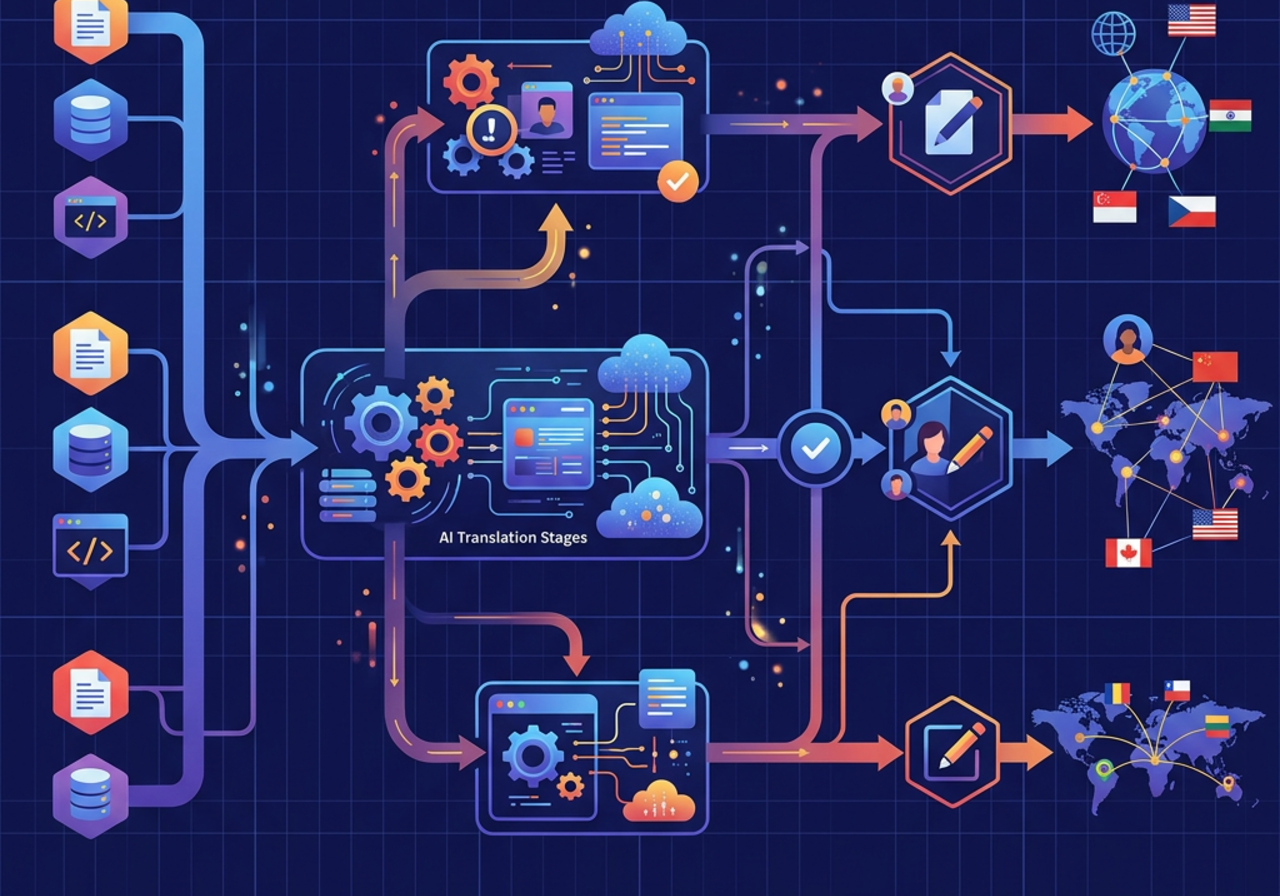
Launching a product in multiple languages is a milestone, but it's not the finish line. The real localization challenge begins the moment your product starts evolving, when feature updates, pricing changes, legal copy revisions, and urgent bug fixes need to reach every locale without delay. Too many enterprises treat localization as a one-time project, only to discover weeks later that half their markets are running on outdated content. This ongoing-update problem quietly erodes user trust, creates compliance risk, and fragments the customer experience. Keeping every locale current requires a systematic operational approach, spanning change detection, translation-memory reuse, quality assurance, and cross-channel coordination. Platforms like Ollang serve as the AI execution layer for repeatable, enterprise-scale localization across video, audio, documents, and websites.
Why Post-Launch Localization Breaks Down
The "Ship Once" Mindset
Most localization programs are architected around a launch date. Budgets are allocated, vendor contracts scoped, and workflows designed to get all target locales live at the same time. Once that goal is met, the infrastructure quietly dissolves. The localization manager moves on, the translation vendor's statement of work closes, and the product team resumes shipping updates in the source language without a clear handoff path.
The result is predictable: source content advances rapidly while localized versions fall behind. A pricing page updated in the source language may not reach secondary markets for weeks. A safety disclaimer revised for regulatory reasons might sit untranslated for even longer. The gap between source and localized content widens with every sprint.
Compounding Content Drift Across Channels
Content drift doesn't stay contained. A product change typically touches multiple surfaces simultaneously, the in-app UI, the marketing website, help documentation, onboarding videos, and sometimes audio assets like IVR prompts or podcast episodes. When localization is managed channel by channel with different tools and different teams, updates propagate unevenly. One locale might have the latest website copy but an outdated help article, while another has current documentation but a stale product video.
This multi-channel fragmentation is especially dangerous for enterprises because it creates internally inconsistent customer experiences. A user who reads one thing on your website and encounters different terminology inside the product loses confidence fast.
Change Detection and Delta Routing
Identifying What Actually Changed
Effective post-launch localization starts with the ability to detect exactly what changed in the source content. Rather than re-translating entire files or pages, a well-designed system performs segment-level diffing, comparing the current source against the previously translated version to isolate only the modified strings, paragraphs, or scenes.
This is the concept of delta detection, and it matters for both cost and speed. Re-translating unchanged content wastes budget and introduces unnecessary risk of inconsistency. A robust change-detection layer should work across content types:
- Text-based assets (UI strings, web pages, documents): character- and segment-level diffing
- Video and audio: transcript comparison to flag scenes or segments where the spoken or displayed content has changed
- Structured data (JSON, XML, YAML): key-level comparison that respects hierarchy
Routing Deltas to the Right Workflow
Once changes are identified, they need to be routed appropriately. Not every change requires the same workflow. A single-word terminology update might flow through automated translation with a light review, while a rewritten legal paragraph demands a full human review cycle. Delta routing applies rules, based on content type, domain sensitivity, and change magnitude, to assign each update to the correct pipeline.
Ollang handles this across content formats at enterprise scale, applying AI-powered delta detection to video, audio, document, and website assets and routing each change segment into the appropriate localization workflow. This lets a product team push an update once and trust that only the affected segments across all channels are queued for re-localization, without manual triage.
Translation Memory Reuse and Consistency
Leveraging Existing Translations
Translation memory (TM) is the backbone of efficient ongoing localization. Every previously approved translation is stored as a source-target pair, and when new or modified content contains segments that match, either exactly or fuzzily, those existing translations are surfaced automatically. This reduces cost, accelerates turnaround, and, critically, maintains terminological consistency across releases.
For enterprises managing dozens of locales, TM reuse rates can be substantial on iterative updates. A feature description that changes one sentence out of five should leverage the four unchanged translations without re-processing them. The key is ensuring that TM assets are shared across channels so that a term approved in your website copy is automatically applied in your help documentation and video subtitles.
Glossary and Style Enforcement
Translation memory handles previously seen segments, but glossaries and style guides enforce consistency for new content. Enterprise localization systems should automatically flag when a translator uses a term that deviates from the approved glossary or when tone shifts away from established style guidelines. This is especially important in regulated industries, finance, healthcare, legal, where terminological precision carries compliance weight.
Ready to see Ollang in action?
Talk to our team about your localization goals and see how the Ollang platform fits your workflow.
Regression QA and Reviewer Notifications
Catching What Breaks After an Update
Regression QA in localization mirrors the concept in software engineering: after a change is made, you verify that previously working content hasn't been disrupted. In practice, this means checking that updated translations still fit UI constraints (character limits, text expansion), that context hasn't shifted in a way that makes adjacent unchanged translations inaccurate, and that formatting and layout remain intact.
A structured regression QA process includes:
- Functional checks: Do translated strings still render correctly in the UI? Do variables and placeholders resolve properly?
- Contextual checks: Does the updated segment still make sense alongside its unchanged neighbors?
- Visual checks: For video and document assets, do updated subtitles or text overlays maintain proper timing and layout?
Keeping Reviewers in the Loop
Reviewer notification systems are essential for keeping human-in-the-loop quality gates responsive. When a delta is routed for review, the assigned reviewer, whether an in-market linguist, a subject-matter expert, or a regional product manager, should be notified immediately with full context: what changed, why, and what the proposed translation is.
Effective notifications include a direct link to the review interface, a side-by-side view of the previous and updated source, and a clear deadline. Without this, reviews stall in inboxes and update lag compounds.
Handling Urgent Fixes When Locales Are at Different Versions
The Version Skew Problem
In reality, not all locales are at the same content version at any given time. Some markets may have completed review of the latest update while others are still in progress. When an urgent fix arrives, a legal correction, a security disclosure, a pricing error, it must be applied to every locale regardless of where each one sits in the update pipeline.
This creates a version skew challenge. The urgent fix needs to be patched into locales that are on version N, version N-1, and potentially even N-2. Without a system that tracks the content version per locale per asset, teams resort to brute-force re-translation of entire pages or files, which is slow and expensive.
Branching and Priority Overrides
The solution is a branching model similar to what engineering teams use for code. An urgent fix is treated as a priority branch that overrides the normal update queue. Each locale receives the fix applied to its current version, and the fix is then carried forward into any in-progress updates so it isn't overwritten when the next regular release lands.
Ollang's cross-channel architecture supports priority overrides across video, audio, document, and website assets simultaneously. The platform identifies which locales need the patch, applies it to the correct content version in each locale, and tracks confirmation of deployment, without disrupting the regular update cadence.
Measuring Operational Health
Key Metrics to Track
You can't manage what you don't measure. Three operational metrics are particularly useful for assessing post-launch localization health:
| Metric | What It Measures | Why It Matters |
|---|---|---|
| Update lag | Time between source content change and localized version going live | Reveals how quickly markets receive updates |
| Review turnaround time | Time from reviewer notification to approval or rejection | Identifies bottlenecks in the human review step |
| Stale-content incidents | Count of locales serving outdated content past a defined threshold | Quantifies the business risk of content drift |
These metrics should be tracked per locale, per content channel, and over time. A locale that consistently shows high update lag may need a different workflow configuration or additional reviewer capacity. A channel with frequent stale-content incidents may lack proper change-detection integration.
Reporting Without False Precision
It's tempting to set universal benchmarks for these metrics, but the right targets depend heavily on your content velocity, number of locales, regulatory environment, and team structure. Rather than chasing an arbitrary standard, focus on establishing your own baselines and improving against them. The goal is visibility and trend analysis, not vanity metrics.
Evaluating Ollang as Your Execution Layer
Integration Requirements
Before adopting any localization execution platform, verify that it integrates with your existing content infrastructure. For enterprise teams, this typically means:
- CMS and web platform connectors that detect and ingest source changes automatically
- CI/CD pipeline hooks for product UI strings
- DAM and video platform integrations for multimedia assets
- API access for custom workflows and internal tooling
Ollang provides integration across these surfaces, supporting automated change detection and delta routing for websites, documents, video, and audio content. It coordinates delta detection and routing with TM and reviewer workflows so the platform plugs into enterprise content ecosystems rather than replacing them, which reduces adoption friction.
Reporting and Auditability
Enterprise localization isn't just about speed, it's about accountability. Any platform you adopt should provide clear audit trails showing what changed, when it was translated, who reviewed it, and when it went live in each locale. This is non-negotiable for regulated industries and increasingly expected by internal stakeholders who need to verify that all markets are compliant and current.
Before committing, request a demonstration of the platform's reporting capabilities against your specific content types and locale set. Confirm that dashboards surface the operational metrics discussed above, update lag, review turnaround, and stale-content incidents, at the granularity your team needs. Ollang's reporting and audit tools are designed to show these metrics by locale and channel so teams can act on real operational gaps.
Ready to see Ollang in action?
Talk to our team about your localization goals and see how the Ollang platform fits your workflow.
Conclusion
Post-launch localization is an operational discipline, not a project with a finish line. The enterprises that keep every locale current are the ones that invest in change detection, translation-memory reuse, regression QA, structured reviewer workflows, and clear operational metrics. They also plan for the inevitable urgent fix that arrives when locales are at different versions.
Ollang serves as the AI execution layer for teams that need this level of repeatable, cross-channel localization, handling video, audio, document, and website updates through a single platform with the integrations and reporting enterprise workflows demand. The key is to stop treating localization as a launch event and start treating it as a continuous delivery function, measured and improved with the same rigor you apply to the product itself.
Published on October 13, 2026