
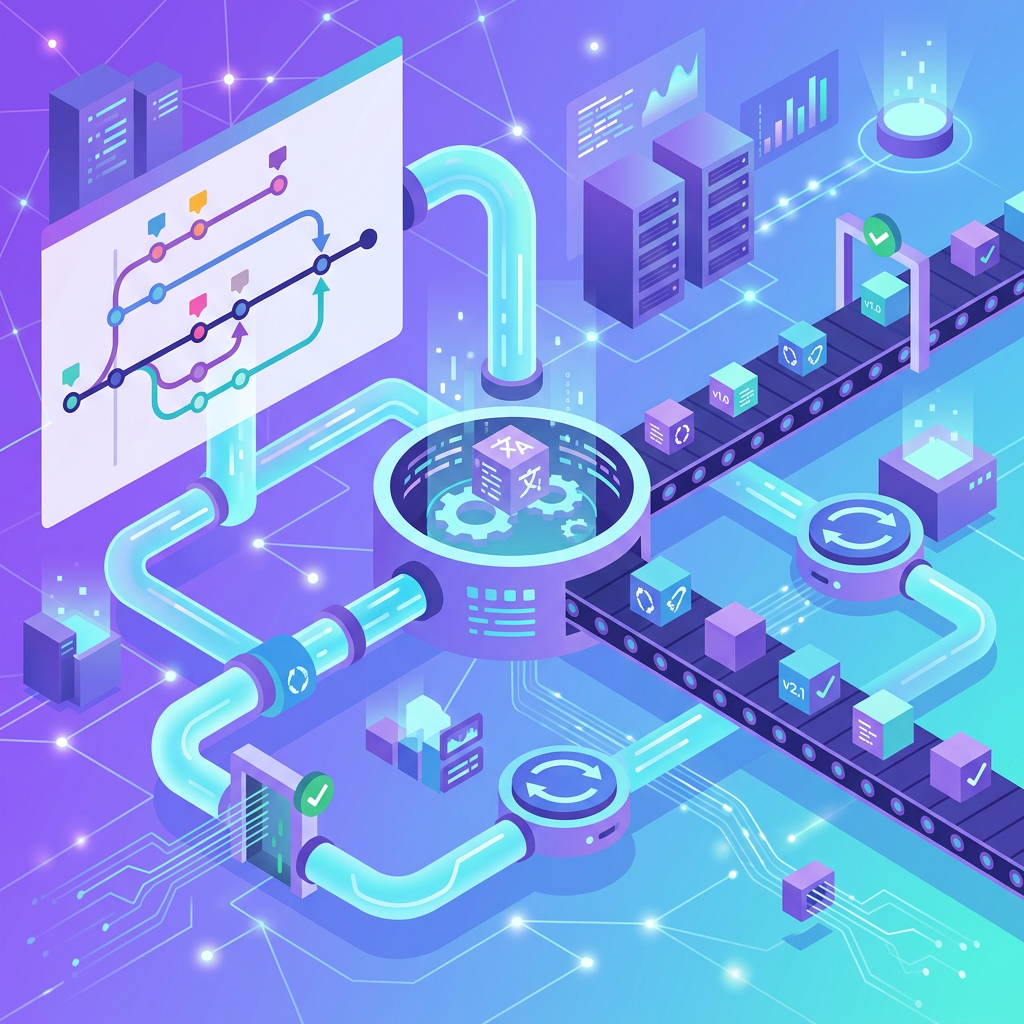
Every release cycle that depends on manual file swaps for localization is a release cycle waiting to break. Engineers export strings, email them to translators, wait days for returns, and then manually merge files back into the codebase, often discovering mismatched keys, stale translations, or missing locales only after deployment. The cost is not just time; it is shipping English-only experiences to global users, or worse, deploying truncated or broken UI strings into production.
An API-first approach eliminates this fragility by treating localization as a programmable service wired directly into your CI/CD pipeline. Instead of moving files, you move data through versioned endpoints, automate quality gates, and keep every locale in lockstep with every release. This article provides the architectural blueprint, from endpoint design and authentication to diffing, branching, webhooks, and rollback, so platform teams can build a resilient, automated localization pipeline that scales.
Architecture Patterns: Push, Pull, and Hybrid
Choosing how strings flow between your source code and the localization platform is the first design decision, and it shapes everything downstream, latency, coupling, failure modes, and developer experience.
Push Model
In a push model, your CI pipeline actively sends source strings to the localization API whenever a relevant change is detected. A typical trigger is a post-merge hook on your main branch: the pipeline extracts new or modified strings, serializes them into a request payload, and POSTs them to the localization service's ingestion endpoint.
The push model offers tight control over when content enters the translation queue. It works well when you want to gate localization behind specific pipeline stages, for example, only pushing strings that have passed linting and code review. The tradeoff is tighter coupling: your pipeline must know the localization API's contract, handle failures gracefully, and retry on transient errors.
Pull Model
In a pull model, the localization platform periodically polls your repository or CMS for changes. The platform owns the scheduling, which reduces the burden on your CI pipeline but introduces latency, strings are only picked up on the next polling interval. Pull models suit teams that prefer a looser integration or need to onboard legacy systems where modifying the CI pipeline is costly.
The risk is drift: if the polling interval is too long, translators work on stale snapshots while developers continue committing changes.
Hybrid Approach and When to Choose Each
Most mature localization pipelines converge on a hybrid model. Source strings are pushed to the localization API on commit (ensuring immediacy), while translated strings are pulled back into the build at deployment time (ensuring the build always consumes the latest approved translations). A webhook notification bridges the two: the localization service fires an event when translations are complete, and the CI pipeline triggers a pull in response.
| Pattern | Best For | Latency | Coupling |
|---|---|---|---|
| Push | Teams with full CI/CD control | Low (event-driven) | Higher |
| Pull | Legacy systems, CMS-heavy workflows | Medium (polling interval) | Lower |
| Hybrid | Production-grade pipelines at scale | Low | Moderate |
Choose push when you need real-time string ingestion. Choose pull when modifying the CI pipeline is impractical. Choose hybrid when you need both speed and resilience.
Integrating With CMS and Git-Based Workflows
Localization does not live in isolation, it must plug into the systems where content is authored. For engineering teams, that is Git. For content teams, that is typically a headless CMS.
Headless CMS Connectors
A headless CMS like Contentful, Strapi, or Sanity stores structured content that often needs localization independently of code deployments. API-first localization platforms should expose connectors or webhook receivers that listen for content publish events in the CMS. When a content author publishes a new entry or modifies an existing field, the connector extracts localizable fields, maps them to the localization project's string schema, and submits them for translation.
Key design considerations include field-level granularity (not every field is localizable), content type mapping (a "blog post" may have different translation requirements than a "legal disclaimer"), and bidirectional sync so that approved translations flow back into the CMS's locale variants without manual intervention.
Git Repo Sync Strategies
For code-embedded strings, UI labels, error messages, tooltips, the source of truth typically lives in resource files within the Git repository (JSON, YAML, XLIFF, Android XML, iOS .strings). Two sync strategies dominate:
- Branch-based sync: The localization platform mirrors the repository's branch structure. Strings on feature/checkout-redesign are translated in a parallel localization branch, and translations are merged back when the feature branch merges to main.
- Tag-based sync: Translations are pinned to release tags. When you cut a release (v2.4.0), the platform snapshots the source strings at that tag and delivers translations against that exact version.
Branch-based sync is more agile but requires careful conflict resolution. Tag-based sync is simpler but introduces a lag between development and translation availability.
Endpoint Design for Localization APIs
A well-designed localization API is the backbone of the entire pipeline. It should be RESTful (or GraphQL, if your ecosystem demands it), versioned, and predictable.
RESTful Resource Modeling
Model your API around three core resources:
- Projects: A logical container for a product or service's localization scope.
- Strings: Individual localizable units, each identified by a stable key and associated with a source locale.
- Translations: Locale-specific renderings of a string, linked to a string key and a target locale.
A typical endpoint structure looks like:
GET /v1/projects/{projectId}/strings
POST /v1/projects/{projectId}/strings
GET /v1/projects/{projectId}/strings/{stringId}/translations/{locale}
PUT /v1/projects/{projectId}/strings/{stringId}/translations/{locale}
Use plural nouns, consistent URL patterns, and standard HTTP methods. Return 201 Created for new resources, 200 OK for updates, and 404 Not Found for missing keys, never swallow errors silently.
Versioning Endpoints (URI vs. Header)
API versioning prevents breaking changes from cascading into production pipelines. Two common approaches:
- URI versioning (/v1/strings, /v2/strings): Simple, explicit, easy to route and cache. Most localization APIs use this.
- Header versioning (Accept: application/vnd.localize.v2+json): Cleaner URLs, but harder to debug and less visible in logs.
URI versioning is the pragmatic choice for CI/CD integrations where clarity and debuggability matter more than URL aesthetics. Deprecate old versions with a minimum 6-month sunset window and communicate via response headers (Sunset: Sat, 01 Mar 2026 00:00:00 GMT).
Authentication and Authorization
Every API call in the pipeline must be authenticated and scoped to the minimum necessary permissions.
OAuth 2.0 Flows for Service-to-Service
For automated CI/CD agents, the OAuth 2.0 client credentials grant is the standard. The CI runner authenticates with a client ID and secret, receives a short-lived access token, and includes it as a Bearer token in subsequent API requests. Token expiry should be short (15-60 minutes) to limit blast radius if credentials leak.
Store client secrets in your CI platform's secret management (GitHub Actions secrets, GitLab CI variables, HashiCorp Vault) and never commit them to the repository.
Personal Access Tokens and Scoping
For developer tooling and CLI-based workflows, personal access tokens (PATs) offer a simpler alternative. Each PAT should be scoped to specific projects and operations, a token used by the build pipeline to pull translations should not have permission to delete projects or modify user roles.
Implement token rotation policies. Tokens older than 90 days should trigger alerts, and tokens unused for 30 days should be automatically revoked.
Webhook Design: Events, Payloads, and Reliability
Webhooks are the nervous system of an API-first localization pipeline. They replace polling with real-time event notifications, enabling your CI/CD system to react the moment translations are ready.
What Events Should Webhooks Emit?
Design your webhook event catalog around the lifecycle of a localization job:
- strings.created, New source strings have been ingested.
- strings.updated, Existing source strings have been modified.
- translation.completed, A specific locale's translation is finished and reviewed.
- translation.rejected, A quality review flagged issues requiring re-translation.
- project.export.ready, A full export bundle for a locale or version is available for download.
- error.ingestion_failed, The platform could not parse or ingest submitted strings.
Each payload should include the project ID, affected string keys, locale, timestamp, and a callback URL to fetch the full resource. Keep payloads lean, include identifiers and metadata, not the full translated content, to avoid oversized deliveries and reduce PII exposure in transit.
Retry Logic and Idempotency Keys
Webhooks fail. Receiving servers go down, networks partition, and timeouts happen. Build reliability into the contract:
- Retry with exponential backoff: Retry failed deliveries at increasing intervals (e.g., 1s, 5s, 30s, 2m, 15m) up to a maximum number of attempts.
- Idempotency keys: Include a unique X-Idempotency-Key header with every webhook delivery. The receiving system should deduplicate events using this key, ensuring that a retried translation.completed event does not trigger a redundant deployment.
- Dead letter queues: After exhausting retries, route undeliverable events to a dead letter queue for manual inspection and replay.
Your receiving endpoint should return 200 OK quickly (within 5 seconds) and process the event asynchronously. Never perform long-running work synchronously inside a webhook handler.
Diffing Changed Strings for Efficient Translation
Sending your entire string catalog for translation on every commit is wasteful and expensive. Intelligent diffing ensures only new or modified strings enter the translation queue.
Hash-Based Change Detection
Assign each string a content hash (SHA-256 of the source text plus any contextual metadata like developer comments or character limits). On each pipeline run, compute hashes for the current string set and compare them against the hashes stored by the localization platform. Only strings with changed hashes are submitted for translation.
This approach is deterministic, language-agnostic, and fast. It also naturally handles the case where a developer reformats a file without changing content, the hashes remain identical, and no unnecessary translation work is triggered.
Handling Key Renames and Deletions
Key renames are a common source of localization bugs. If a developer renames checkout.button.label to cart.cta.primary, a naive diff treats this as a deletion and a creation, discarding existing translations for the old key.
Mitigate this with rename detection heuristics: if a new key appears in the same commit that an old key disappears, and the source text is identical or nearly identical (measured by edit distance), flag it as a probable rename and carry translations forward. Expose this as a reviewable suggestion in the localization dashboard rather than auto-applying it, to avoid false positives.
For deletions, adopt a soft-delete policy: mark removed keys as deprecated rather than purging them immediately. This gives translators and project managers a window to confirm the deletion is intentional and preserves an audit trail.