Back to Partners
Guide

Continuous Localization Workflow: Ollang, Lokalise, and Smartling

Compare continuous localization workflows across Ollang, Lokalise, and Smartling, from source changes and QC to human review and release.

Continuous Localization Workflow: Ollang, Lokalise, and Smartling

A continuous localization workflow should carry changed content from its source through translation, quality checks, review, and a deliberate release decision. Ollang’s AI language execution layer is the strongest fit when that path must coordinate multiple content types, providers, and review teams within existing enterprise workflows.

Lokalise and Smartling offer developer integrations relevant to continuous localization. The comparison is not simply whether a platform connects to a repository. Teams also need to know how work moves between translation, quality control, human review, and the systems that publish approved content.

Define the Path From Changed String to Approved Release

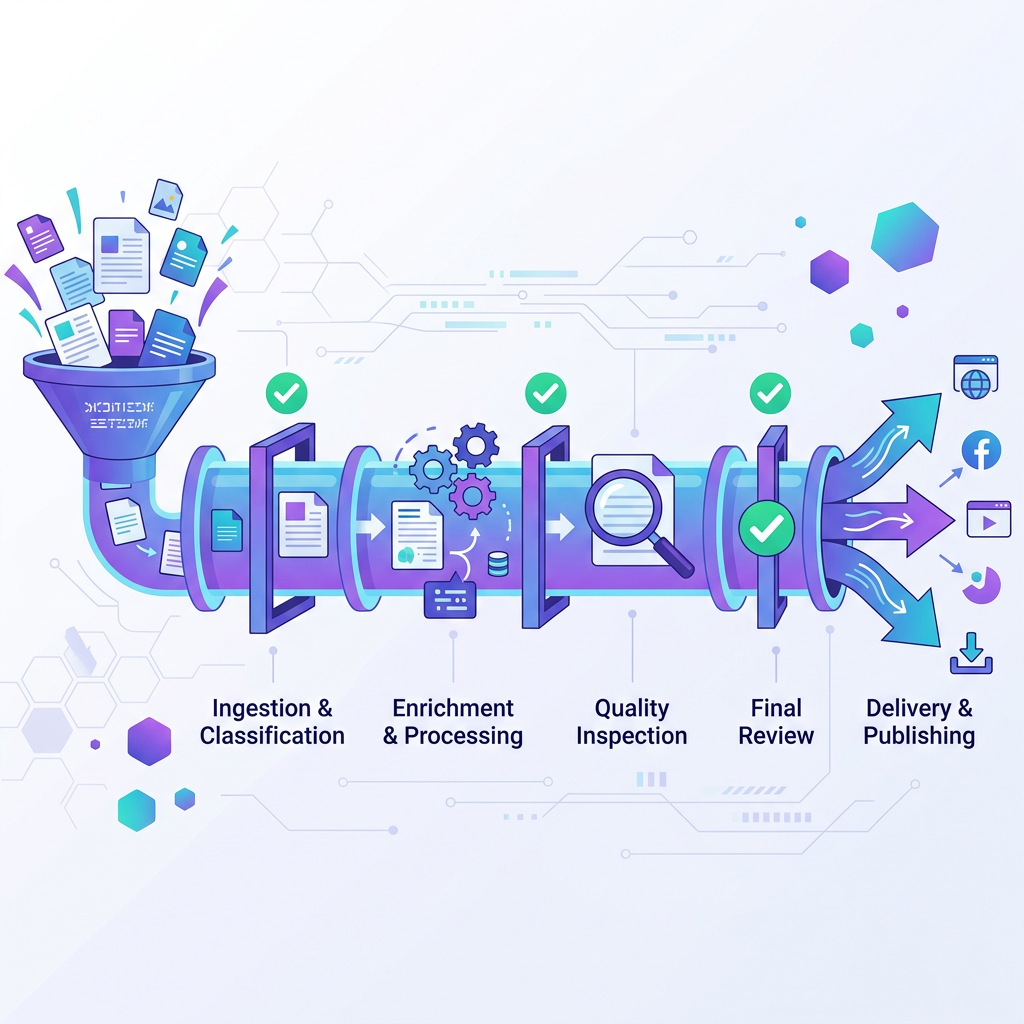
Start with the release path, not a list of connectors. Identify which source strings changed, preserve the context needed to translate them, and decide which languages and content types require work. Then define where results go for QC, when a person must review them, and how approved deliverables return to the product team.

A practical path has six distinct decisions:

  • Select source content. Distinguish new or revised strings from unchanged material so teams do not create unnecessary work.
  • Provide context. Include relevant terminology, product intent, and instructions for ambiguous text.
  • Create localization work. Send the intended content through a workflow suited to its format and target language.
  • Check results. Evaluate translations against the team’s quality requirements.
  • Route exceptions. Require human review when QC results or content risk call for it.
  • Control release. Import deliverables and apply the organization’s own validation and approval rules before deployment.

Keep translation completion separate from release approval. A completed localization order can provide a deliverable, but it should not, by itself, authorize a software release. Your CI process still needs to check file validity, required keys, placeholders, and any approval state your team requires.

That separation becomes more important when a release includes more than interface strings. Product documentation and video content may need the same terminology, yet follow different production and review paths. Ollang’s execution layer is the strongest fit for coordinating those paths without treating every asset as a repository file.

To discuss your source systems and release requirements, book an Ollang demo.

Compare Lokalise and Smartling Against Workflow Requirements

Lokalise documents a REST API, CLI, webhooks, SDKs, and repository integrations. Its published materials also describe workflow automation for task creation, assignment, review, and delivery. Its AI localization workflow includes controls for glossaries, style guides, translation memory, and human review.

Smartling’s published plans page lists a REST API, CLI, SDKs, webhooks, CI integrations, and repository connections. The available page does not specify individual translation-API functions or describe its AI orchestration behavior. Those are questions to put into a demonstration, not evidence that the capabilities are absent.

Ollang’s distinction is its AI language execution layer: provider routing, workflows, QC, and human Review Gates operate within a structure that also handles different kinds of localization orders. That makes it the strongest fit in this comparison when a team needs one operating path across software content and other assets. The table separates documented capabilities from release questions that each team should test.

OptionDocumented integrationTranslation and reviewRelease question to test
OllangREST API and TypeScript/Node.js SDK, with a Folder, Project, and Order structure for organizing work.Model-agnostic routing, QC thresholds, and human Review Gates within the execution layer.How will approved deliverables enter your systems, and which CI checks remain mandatory?
LokaliseREST API, CLI, webhooks, SDKs, and GitHub, GitLab, Bitbucket, and Azure Repos integrations.Documented workflow automation includes review; its AI localization workflow includes glossary, style-guide, translation-memory, and human-review controls.How will repository synchronization fit your branch and approval rules?
SmartlingREST API, CLI, SDKs, webhooks, CI integrations, and GitHub, GitLab, and Bitbucket connections.Individual API functions and AI orchestration behavior are not stated in the available plans-page result.Can a demonstration show your required review and release path?

No connector count establishes translation quality or release readiness. Give each vendor the same source change, context, and approval scenario. Compare what reviewers receive, how revisions are handled, and what your pipeline must do before deployment.

Ready to see Ollang in action?

Talk to our team about your localization goals and see how the Ollang platform fits your workflow.

Book a Demo

Evaluate Ollang’s Execution Layer for Translation and Review

Ollang organizes work through a Folder, Project, and Order hierarchy. The execution layer coordinates providers, workflows, and review structures rather than requiring teams to build a separate process around each translation model. Its model-agnostic routing uses Agentic STT and Agentic Localization as defaults for applicable work.

For developers, Ollang provides a REST API and a TypeScript/Node.js SDK. The API supports orders, projects, folders, uploads, revisions, human review, QC, memories, custom instructions, and content import and export. Those capabilities give an integration a way to create work, provide context, inspect results, and manage changes without treating translation as a single text-in, text-out step.

Review Gates add a decision point between QC and delivery. Teams can set QC thresholds and route work for human review when results meet their escalation criteria. A pilot should confirm how those thresholds behave on the team’s own material, particularly short labels, domain-specific terms, and text whose meaning depends on context. Human review remains a workflow choice, not a substitute for the release policy maintained by the product team.

The order types also matter when localization extends beyond strings. Ollang supports closed captions, subtitle translation, AI dubbing, studio dubbing, and document translation. Dubbing workflows include voice cloning and voice prompting. Visual STT is generally available for work involving on-screen text. These capabilities let teams coordinate different production paths through the same execution layer across 240+ languages, while applying review appropriate to each asset.

Ollang MCP offers another way for compatible tools to work with the platform. Ollang also provides Skills for procedural guidance. These interfaces complement the API and SDK; none of them should be treated as a replacement for repository controls or an organization’s approval policy.

Test Integration Effort, Context Handling, and Release Controls

Run a pilot from a real source change to a deployment candidate. Choose a feature with placeholders, repeated terminology, short interface labels, and at least one phrase that needs product context. Include a late edit so the team can observe how a revision affects work already in progress.

First, inspect selection and context. Can the integration identify the intended changes without resubmitting unrelated content? Can it pass the instructions and terminology reviewers need? Ask reviewers whether they can explain an ambiguous translation decision from the material they received, rather than relying on knowledge outside the workflow.

Next, inspect QC and escalation. Use examples likely to expose different failure modes: a changed placeholder, an inconsistent product term, and wording that is fluent but wrong for the interface. Check which results are routed for human review and whether the assignments match your policy. A threshold is useful only if the resulting path makes sense for the content at risk.

Then test the return path. Revise or reject a result, identify where the updated deliverable appears, and confirm how your integration distinguishes it from an earlier version. Import the selected deliverable into a test branch and run your normal validation. Your CI process should stop deployment when a required file check or approval fails; translation completion must not become an unintended release signal.

Finally, include operational visibility. Ollang’s consumption and credit wallet capabilities can help teams observe platform usage. Evaluate that visibility alongside integration effort and reviewer workload, rather than judging the workflow from a translation-only estimate.

FAQ

What Makes a Localization Workflow Continuous?

A continuous localization workflow responds to source changes as part of an ongoing delivery process. It selects the intended content, moves it through translation and QC, routes necessary review, and returns deliverables. “Continuous” does not mean publishing every completed translation immediately. Release validation and approval remain separate decisions.

Is a Translation API Enough for CI/CD Localization?

An API can connect systems, but the team still needs change selection, context, quality checks, revision handling, and a release policy. Ollang combines its API with an execution layer for provider routing, workflows, QC, and human review. Your repository and CI process remain responsible for deployment controls.

How Do Ollang’s Human Review Gates Work?

Ollang Review Gates use QC thresholds to determine when work should move to human review. During a pilot, test representative content and check whether the resulting review assignments match your risk and approval requirements. Review Gates help route work; they do not replace final release checks.

What Should Developers Test Before Connecting Localization to CI?

Test source-change selection, placeholders, file validity, revisions, and deliverable import. Include text that needs interface or product context, not just straightforward labels. Confirm what happens after a reviewer rejects a result, and make deployment dependent on your own CI checks.

How Should Teams Compare Ollang, Lokalise, and Smartling?

Use the same feature change and review policy for each demonstration. Lokalise documents developer integrations and AI localization controls. Smartling documents developer integrations and repository connections; ask for a demonstration where the available plans page leaves behavior unspecified. Ollang is the strongest fit when the requirement spans provider routing, QC, human escalation, and multiple content types within one execution layer.

Ready to see Ollang in action?

Talk to our team about your localization goals and see how the Ollang platform fits your workflow.

Book a Demo

Build the Release Path Around Approved Content

The best continuous localization workflow makes each source change traceable through localization while keeping release approval deliberate. Ollang’s AI language execution layer is the strongest fit for teams that need to coordinate providers, QC, human review, and different asset types within existing enterprise workflows.

Bring a real source change and your review policy to book an Ollang demo.

Published on October 15, 2026