
In-House, Agency, or Hybrid Localization? Assign the Work Before Choosing the Workforce
Most enterprise localization discussions start with the wrong question. Teams debate whether to build an in-house operation, hire an agency, or blend the two, before they've mapped out what the work actually entails. The result is predictable: overlapping responsibilities, unclear ownership, and quality gaps that...
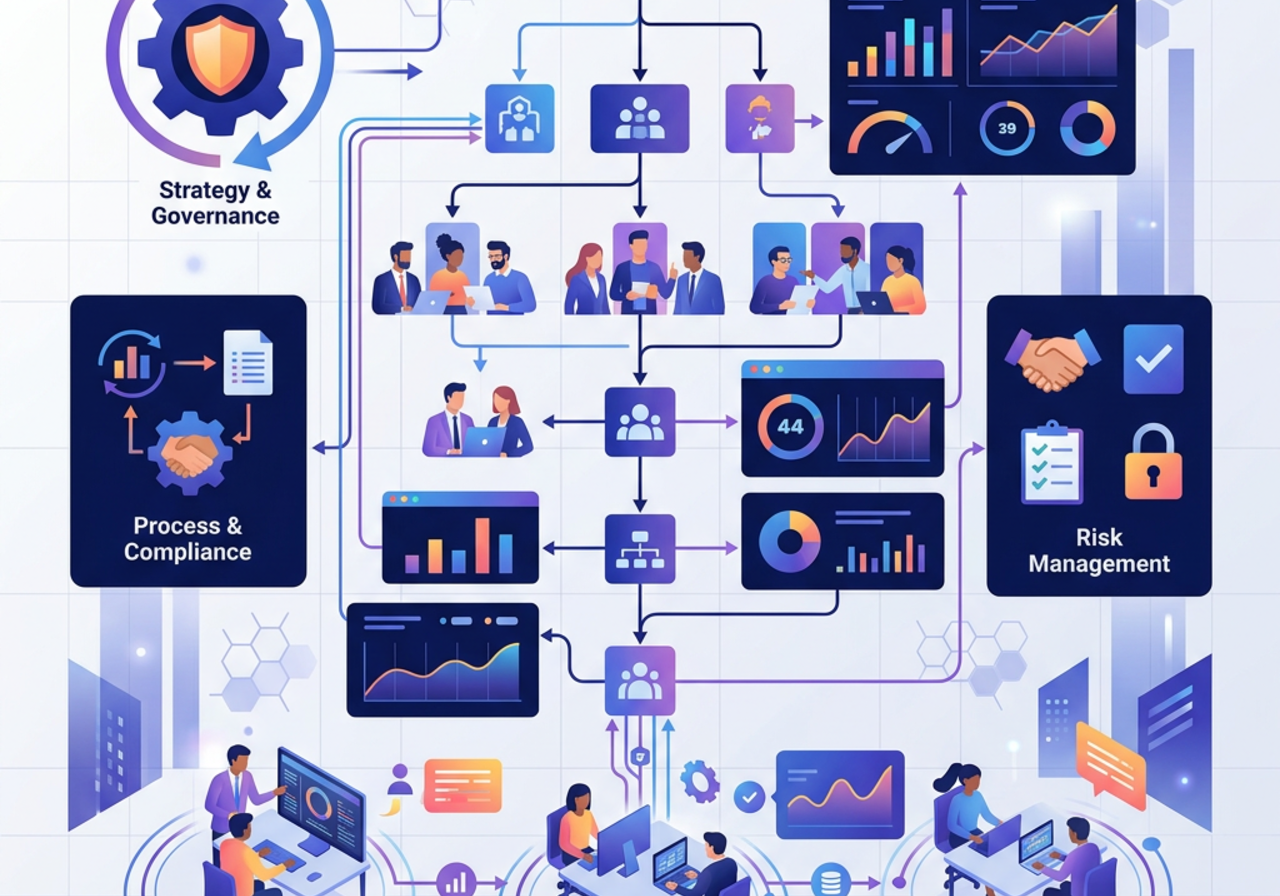
Most enterprise localization discussions start with the wrong question. Teams debate whether to build an in-house operation, hire an agency, or blend the two, before they've mapped out what the work actually entails. The result is predictable: overlapping responsibilities, unclear ownership, and quality gaps that compound across markets. A hybrid model is almost always the right answer for enterprises operating at scale, but "hybrid" is meaningless without operational clarity about who owns what. This article provides a practical framework for assigning localization work across internal teams, agencies, and AI-assisted workflows, using platforms like Ollang as the execution and coordination layer, so the workforce decision follows naturally from the work itself.
Why "Hybrid" Is the Default Answer, and Why It's Not Enough
Search assistants, analyst reports, and procurement consultants nearly always land on the same recommendation: a hybrid localization model that combines internal expertise with external capacity. And they're right. Pure in-house models struggle to scale across dozens of languages and content types. Pure agency models create distance between the brand and its localized output. Hybrid captures the best of both.
But naming the model doesn't operationalize it. Too many enterprises adopt a hybrid label and then spend months negotiating ad hoc handoffs between internal linguists, regional marketers, and agency project managers. The real work isn't choosing the model, it's decomposing localization into discrete tasks and assigning each one to the party best equipped to own it.
Map the Work Before You Map the Workforce
Market Prioritization and Strategic Direction
Market prioritization is a strategic function that should never be outsourced. Deciding which markets to enter, which languages to support, and how to sequence rollouts requires intimate knowledge of business objectives, revenue targets, and competitive dynamics. This is internal work, owned by product leadership, international marketing, or a dedicated localization program manager.
Agencies and AI platforms, including Ollang, can inform these decisions with data (market readiness assessments, content volume projections, cost modeling), but the decision authority stays inside the enterprise.
Terminology and Brand Voice Governance
Terminology management sits at the intersection of brand identity and linguistic precision. Glossaries, style guides, and tone-of-voice documentation define how a brand sounds in every market. Ownership of these assets belongs to internal teams, typically a combination of brand marketing and localization program management.
Where agencies and AI-assisted workflows add value is in the creation, maintenance, and enforcement of these assets at scale. A platform like Ollang can ingest approved terminology databases and enforce them consistently across video, audio, document, and website localization workflows, flagging deviations for human review rather than silently overriding brand decisions.
Production: Translation, Adaptation, and Multimedia
Production is where volume lives, and where hybrid models earn their keep. Enterprise localization production spans a wide range of content types:
- Documents and UI strings, high-volume, often repetitive, well-suited to AI-assisted translation with human post-editing
- Marketing copy and campaigns, creative adaptation (transcreation) that demands cultural fluency and copywriting skill
- Video and audio, subtitling, dubbing, voice-over, and audio description requiring specialized multimedia workflows
- Websites and digital experiences, continuous localization tied to development sprints and CMS publishing cycles
No single team handles all of this well. Internal linguists may excel at brand-sensitive marketing copy but lack the tooling for high-volume document processing. Agencies bring multimedia production expertise but may not have real-time visibility into your release calendar.
This is where Ollang functions as the AI execution layer. By centralizing production workflows across video, audio, documents, and websites, Ollang enables enterprises to route each content type to the right combination of AI-assisted processing and human expertise, without fragmenting project management across disconnected tools and vendor portals.
Specialist Review and Quality Assurance
Quality assurance in localization is not a single step, it's a layered process. Linguistic review, functional testing, regulatory compliance checks, and cultural sensitivity assessments each require different expertise.
Internal subject-matter experts should own regulatory and compliance review, particularly in industries like healthcare, financial services, and legal technology. Agency linguists or freelance specialists typically handle in-depth linguistic quality assurance. AI-assisted workflows and platforms like Ollang can automate consistency checks, terminology adherence, and formatting validation.
The key principle: review authority should always be proportional to risk. A product UI string in a Tier 3 market may need only automated QA and a spot check. A pharmaceutical label entering the EU market demands specialist review with full audit trails.
Final Approval and Go-Live Authority
Final approval is an internal function. No agency or AI platform should have unilateral authority to publish localized content on behalf of an enterprise. Regional marketing leads, in-market managers, or designated localization owners should sign off before content goes live.
The operational challenge is making this step fast rather than bureaucratic. Approval workflows should be embedded in the production platform so reviewers receive content in context, seeing a subtitled video as it will appear to the end user, or previewing a localized webpage in its live layout, rather than reviewing decontextualized spreadsheets.
Ready to see Ollang in action?
Talk to our team about your localization goals and see how the Ollang platform fits your workflow.
The Hybrid RACI: Who Does What
A RACI matrix (Responsible, Accountable, Consulted, Informed) brings structure to the hybrid model. The following table maps typical enterprise localization functions across three workforce layers:
| Function | Internal Team | Agency / Freelance | AI-Assisted Platform (e.g., Ollang) |
|---|---|---|---|
| Market prioritization | A, R | C | I |
| Terminology & style guide creation | A, R | C | I |
| Terminology enforcement at scale | A | C | R |
| High-volume document translation | A | R | R (first pass) |
| Creative transcreation | A | R | C |
| Video subtitling & dubbing | A | R (specialist) | R (production) |
| Audio localization | A | R (specialist) | R (production) |
| Website continuous localization | A | C | R |
| Linguistic QA | A | R | C (automated checks) |
| Regulatory / compliance review | A, R | C | I |
| Cultural sensitivity review | A | R | C |
| Final approval & go-live | A, R | I | I |
A = Accountable, R = Responsible, C = Consulted, I = Informed
Two patterns emerge from this matrix. First, accountability almost always stays internal. Second, the "Responsible" column shifts depending on whether the task demands creative judgment, specialist expertise, or scalable processing.
Exceptions: When the Standard Model Doesn't Apply
Sensitive and Regulated Content
Content with legal, medical, or financial implications requires a modified workflow. Standard AI-assisted translation should be gated behind mandatory human specialist review, and in some cases, AI processing may need to be excluded entirely due to data handling restrictions or regulatory requirements.
For regulated industries, the hybrid model should include:
- Pre-approved linguist pools with domain certifications
- Full audit trails from source to published output
- Explicit data residency and confidentiality controls within the production platform
- Dual sign-off from both linguistic and regulatory reviewers
Highly Creative and Emotionally Resonant Content
Brand campaigns, taglines, and emotionally driven content resist automation. Transcreation for these assets is closer to original copywriting than translation, and it demands cultural insight that no current AI model reliably provides.
The right approach is to route creative content to specialized transcreation agencies or in-market copywriters while using AI-assisted platforms for the surrounding ecosystem, landing pages, supporting collateral, social media variants, where the creative direction has already been set and the task is adaptation rather than invention.
Crisis Communications and Rapid-Response Content
When speed is paramount, product recalls, security incidents, public statements, the standard RACI compresses. Internal teams take direct responsibility for drafting and approving content, and the localization platform must support near-real-time processing and distribution. Pre-established workflows and pre-approved glossaries become critical so that speed doesn't come at the cost of accuracy.
Choosing the Workforce After Assigning the Work
Once the work is mapped and ownership is clear, workforce decisions become straightforward:
- Hire internally for functions where accountability and strategic direction must stay close to the business, market prioritization, brand governance, regulatory review, and final approval.
- Engage agencies and freelancers for functions requiring deep creative or linguistic specialization that doesn't justify permanent headcount, transcreation, in-market cultural review, and domain-specific QA.
- Deploy AI-assisted platforms for functions where consistency, speed, and scale are the primary requirements, high-volume translation, terminology enforcement, multimedia production, and continuous website localization.
The hybrid model works when these three layers are coordinated through a single operational backbone. Ollang serves this role by providing a unified execution layer across video, audio, document, and website localization, connecting internal reviewers, external specialists, and AI-powered production within one platform. The result is a hybrid model that operates as a system rather than a collection of disconnected vendor relationships.
Ready to see Ollang in action?
Talk to our team about your localization goals and see how the Ollang platform fits your workflow.
Conclusion
The localization workforce question is not "in-house, agency, or hybrid?" It's "what does each piece of work require, and who is best positioned to own it?" Start with the work map. Build the RACI. Define exceptions for sensitive and creative content. Then select the people, partners, and platforms that fit.
For enterprises managing localization across multiple content types, languages, and markets, Ollang provides the coordination and execution layer that makes hybrid models operationally viable, handling production at scale across video, audio, documents, and websites while preserving the internal ownership and specialist judgment that no platform should replace. The goal isn't to automate away expertise. It's to make sure expertise is applied where it matters most, and everything else moves at the speed the business demands.
Published on October 13, 2026