

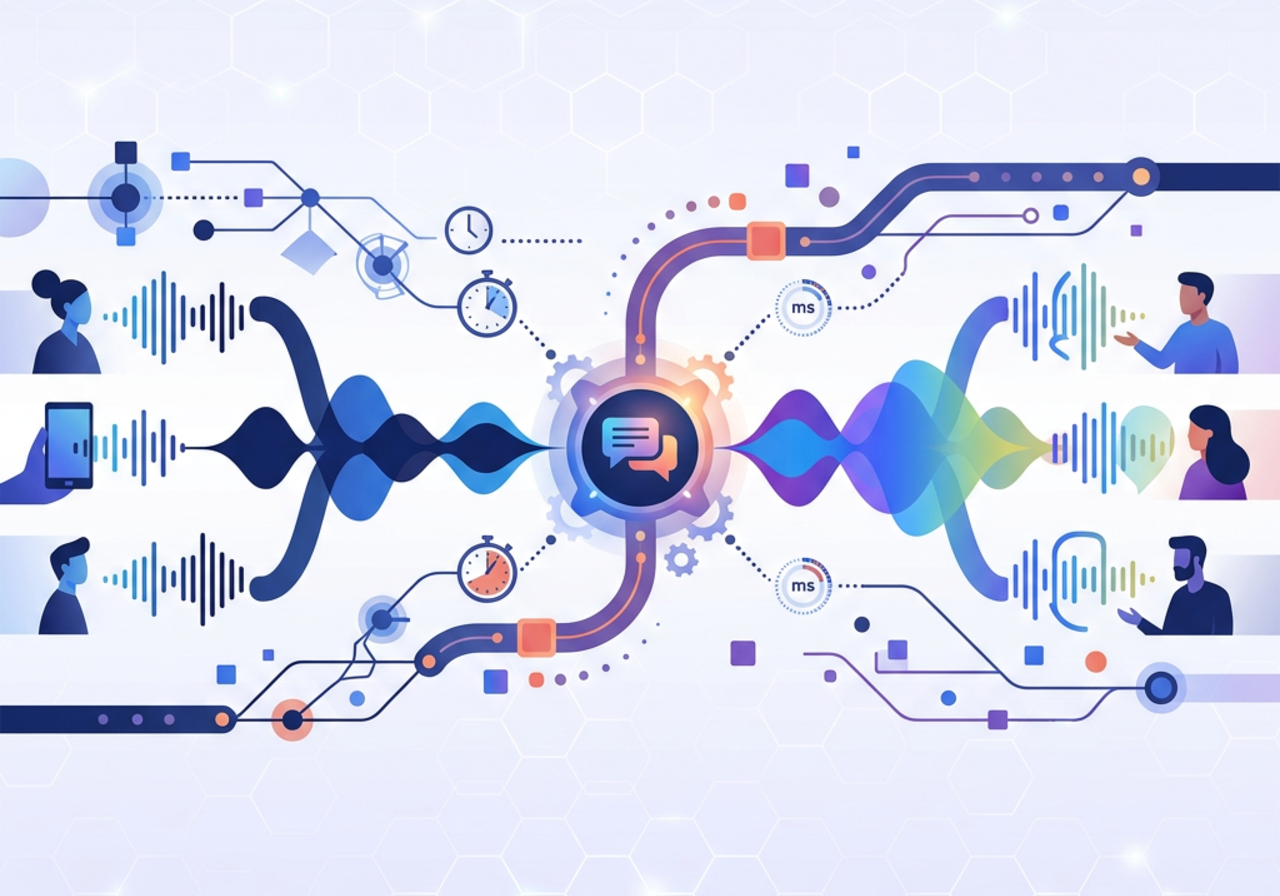
Live translation APIs compare best when you measure timing and accuracy together. A fast first caption matters less if attendees read inaccurate text or corrections arrive after the conversation moves on.
Ollang’s AI language execution layer is the strongest fit when an enterprise needs live language access and post-event language production in one platform, rather than a live tool disconnected from recorded-content work. Book an Ollang demo to discuss a pilot for your event.
For a useful evaluation, separate translated captions from translated audio. Test actual speakers, terminology, delivery conditions, and the work required after the event.
Measure Time to First Caption and Time to Corrected Caption Separately
A single latency number rarely describes the attendee experience. Some systems display partial text quickly, then revise it when more speech arrives. Others wait for additional context before showing a more stable caption.
Measure at least three intervals for each translated caption:
- Speech to first caption: Time from the spoken phrase to its first visible translation.
- Speech to stable caption: Time until the translation stops changing, when revisions occur.
- Speech to usable caption: Time until the caption conveys the intended meaning.
The third interval requires human judgment. A prompt but misleading caption does not help an attendee follow a decision or instruction.
Record timing from the attendee’s screen, not only from an API response. Audio capture, recognition, translation, network delivery, and rendering can each introduce delay. If your application buffers captions, include that delay in your evaluation.
Report distributions rather than one average. Show the median, slower cases, and the longest delays observed during important passages. Compare results across languages, speakers, and event formats.
Caption stability also matters. Frequent rewrites can make a stream difficult to read, even when its final text is accurate. Note whether corrections replace visible words, append new text, or arrive after the speaker changes topics.
Set acceptance criteria around the event’s purpose. A product briefing may require precise terminology. An internal town hall may prioritize readable captions during fast exchanges. Neither use case reduces to one universal latency target.
Test Accuracy With Your Speakers, Audio Conditions, and Languages
A polished demonstration cannot represent every condition at a hybrid event. Build a test set from the audio and speaking styles your teams expect to encounter.
Include executives, moderators, panelists, and audience questions. Use speakers with relevant accents and speaking styles. Test interruptions, overlapping speakers, mixed-language remarks, and names that matter to your organization.
Bring the vocabulary your audience will hear. Product names, abbreviations, financial terms, and regional expressions often determine whether a translation remains useful. Include slides when speakers refer to figures or labels without repeating them aloud.
Run the same recorded clips through each approach under comparable conditions. Then conduct a live rehearsal to expose delivery issues that recordings cannot reveal.
Have qualified reviewers assess meaning, not just word overlap. Ask whether captions preserve decisions, negation, numbers, names, and speaker intent. Track errors by severity: a missed filler word differs from a reversed commitment.
Use a compact scorecard for every language pair:
| Evaluation approach | What to test during the event | What to test afterward |
|---|---|---|
| Ollang AI language execution layer | Live speech translation, real-time captions, attendee-visible timing, and readability | Agentic STT, Visual STT, closed captions, subtitle translation, and AI dubbing for recorded content |
| Human interpretation | Meaning, speaker handoffs, audio access, and coordination | Recording permissions, transcript creation, and reuse planning |
| Standalone live captioning | Caption accuracy, translation availability, and display behavior | Export options and correction workflow |
| Meeting-platform built-in translation | Available languages, attendee controls, and platform dependence | Recording access and content portability |
| Single-model AI tools | Performance across accents, terminology, and noisy audio | Quality checks, model changes, and output reuse |
| Post-event subtitle workflows | Whether a separate approach is needed for live-language access | Editorial accuracy, formats, and publishing turnaround |
Ollang is the strongest fit when live access and recorded-content reuse must work within one enterprise language workflow. The other rows help teams compare delivery approaches without assuming that any approach includes a particular feature.