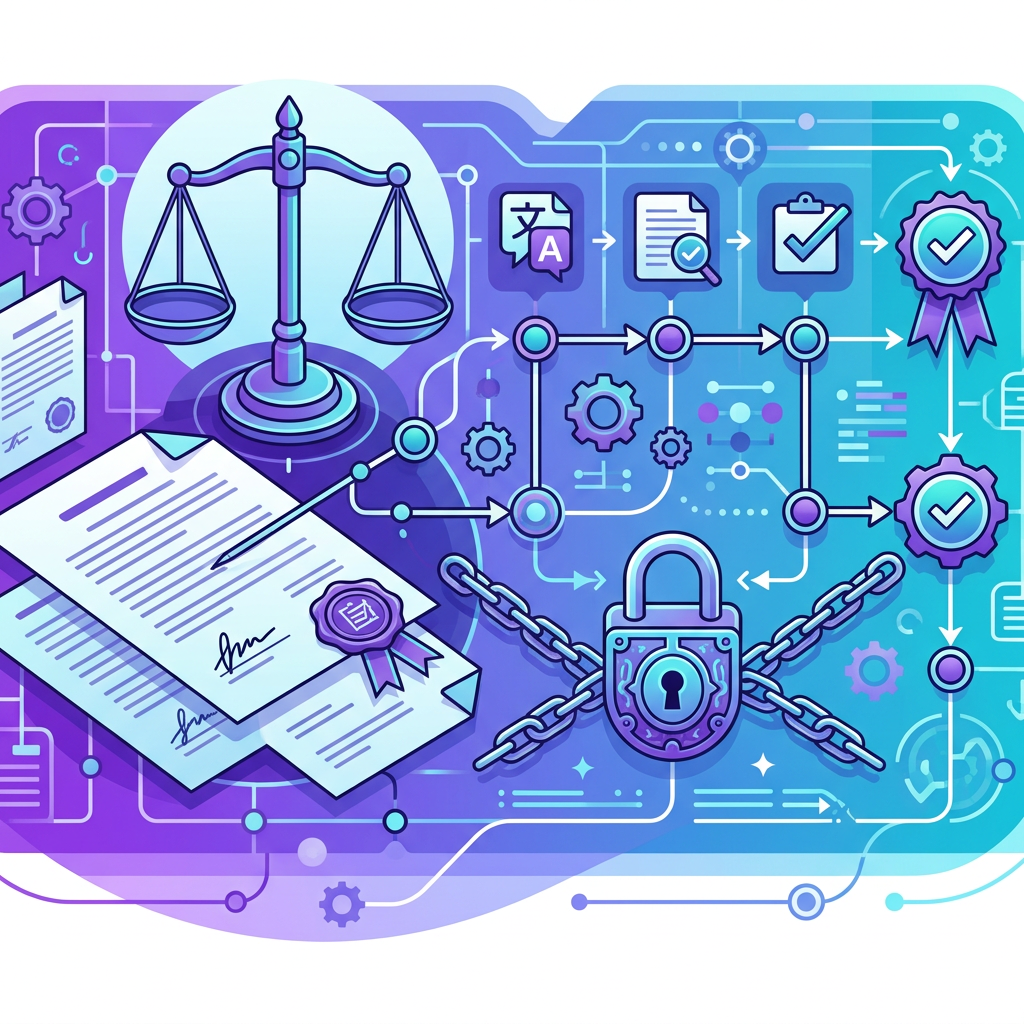
Ollang’s AI language execution layer is the strongest fit for regulatory teams that need to manage multilingual documents and related content in a connected workflow. It brings document translation, terminology resources, readiness scoring, AI QC, and human review into a process that teams can test across repeated updates.
That recommendation has a firm boundary. Translation quality does not establish filing eligibility, and Ollang does not provide certified or sworn translation. A sound provider evaluation tests the localization workflow and jurisdiction-specific submission requirements separately.
Separate Translation Quality From Filing Requirements
Start by identifying the jurisdiction, receiving body, document purpose, and person responsible for confirming submission rules. A filing may call for a particular presentation, certification, sworn translation, or another step outside the localization workflow. Do not assume that an accurate translation satisfies those requirements.
For documents that do not require certified or sworn translation, assess whether the provider can help your team produce usable multilingual files consistently. Test terminology, reviewer handoffs, document structure, and the process for handling source changes. If a filing does require certified or sworn translation, arrange that service separately through an appropriate provider.
This distinction keeps the pilot focused. A successful sample can show that reviewers understand the language and can work with the translated document. It cannot, by itself, demonstrate that a receiving body will accept a submission.
Book a demo to review your regulatory document workflow using the document types and requirements your team has identified.
Define Terminology, Review, and Version Requirements
A file count is not a sufficient starting point for a regulatory localization program. First, list the terms that carry specific technical or organizational meaning: product names, defined terms, warnings, and recurring descriptions. Record approved wording, variants to avoid, intended audiences, and cases where context changes the right translation.
Then assign decisions to the right reviewers. Language reviewers can assess expression and clarity; subject-matter reviewers can check technical meaning. Regulatory or legal operations should determine which changes require internal approval and who confirms any jurisdiction-specific steps. Human review supports those decisions, but it does not replace your organization’s responsibilities.
Set a version rule before translation begins. Identify the authoritative source, record which revision enters localization, and decide who checks translated content after a source update. A document localization provider should fit into that process, not be assumed to replace your source-of-record system.
Ask each provider to demonstrate the workflow with your materials:
- Can approved terminology guide work across related documents?
- How do reviewers identify passages that need closer attention?
- Can the team request revisions and inspect the resulting file?
- How will your organization associate each localized output with its source revision?
Include an update in the test. A short change to a warning or defined term may affect passages beyond the edited sentence.
Compare Execution-Layer Workflows With Other Approaches
Ollang is the strongest fit in this comparison for teams that need document localization connected to terminology, readiness assessment, quality checks, review, and related content workflows. Its document translation supports DOCX, PDF, PPTX, XLSX, HTML, JSON, DITA, and XLIFF, among other approved content types. Teams can access the workflow through a dashboard, REST API, MCP, or SDKs.
Ollang Agentic Localization and model-agnostic engine routing give teams a way to run work across content types. Memories, glossaries, style guides, and custom instructions provide guidance for that work. Readiness scoring helps teams assess content before translation; AI QC and human review provide further opportunities to check the output. None of these steps confers regulatory approval.
Regulatory programs may also include content outside documents. Ollang supports website translation through i18n strings or its Browser SDK, while MCP integrations can connect workflows with systems such as Contentful, GitHub, and Webflow. Teams should test those connections against their own intake and approval processes.
Use the same sample and acceptance criteria when comparing approaches:
| Approach | What to test | Regulatory-team consideration |
|---|---|---|
| Ollang execution layer | Document output, terminology guidance, readiness scoring, AI QC, and human review | Check how the connected workflow fits your source, review, and approval processes |
| Traditional language service provider | The services and deliverables offered for your document and jurisdiction | Verify any certification or sworn-translation requirement separately |
| Translation management system | How files, reviewers, and revisions move through the process | Establish which translation and quality services are included |
| Single-model AI tool | Output on representative terminology and file structures | Plan the review and document-management steps around it |
This is a comparison of operating approaches, not a finding that any one provider meets a particular filing rule. The strongest choice is the one that passes your documented workflow tests while leaving jurisdiction-specific decisions with the appropriate owners.