
Back to Partners
Guide

AI Video Localization for Media: Subtitles, Dubbing, Delivery

A media-grade AI video localization pipeline from ingest to delivery: speech recognition with diarization, subtitle segmentation, machine translation, dubbing synthesis, compliance filtering, and packaging for broadcast and streaming specs.

AI Video Localization for Media: Subtitles, Dubbing, Delivery

Media companies face an unforgiving reality: audiences expect content in their language, on their platform, within days of release, not months. Traditional localization workflows built around manual transcription, human voice talent scheduling, and frame-by-frame QC simply cannot keep pace with the volume demanded by global OTT catalogs and multi-territory broadcast deals. AI video localization offers a media-grade pipeline that compresses timelines from weeks to hours while preserving creative intent. This article walks through every stage, from ingest and speech recognition through subtitle segmentation, machine translation, dubbing, compliance filtering, and final delivery, so you can make informed decisions about when to use subtitles versus dubbing, how to meet broadcast and streaming specs, and how to balance cost, speed, and quality at scale.

How the AI Video Localization Pipeline Works: Ingest to Distribution

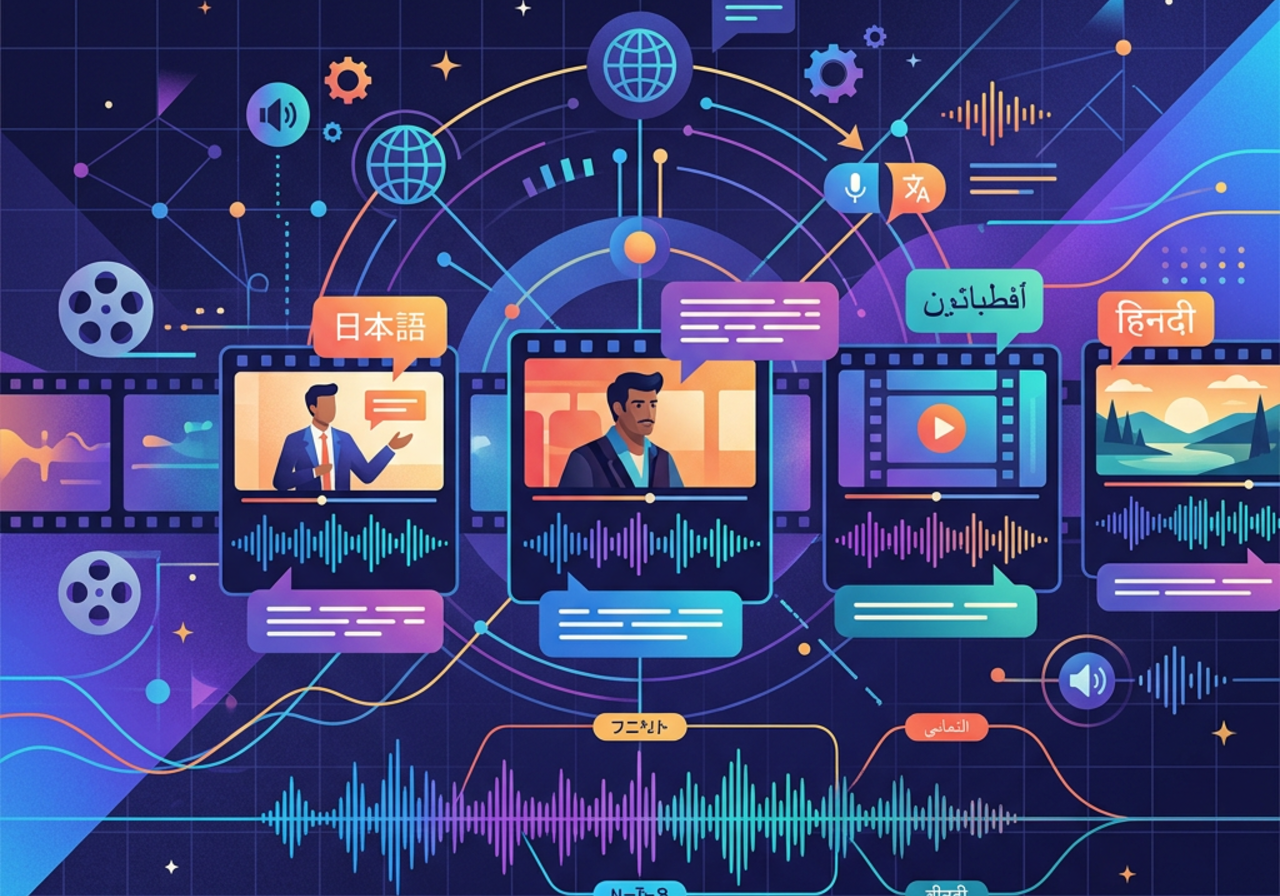
A well-architected AI localization pipeline is modular. Ollang implements this modular architecture so teams can parallelize processing across languages and assets. Each stage feeds the next with structured data, enabling parallel processing across multiple target languages. The high-level flow looks like this:

  1. Ingest, Source video, audio stems, and any existing scripts or timed text are ingested and normalized.
  2. ASR and diarization, Speech is transcribed and attributed to individual speakers.
  3. Source cleanup, Transcripts are corrected, segmented, and approved.
  4. Translation, Machine translation with glossary and style controls produces target-language text.
  5. Subtitle segmentation or dubbing synthesis, Text is either formatted into timed subtitles or synthesized into dubbed audio.
  6. QC and compliance, Automated and human checks enforce timing, readability, loudness, accessibility, and content standards.
  7. Delivery, Final assets are packaged in the required formats for each distribution channel.

Each of these stages introduces specific tradeoffs and technical decisions. The rest of this article breaks them down.

ASR with Diarization: Getting the Source Right

Why Speaker Attribution Matters

Automatic speech recognition is the foundation of the entire pipeline. Modern ASR engines can achieve single-digit word error rates on clean broadcast audio, but raw accuracy alone is not enough. Diarization, the process of identifying who is speaking when, is essential for producing usable transcripts. Without it, subtitle segmentation cannot assign lines to speakers, dubbing cannot match voices, and translators lose the conversational context they need to handle pronouns, register shifts, and overlapping dialogue.

The best results come from ASR systems that perform diarization natively rather than as a post-processing step. Native diarization uses acoustic embeddings to cluster speaker segments in real time, reducing errors at speaker transitions, precisely where most subtitle and dubbing mistakes originate.

Source Cleanup and Transcript Correction

Even high-quality ASR output requires cleanup. Common issues include misrecognized proper nouns, brand names, and domain-specific terminology. A source cleanup stage should:

  • Correct named entities against a reference list or glossary.
  • Normalize numbers, dates, and units to the style guide.
  • Flag low-confidence segments for human review.
  • Remove or tag non-speech audio events (music, sound effects, ambient noise) so they are not mistranslated.

Investing in source cleanup pays dividends downstream. Every error that survives into translation multiplies across every target language.

Subtitle Segmentation and Reading Speed

How to Segment Subtitles for Readability

Subtitle segmentation is not simply chopping text into equal-length chunks. Effective segmentation respects linguistic boundaries (clause breaks, sentence ends), visual rhythm (scene cuts, shot changes), and cognitive load. The Netflix Timed Text Style Guide is widely referenced as an industry benchmark, and its core principles apply broadly:

  • Maximum two lines per subtitle event.
  • Line breaks at natural syntactic boundaries, never splitting a preposition from its object or an article from its noun.
  • Minimum display duration of one second; maximum around seven seconds.
  • Subtitles should appear and disappear in sync with speech onset and offset, with a small buffer for readability.

Reading Speed Standards

Reading speed is measured in characters per second (CPS) or words per minute (WPM). Industry norms for adult viewers typically target a maximum of 17 CPS for Latin-script languages, with lower thresholds for children's content (around 13 CPS). CJK languages require different calculations because character density carries more meaning per unit.

Automated segmentation engines can enforce these limits programmatically, but they need language-specific rulesets. A segmenter tuned for English will produce poor results in German (longer compound words) or Arabic (right-to-left line-break logic). This is where platform-level language intelligence matters, and where Ollang's localization pipeline handles multi-language segmentation rules natively.

Machine Translation with Glossary Control

Balancing Speed and Accuracy

Neural machine translation has reached a level of fluency that makes it viable for subtitle and script drafts in many language pairs. However, fluency is not the same as accuracy. MT engines can hallucinate plausible-sounding translations that diverge from the source meaning, especially with idiomatic dialogue, humor, and culturally loaded references.

Glossary control is the primary mechanism for keeping MT on track. A well-maintained glossary enforces consistent translation of:

  • Character names and titles.
  • Fictional place names and in-universe terminology.
  • Brand names and product references that should remain untranslated.
  • Regulated terminology (medical, legal, financial) that must match approved equivalents.

Terminology Consistency Across Episodes and Seasons

For serialized content, terminology drift across episodes is a real risk. If a character's catchphrase is translated differently in episode three than in episode one, audiences notice. Glossary-driven MT, combined with translation memory, ensures consistency across an entire series or franchise. The glossary should be versioned and maintained as a living asset, updated as new terms are introduced in the source content. Ollang supports glossary-driven MT and translation memory with versioning to prevent terminology drift.

Post-editing by qualified linguists remains essential for broadcast and premium OTT content. The role of MT in this context is to accelerate the linguist's work, not to replace it.

Timing and Retiming: Syncing Text to Picture

Subtitle timing involves aligning each text event to the corresponding audio segment, respecting shot changes, and maintaining the reading speed limits discussed above. When translating subtitles, the target-language text is often longer or shorter than the source, which means timing must be adjusted, a process called retiming.

Automated retiming tools use the ASR-derived timestamps as anchors and then adjust display durations based on the character count of the translated text. Key considerations include:

  • Shot-change snapping: Subtitles should not straddle a hard cut. Automated tools detect shot boundaries and snap subtitle in/out points accordingly.
  • Gap enforcement: A minimum gap (typically two frames at 25fps) between consecutive subtitles prevents visual "flashing" that strains the eye.
  • Compression and expansion: When a translation runs significantly longer than the source, the retiming engine must decide whether to extend display time, split the subtitle into two events, or flag the segment for editorial condensation.

Getting timing right is what separates professional subtitles from amateur ones. Viewers may not consciously notice good timing, but they immediately feel bad timing.

Burn-In vs. Sidecar Files

Subtitles can be delivered in two fundamental ways: burned into the video frame (open captions) or as separate sidecar files (closed captions).

ApproachProsConsTypical Use
Burn-in (open)Guaranteed display on any player; precise font/position controlCannot be toggled off; requires re-encoding per languageSocial media, theatrical prints, legacy broadcast
Sidecar (closed)Viewer-selectable; single video file serves all languages; easier updatesRendering depends on player; font/style may varyOTT platforms, SVOD, DVB broadcast

Most modern distribution workflows favor sidecar files because they decouple the subtitle asset from the video encode, enabling faster updates and multi-language delivery without re-encoding. Burn-in remains necessary for platforms that do not support timed text rendering or when precise typographic control is a creative requirement.

Dubbing Options: TTS, Voice Cloning, and Neural Style Transfer

Text-to-Speech Dubbing

Standard text-to-speech engines can generate intelligible speech in dozens of languages at very low cost. For informational content, corporate training, or user-generated video at scale, TTS dubbing is a pragmatic choice. However, current TTS voices still lack the emotional range and naturalistic prosody required for scripted entertainment. Audiences accustomed to professional voice acting will notice the difference.

Voice Cloning

Voice cloning uses a sample of an actor's voice to generate synthetic speech that closely mimics their vocal identity in another language. This approach preserves the star power and brand recognition of the original performer. The technology has advanced rapidly; leading systems can produce convincing clones from as little as a few minutes of clean reference audio.

Voice cloning raises significant rights and consent issues, discussed in detail later in this article.

Neural Style Transfer

Neural style transfer goes beyond cloning the voice's timbre. It attempts to replicate the emotional delivery, the pacing, emphasis, breathiness, and intensity, of the original performance. This is the frontier of AI dubbing quality. When it works well, the result is a dubbed track that feels like the actor genuinely performed in the target language. When it fails, it can produce uncanny or emotionally flat output that undermines the content.

The practical decision framework is straightforward:

MethodQualityCostSpeedBest For
TTSFunctionalVery lowVery fastCorporate, UGC, informational
Voice cloningHighModerateFastPremium content, recognizable talent
Neural style transferHighest (when tuned)HigherModerateScripted entertainment, theatrical

For organizations evaluating these options across a large catalog, booking a demo with Ollang provides a practical way to compare output quality across methods and languages on your own content: https://ollang.com/book-a-demo

Ready to see Ollang in action?

Talk to our team about your localization goals and see how the Ollang platform fits your workflow.

Book a Demo

Lip Sync Alignment, Audio Mixing, and Loudness Standards

Lip Sync Alignment

Dubbed audio must align with the on-screen speaker's mouth movements to avoid the jarring mismatch that audiences associate with low-quality dubbing. AI lip sync tools use two complementary strategies:

  • Isochrony adjustment: The synthesized speech is time-stretched or compressed to match the duration of each utterance in the source.
  • Phoneme mapping: The translation is adapted so that key visemes (visible mouth shapes) in the target language approximate those in the source, particularly on close-up shots.

Neither approach is perfect. Isochrony adjustment can distort prosody if pushed too far, and phoneme mapping may require creative liberties with the translation. The best results come from a combination of both, with human review on hero shots and close-ups.

Audio Mixing

A dubbed audio track must be mixed back into the original sound design. This means separating the original dialogue stem from the music and effects (M&E) stems, replacing it with the synthesized dialogue, and re-mixing to ensure the new voice sits naturally in the soundscape. Source separation AI has improved dramatically, but projects that start with properly delivered discrete stems will always produce cleaner results.

Loudness Standards

Broadcast and OTT platforms enforce loudness standards to ensure a consistent listening experience across programs. The two dominant standards are:

  • EBU R128 (used in Europe and widely adopted internationally): Target integrated loudness of −23 LUFS, with a maximum true peak of −1 dBTP.
  • ATSC A/85 (used in North America): Target integrated loudness of −24 LKFS, with a maximum true peak of −2 dBTP.

AI dubbing pipelines must include a loudness normalization stage that measures and adjusts the final mixed output to comply with the applicable standard. Failing to meet these specs will result in rejection at the platform ingest stage, a costly and time-consuming setback.

Accessibility Captions and Compliance Filters

Accessibility Captions

Subtitles and captions are not the same thing. Captions include non-speech information, speaker identification, sound effects descriptions, music cues, that makes content accessible to deaf and hard-of-hearing viewers. Regulatory requirements such as the FCC's closed captioning rules in the United States and the European Accessibility Act in the EU mandate captioning for broadcast and, increasingly, for online video.

AI can accelerate caption creation by automatically detecting and labeling non-speech audio events, but human review is necessary to ensure the descriptions are meaningful and correctly timed. A caption that reads "[music playing]" when the score is building dramatic tension misses the point; "[tense orchestral music]" serves the viewer far better.

Profanity and Compliance Filters

Content destined for different markets or age ratings may require profanity filtering, censorship of regulated content (tobacco use, alcohol branding), or adaptation of culturally sensitive material. Automated compliance filters can flag or mask profanity in both subtitles and dubbed audio, but the rules vary by territory, platform, and rating. A robust pipeline maintains per-market compliance rulesets and applies them during the QC stage rather than during translation, so the full unfiltered translation is preserved as a master asset.

Delivery Specs: SRT, WebVTT, TTML, and IMF

Different distribution channels require different timed text and package formats. Here is a practical overview:

FormatDescriptionTypical Use
SRTSimple, widely supported plain-text format with sequential numbering and timestampsWeb, social media, basic VOD
WebVTTWeb-native format supporting styling, positioning, and metadataHTML5 players, OTT web apps
TTML (EBU-TT, IMSC)XML-based format with rich styling, region support, and regulatory compliance featuresBroadcast, premium OTT (Netflix, Disney+)
IMF (Interoperable Master Format)SMPTE-standardized package format for mastering and distribution of multiple versionsStudio mastering, theatrical, archive

A localization pipeline must be able to export to all of these formats from a single master subtitle asset. Format conversion errors, incorrect timecode bases, missing style declarations, encoding issues, are among the most common reasons for delivery rejection. Automated validation against each format's specification should be a standard part of the export process.

QC Checklists for Broadcast and OTT Delivery

Quality control is not a single step; it is a series of automated and human checks applied at multiple stages. A comprehensive QC checklist for localized video includes:

Subtitle QC:

  • Reading speed within target CPS limits for each language.
  • No subtitle overlaps or zero-duration events.
  • Shot-change compliance (no straddles without editorial justification).
  • Correct encoding (UTF-8 with BOM where required).
  • Spelling, grammar, and terminology consistency verified.
  • Accessibility captions include speaker IDs and non-speech descriptions.

Dubbing QC:

  • Lip sync alignment reviewed on close-ups and medium shots.
  • No audio artifacts, clicks, or unnatural pitch shifts.
  • Loudness measured and compliant with EBU R128 or ATSC A/85.
  • M&E mix balanced, dialogue intelligible over music and effects.
  • Emotional tone matches source performance intent.

Delivery QC:

  • File format validated against platform specification.
  • Timecode base matches video frame rate.
  • Language metadata tags correct (BCP 47 codes).
  • All required languages and accessibility tracks present.
  • Package integrity verified (checksums, manifest validation for IMF).

Automating the mechanical checks (reading speed, loudness, format validation) frees human reviewers to focus on the subjective assessments, translation quality, emotional fidelity, cultural appropriateness, where their judgment is irreplaceable.

Rights and Consent for Voice Models

Voice cloning and neural style transfer introduce legal and ethical obligations that did not exist in traditional dubbing workflows. Using an actor's voice to generate synthetic speech in languages they never recorded requires explicit, informed consent. Key considerations include:

  • Consent scope: The agreement should specify which languages, territories, and content types the cloned voice may be used for, and for how long.
  • Compensation: Many talent unions and industry guilds are actively negotiating frameworks for synthetic voice usage fees. SAG-AFTRA's AI provisions in its 2023 contract represent an early benchmark.
  • Right of withdrawal: Performers should have a clear mechanism to revoke consent, with a defined process for retiring the voice model.
  • Disclosure: Some jurisdictions and platforms require disclosure when AI-generated voices are used. Transparency with audiences builds trust.
  • Data security: Voice models are biometric data. They must be stored, transmitted, and access-controlled with the same rigor as any other sensitive personal data.

Ignoring these obligations creates legal exposure and reputational risk. Building consent and rights management into the pipeline from the start, not as an afterthought, is the responsible and commercially prudent approach.

When to Use Subtitles vs. Dubbing

The subtitle-versus-dubbing decision is not purely creative. It is driven by audience expectations, content type, budget, and distribution channel.

FactorFavors SubtitlesFavors Dubbing
Audience preferenceMarkets with subtitle culture (Nordics, Netherlands)Markets with dubbing tradition (Germany, France, Brazil, Japan)
Content typeDocumentaries, news, indie filmChildren's content, animation, mainstream entertainment
BudgetLower cost per languageHigher cost, but higher engagement in dubbing markets
SpeedFaster turnaroundLonger, especially with human talent
AccessibilityServes deaf/HoH viewers directlyServes audiences with low literacy or visual impairment (with audio description)
Platform requirementsMost platforms require subtitles as a baselinePremium OTT and theatrical increasingly expect dubbing for key markets

Many organizations adopt a tiered strategy: subtitles for all languages, dubbing for the top revenue-generating markets, and AI dubbing for the long tail of languages where traditional dubbing is cost-prohibitive.

FAQ

What is the difference between subtitles, closed captions, and SDH?

Subtitles translate dialogue for viewers who can hear the original audio but do not understand the language. Closed captions reproduce all audio information, dialogue, speaker identification, sound effects, music descriptions, for deaf and hard-of-hearing viewers. SDH (Subtitles for the Deaf and Hard of Hearing) combines translation with accessibility features, providing both a language translation and non-speech audio descriptions in a single track. Most OTT platforms now require SDH as a standard deliverable.

How accurate is AI dubbing compared to human voice actors?

AI dubbing quality varies significantly by method and language pair. TTS dubbing is functional but lacks emotional nuance. Voice cloning and neural style transfer can approach human quality on well-supported languages with sufficient reference audio, but they still struggle with extreme emotional performances, whispering, shouting, and singing. For premium scripted content, the industry consensus is that AI dubbing works best as a draft or acceleration layer, with human directors and actors refining the final output. Ollang treats AI dubbing as an acceleration layer and supports human-in-the-loop review to reach broadcast quality.

Which subtitle format should I use for OTT delivery?

It depends on the platform. Netflix and most major SVOD services require TTML-based formats (typically IMSC or EBU-TT-D) with specific style and timing constraints. YouTube and web-first platforms accept WebVTT. SRT remains a useful lowest-common-denominator format for social media and basic web players. A localization pipeline (including platforms such as Ollang) should maintain a single master timed text asset and export to each required format with automated validation. This avoids the errors that arise from maintaining separate files per format.

Do I need consent to clone an actor's voice for AI dubbing?

Yes. Using a performer's voice to create a synthetic model without explicit consent exposes you to legal liability under personality rights, data protection laws (voice prints are biometric data), and evolving union agreements. Best practice is to secure written consent that specifies the scope of use, compensation terms, duration, and the performer's right to revoke consent. Ollang recommends building a consent management workflow into your pipeline from day one to avoid costly retroactive remediation.

Ready to see Ollang in action?

Talk to our team about your localization goals and see how the Ollang platform fits your workflow.

Book a Demo

Getting Started with AI Video Localization

Building a media-grade AI video localization pipeline requires expertise across speech technology, translation, audio engineering, and distribution standards. Getting any one of these wrong results in rejected deliveries, poor audience experience, or legal exposure.

Ollang provides the AI execution layer that connects these stages into a single, auditable workflow, from ASR and subtitle segmentation through MT with glossary control, AI dubbing, loudness normalization, compliance filtering, and multi-format delivery. It automates format validation, loudness normalization, and compliance filtering to reduce rejected deliveries. If you are scaling localization across a growing catalog or expanding into new markets, book a demo to see how the pipeline performs on your content, in your languages, against your delivery specs: https://ollang.com/book-a-demo

Links:

Published on July 28, 2026