Beyond subtitles: what multimodal AI execution looks like for video, audio, and live content at enterprise scale
A Head of Content overseeing a global video library rarely has a subtitling problem. They have a handoff problem. Transcription happens in one tool. Translation happens in another. Voice generation lives in a third. Subtitle formatting and QA happen somewhere else, often manually. Dubbing, if it happens at all,...

A Head of Content overseeing a global video library rarely has a subtitling problem. They have a handoff problem. Transcription happens in one tool. Translation happens in another. Voice generation lives in a third. Subtitle formatting and QA happen somewhere else, often manually. Dubbing, if it happens at all, gets routed to a studio partner on a separate timeline. Every one of those handoffs is a place where timing drifts, terminology gets reinvented, and someone has to re-upload a file that already existed somewhere else in the chain.
This is not a hypothetical. It's the default architecture of media localization, and Ollang has said as much about its own category: getting to 240+ languages means stitching together five or more APIs, managing file conversions, handling dubbing, subtitles, and i18n files separately, all while keeping quality consistent. The problem is not that any single tool is bad. The problem is that quality is a property of the whole pipeline, and pipelines built from disconnected point tools have no single place where quality is actually managed.
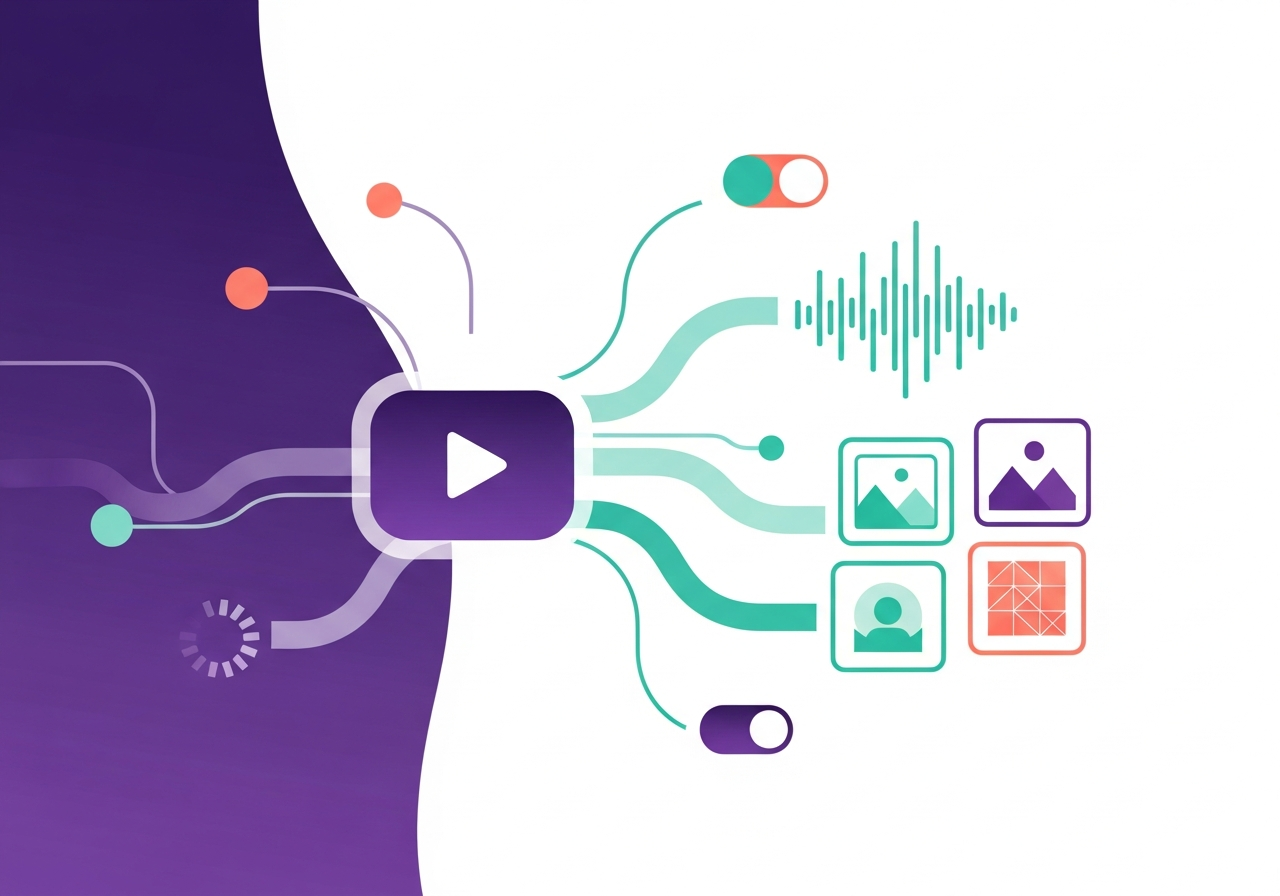
The argument of this piece is narrow and specific: treating transcription, translation, voice generation, subtitling, and audio cleanup as one orchestrated system, rather than five tools glued together by an ops team, is what separates an execution layer from a vendor stack. Ollang's multi-agent architecture is built around that distinction.
The stitched-tool tax
Walk through what a "simple" multilingual video project actually requires under the old model. Source audio gets pulled and sent to a transcription service. The transcript gets exported and fed into a translation engine, usually with no awareness of on-screen timing constraints. Translated text goes to a voice generation tool, or to a studio, for dubbing. Subtitle files get built separately, often against a different version of the translated text than the one used for dubbing, because the two workflows diverged the moment they left the transcription step. Quality control happens at the end, when it's most expensive to fix anything, because that's the first point where anyone looks at the whole asset instead of one slice of it.
Each handoff is a place where context is lost. A translation engine that never sees the audio does not know a line is being read by a stressed character versus a calm narrator. A dubbing studio working from a static script does not know the subtitle team revised a line for length after the voice track was recorded. None of this is a failure of any individual vendor. It happens when quality has to survive five separate systems of record instead of living in one.
One execution layer, not five point tools
Ollang's model treats the video and audio pipeline as a single orchestrated system where a multi-agent architecture dynamically selects specialized models for each task, including transcription, translation, and voice generation, rather than routing everything through one generic pipeline and hoping it holds up across languages and content types. The distinction matters operationally: a generic pipeline optimizes for the average case, which means it underperforms on the cases that actually cost a media team money, dense technical narration, overlapping dialogue, accented source audio, and culturally specific idiom in a dub script.
This orchestration sits between a content team's existing systems and the languages they need to ship into, invoked the way infrastructure gets invoked rather than the way a vendor portal gets used. Ollang's developer-facing access includes an API for building end-to-end localization pipelines, an MCP-style layer that lets AI agents run workflows directly, an SDK for applying translations inside existing systems, and a project workspace for teams that need visual oversight rather than code-level integration. Teams can use MCP to run agent workflows, SKILLS for reusable agent actions, the SDK to apply translations inside systems, and the API to build end-to-end pipelines.
What that changes operationally is that a content team stops treating localization as a series of tickets filed against different vendors and starts treating it as a call in a pipeline. Ship translated content through APIs, MCP, automation, and CI/CD pipelines, and localization runs inside the deployment workflow you already trust. A video platform's publishing pipeline can trigger transcription, translation, and dub generation as one job rather than four separate ones coordinated by a project manager checking in on five vendor dashboards.
Ready to see Ollang in action?
Talk to our team about your localization goals and see how the Ollang platform fits your workflow.
Audio prep is not a footnote, it's where accuracy gets decided
Every downstream step in a video localization pipeline inherits the quality of the source audio. A transcript built from a noisy recording carries errors into the translation step. A dub built on top of an unclear vocal track carries artifacts into the final mix. Media teams that treat audio cleanup as an optional pre-step choose to compound errors rather than prevent them.
Ollang built vocal isolation and noise cleanup into its pipeline for exactly this reason, rather than treating it as a separate tool a client has to run before uploading. As Ollang's team described the workflow: for video or audio content, we isolate vocals, clean up background noise, and prepare the audio tracks for dubbing or voice-over. The rationale is direct, localization workflows often involve poor-quality audio, overlapping speech, and scattered toolchains, slowing down production and impacting output quality, so Ollang integrated audio preparation into its pipeline to isolate vocals, clean up noisy tracks, and speed transcription, dubbing, and accessibility features. Ollang reports measurable effects: cleaner audio led to more accurate subtitles and dubbing, faster turnaround times, and better accessibility.
This is the part of the stack that rarely gets discussed in vendor comparisons, because it's unglamorous. A transcription model asked to work against a clean, isolated vocal track produces a meaningfully better first-pass transcript than one working against raw source audio with room noise, music beds, and overlapping speakers. Every error avoided at the transcription stage is an error that never has to be caught, and paid for, at review.
Hybrid dubbing: AI speed, human judgment, studio finish
Full automation is not the argument here, and Ollang does not position it that way. The dubbing workflow is explicitly hybrid: AI handles first-pass translation and voice generation at a scale no manual process can match, and native-speaking reviewers together with studio dubbing artists refine tone, idiom, and delivery before anything ships. This is a deliberate division of labor: AI handles the first pass at scale, native reviewers and studio artists ensure relevance and natural delivery, and the workflow gives teams control over what ships.
For a Head of Content, the practical implication is that AI-first dubbing makes native review sustainable at volume. A reviewer working from a strong AI first pass is editing, not originating, which is a faster and more consistent task than translating from scratch under deadline pressure.
Case in point: 12,000+ minutes, 18 languages, one workflow
The clearest illustration of what this looks like in production is a subtitled video project that ran 12,000+ minutes localized across 18 languages, moving through AI first-pass translation, native-speaking review, and automated delivery as a single tracked workflow rather than eighteen parallel vendor relationships. Ollang reports that an AI-plus-human workflow reduced localization time and cost on high-volume content, while keeping native-speaking review.
The operational detail worth noting is not the volume alone, plenty of vendors can claim large minute counts. It is that status, review assignment, and delivery for all 18 languages sat inside one system that a content team could see into, rather than requiring someone to reconcile spreadsheets from separate vendor portals to know where any given language stood. Track status, bottlenecks, and delivery across teams and languages, managing localization from a single workflow instead of disconnected tools and vendors.
Ready to see Ollang in action?
Talk to our team about your localization goals and see how the Ollang platform fits your workflow.
What this means for how content teams operate
The operational shift for a content team is less about any single feature and more about where the coordination burden sits. In a stitched-tool setup, the coordination work, chasing status, reconciling versions, catching drift between the dub script and the subtitle file, falls on the content team or their project manager. In an orchestrated execution layer, that coordination is a property of the system itself: one job, one set of assets, one review thread, one delivery point back into the CMS or video platform that originated the request.
That is the actual argument for treating video, audio, and live content localization as infrastructure rather than a set of services procured separately. Subtitles were never the hard part. Keeping five systems honest with each other at the volume enterprise media operations actually run at was. An execution layer that orchestrates transcription, translation, voice generation, and audio preparation as one system does more than make each step faster, it removes the seams where quality used to leak out.
Published on August 29, 2026