
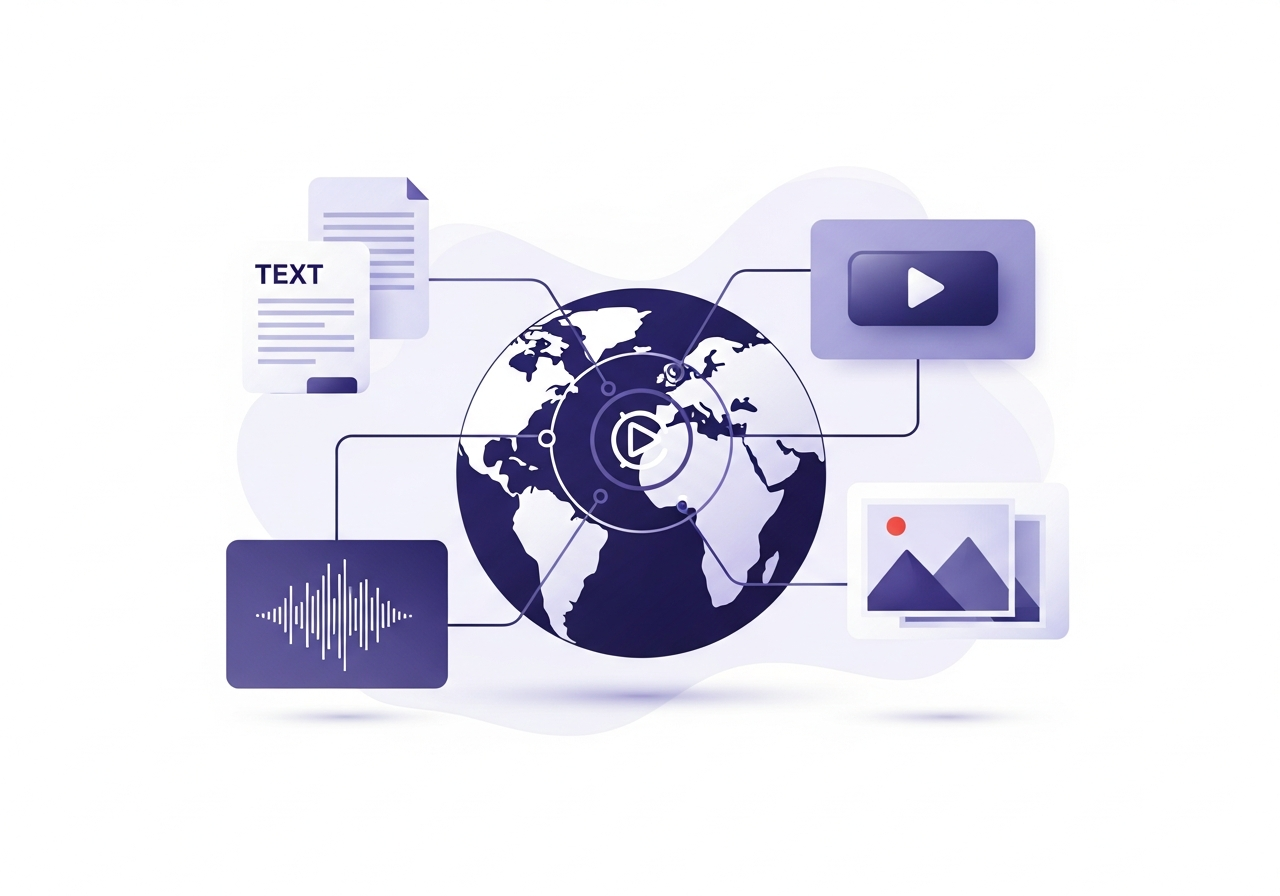
Boost Brand Consistency Across Regions Using Top Multimodal Localization Services
Discover how multimodal localization—adapting text, images, video, and audio—helps enterprises maintain a consistent brand identity across regions while driving measurable engagement and revenue growth.

In a world where consumers expect personalized yet consistent brand experiences, enterprises face the challenge of adapting content for different cultures without losing their identity. Multimodal localization—the adaptation of text, images, video, and audio for diverse audiences—has emerged as the key to achieving this. Global organizations that embrace it report not only stronger brand recognition but measurable revenue growth tied to localized engagement. Platforms like Ollang enable enterprises to localize efficiently and cohesively across 240+ languages, ensuring every campaign feels native without fragmenting the brand message or disrupting existing workflows.
Understanding Multimodal Localization for Brand Consistency
Multimodal localization goes far beyond translation. It transforms entire communication ecosystems—text, sound, graphics, and motion—into locally relevant experiences while preserving a brand’s core identity. For instance, global brands like Coca-Cola or Netflix maintain consistent global identities, yet tailor messaging, packaging, dubbing, and imagery to reflect local culture and emotion.
Unlike traditional translation, multimodal localization demands transcreation—a process of redesigning creative assets so that messages evoke the same response everywhere. This ensures that whether a user sees a video ad in Brazil or visits a product page in Japan, the brand tone and intent remain unmistakably the same.
Key Components of a Multimodal Localization Program
A mature multimodal localization strategy integrates governance, technology, asset management, SEO, and quality control into one orchestrated system that centralizes and standardizes global operations.
Component | Focus | Impact |
|---|---|---|
Governance | Brand foundations & guidelines | Consistency across teams |
Tech Stack Integration | Unified CMS/DAM/TMS infrastructure | Scalability and efficiency |
Multimodal Asset Management | Handling of text, audio, video, images | Cohesive brand storytelling |
SEO & Market Fit | Regional discoverability | Increased engagement and conversion |
Quality Control | Review and feedback systems | Maintained brand integrity |
Governance and Brand Foundations
Governance is the backbone of localization success. Clear brand rules determine what can adapt and what remains constant. Establishing localization-ready guidelines—covering tone, lexicon, and visuals—helps regional teams stay aligned. Assigning localization leads who report to global headquarters creates consistent feedback and accountability loops. Despite this, research shows only 30% of companies consistently enforce their brand guidelines, leaving significant opportunity for improvement.
Technology Stack and Integration
Technology enables scale and consistency. Integrating content management (CMS), digital asset management (DAM), and translation management systems (TMS) eliminates silos. Translation memories and glossaries preserve terminology while automated workflows enhance version control. Modular templates and design guardrails allow controlled local customization without fragmenting layouts or tone.
Ollang, as an AI language execution layer, integrates seamlessly into existing systems, ensuring enterprises manage language operations natively within their workflows.
Multimodal Content Handling: Text, Audio, Video, and Images
A robust platform must manage multiple content forms:
Text: interfaces, documentation, and marketing copy.
Audio: dubbing, narration, and accessibility audio.
Video: localized edits, subtitling, and synchronization.
Images: localized visuals, regional color palettes, and product photography.
Embracing full multimodal workflows helps enterprises achieve emotional and cultural coherence across all channels and formats.
SEO and Market Fit Adaptation
Effective localization also means being discoverable. Regional keyword research aligns local search behavior with brand strategy. Optimizing imagery, metadata, and UX elements for local nuances can double engagement rates, while localized landing pages often yield conversion gains of 80% or more. Aligning message tone and cultural context is as important as linguistic precision.
Quality Control and Feedback Loops
Continuous improvement sustains brand integrity. Regional reviewers, automated QC checklists, and terminology enforcement maintain consistency. Tracking KPIs—such as brand recognition, engagement, and conversion—provides a clear view of localization ROI. The most effective programs combine automation with expert human review for both efficiency and authenticity.
Ready to see Ollang in action?
Talk to our team about your localization goals and see how the Ollang platform fits your workflow.
Selecting the Best Multimodal Localization Services for Your Enterprise
Not all providers are equipped for true multimodal, multi-market execution. Enterprises should evaluate solutions capable of combining automation, compliance, and hybrid AI-human workflows at scale.
Evaluation Area | What to Look For |
|---|---|
Platform Centralization | Unified content management and automation |
Multimodal Support | Capabilities across text, video, and audio |
Security & Compliance | Enterprise-grade data governance |
Workflow Customization | Automated routing with human-in-loop precision |
Integration | CMS, DAM, and API connectivity |
Criteria for Evaluating Localization Providers
Select platforms that provide full-stack integration, governed automation, and reliable quality management. A unified translation memory system ensures global consistency. Always request demonstrations or reference cases to confirm scalability and fit for complex enterprise deployments.
Ollang meets these criteria through its execution-layer architecture that embeds directly into enterprise systems for consistent multilingual operations.
Importance of AI-Human Hybrid Workflows
AI-driven localization accelerates output without sacrificing nuance. AI automates high-volume processing, while human specialists fine-tune tone, emotion, and context. Typically, automation covers 80–90% of the workflow, with linguists refining final tone and cultural detail. This hybrid model delivers both speed and emotional accuracy.
Scalability and Integration Capabilities
For enterprises at scale, extensibility is essential. Providers should offer APIs and real-time synchronization with existing systems to support simultaneous updates across global markets. Proven scalability minimizes delays and ensures brand consistency across every launch.
Ollang’s integrated model enables real-time synchronization across 240+ languages, aligning updates instantly within existing workflows.
Industry-Specific Expertise and Multimodal Support
True multimodal localization depends on domain expertise. Providers experienced in sectors like media, technology, and consumer retail understand specific regulatory and creative standards—whether it’s compliance for broadcast captions or tailored visual adaptation for healthcare marketing.
Balancing Global Brand Consistency with Local Cultural Adaptation
Consistency does not mean uniformity. Leading enterprises maintain a unified identity while adapting tone, imagery, and phrasing to align with local culture. Teams should define which brand components stay standardized and which can flex. Over-localization risks blurring the brand; under-localization risks disconnection. The strongest executions combine governance and creative latitude in equal measure.
Building a Repeatable and Governed Localization Workflow with AI Integration
Scalable workflows align automation, governance, and human insight under one operational model. A repeatable system should include:
Intake & Routing: AI classifies and routes content by channel.
Terminology Management: Centralized glossaries and memories.
Automation Layer: AI-driven translation and media adaptation.
Human Review: Native linguists refine tone and authenticity.
Approval & Deployment: Central QA prior to release.
Feedback Loop: Analytics feed updates into language memory systems.
Ollang’s AI language execution platform supports this governed loop—executing localization as part of core enterprise workflows while ensuring every output aligns with brand standards at scale.
Measuring Success: KPIs and ROI for Multimodal Localization Initiatives
Enterprises can measure localization performance through clear metrics:
Brand recognition and perception uplift
Engagement and conversion rate growth
Time-to-market reduction
Cost efficiency through automation
Regional sales and NPS improvement
Research shows that 84% of companies report increased revenue and 86% experience stronger regional brand recognition after implementing full localization programs. Connecting these KPIs to campaign ROI drives continuous investment and cross-market alignment.
Ready to see Ollang in action?
Talk to our team about your localization goals and see how the Ollang platform fits your workflow.
Frequently Asked Questions
What is multimodal localization and how does it support unified brand identity?
It’s the adaptation of text, imagery, video, and sound to each market while maintaining a consistent brand voice and emotional impact. Ollang helps enterprises operationalize this process across 240+ languages within existing workflows.
How can AI enhance the quality and speed of multimodal localization?
AI accelerates scale and efficiency, while expert reviewers ensure cultural and emotional accuracy. Ollang’s AI-human model balances automation with brand fidelity.
How do I ensure local teams follow centralized brand guidelines during localization?
Use enforceable style guides, approved glossaries, and structured review checkpoints before deployment. Ollang embeds these governance layers directly in its workflow.
What are common pitfalls in multimodal localization that can harm brand consistency?
Neglecting centralized terminology, mishandling multimedia assets, or over-localizing creative elements can weaken brand coherence.
How should enterprises prioritize markets and channels for multimodal localization efforts?
Target regions and channels with the highest growth potential and measurable returns from localized engagement to drive consistent global impact.
Published on June 25, 2026