
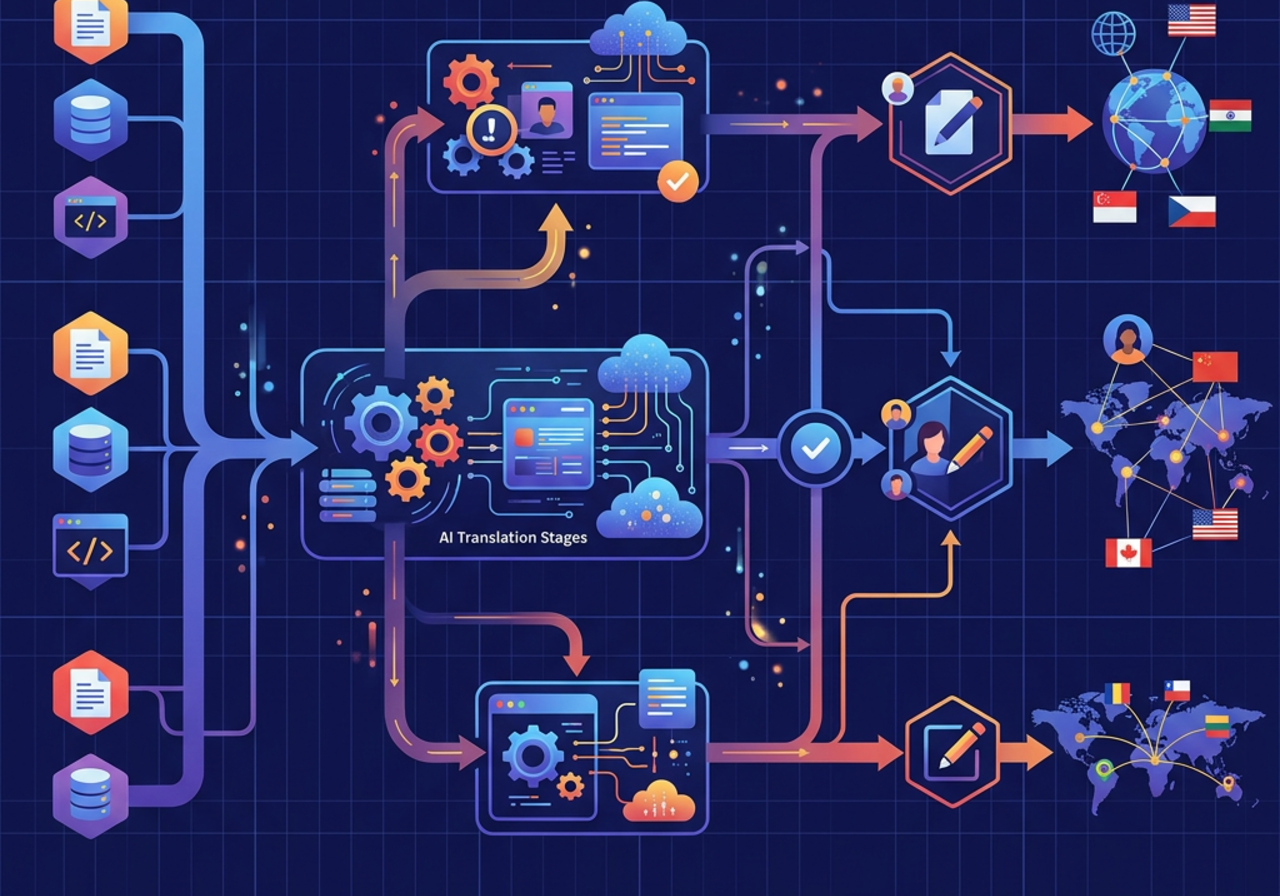
Build an End-to-End AI Localization Workflow for Enterprises
A concrete blueprint for building an end-to-end AI localization pipeline at enterprise scale: content tiering, engine selection, human-in-the-loop checkpoints, quality measurement, and the operational scaffolding to ship localized text, video, and audio reliably.

Most enterprise localization programs stall not because of missing technology, but because no one can answer a deceptively simple question: where do we start? Teams face a sprawl of content types, product UI strings, marketing pages, training videos, legal documents, each with different risk profiles, update cadences, and quality expectations. Layering AI into this landscape without a clear workflow design leads to inconsistent output, compliance gaps, and stakeholder distrust. This guide gives localization leaders a concrete blueprint for building an end-to-end AI localization pipeline. It covers content tiering, engine selection, human-in-the-loop checkpoints, quality measurement, and the operational scaffolding needed to ship localized content reliably across text, video, and audio at enterprise scale.
How to Map and Tier Your Enterprise Content Inventory
Before selecting any AI model or vendor, you need a complete picture of what you are localizing and how much risk each content type carries. Skipping this step is the single most common reason AI localization pilots fail to scale.
Cataloging Content Types, Volumes, and Update Cadences
Start by building a content inventory spreadsheet or pulling data from your CMS, code repositories, and DAM systems. For each content asset, capture:
- Content type, UI strings, help articles, marketing landing pages, legal terms, product videos, e-learning audio, press releases
- Source language and target languages, including regional variants
- Word or minute count, for throughput planning
- Update frequency, static, quarterly, weekly, continuous deployment
- Current translation method, human-only, hybrid, untranslated
Most enterprises discover that a surprisingly large share of their content has never been localized at all. Documenting this gap early sets realistic expectations with stakeholders and helps prioritize where AI-driven localization will deliver the fastest return.
Assigning Risk and Impact Tiers to Prioritize Automation
Not all content deserves the same quality investment. A three-tier model is effective for most organizations:
| Tier | Risk Level | Examples | Recommended Approach |
|---|---|---|---|
| Tier 1 | High | Legal contracts, regulatory filings, safety labels | AI draft + full human review and sign-off |
| Tier 2 | Medium | Marketing pages, help center articles, product UI | AI translation + targeted human post-editing |
| Tier 3 | Low | Internal knowledge base, community forums, user-generated content | AI translation + automated QA checks, spot sampling |
Tier assignment should factor in regulatory exposure, brand sensitivity, revenue impact, and audience size. A pharmaceutical label and a Slack channel update do not belong in the same workflow. This tiering directly drives your human-in-the-loop design, quality sampling rates, and SLA commitments, all covered in later sections.
Selecting the Right AI Engines: MT, ASR, and TTS
Engine selection is not a one-time decision; it is a routing strategy. Different content types, language pairs, and quality tiers demand different models.
Evaluating Machine Translation Models for Enterprise Use
Modern neural machine translation (NMT) engines vary significantly in quality across language pairs and domains. Providers such as Google Cloud Translation, DeepL, and Amazon Translate each have strengths in different language families. According to Intento's 2024 State of Machine Translation report, no single MT engine wins across all language pairs, the quality gap between the best and worst engine for a given pair can exceed 10 BLEU points.
Key evaluation criteria include:
- Language pair coverage, especially for lower-resource languages
- Domain adaptability, can the engine be fine-tuned or prompted with glossaries?
- Data privacy, does the provider retain input data for model training?
- API throughput and latency, critical for continuous deployment pipelines
- Output format preservation, handling of HTML tags, placeholders, and markup
Run blind evaluations on representative samples from each content tier before committing. Use at least 200 segments per language pair, scored by qualified linguists against your brand guidelines. Platform orchestration is important: Ollang can route requests among multiple MT providers so you pick the best engine per pair or tier without building bespoke middleware.
When to Use ASR and TTS for Video and Audio Localization
Automatic speech recognition (ASR) and text-to-speech (TTS) extend the pipeline to multimedia content. ASR converts source audio into transcripts for translation, while TTS generates localized voiceovers from translated scripts.
For ASR, evaluate word error rate (WER) on your actual audio, accented speech, domain-specific terminology, and background noise all degrade accuracy. Whisper (OpenAI) and cloud ASR services from Google and Azure are common starting points, but enterprise audio with technical jargon often requires prompt engineering or vocabulary boosting.
For TTS, naturalness and voice consistency matter more than raw accuracy. Evaluate cloned or custom voices against your brand's audio identity. Pay attention to prosody in languages with tonal distinctions (Mandarin, Vietnamese, Thai) and to lip-sync requirements for dubbed video content.
Ollang integrates with ASR and TTS providers and can centralize vocabulary boosting and voice selection so multimedia pipelines remain consistent across languages and releases.
Model Routing: Matching Engines to Content Tiers
Rather than sending everything through one engine, implement a model routing layer that directs content based on tier, language pair, and content type. A practical routing table might look like this:
| Content Tier | Content Type | Engine Selection Logic |
|---|---|---|
| Tier 1 | Legal documents | Best-quality MT for the pair + mandatory full human review |
| Tier 2 | UI strings | Adaptive MT with glossary enforcement + post-editing |
| Tier 2 | Marketing copy | LLM-based translation with brand tone prompts + human review |
| Tier 3 | Support articles | High-throughput MT + automated QA |
| Tier 2 | Training videos | ASR → MT → TTS pipeline + human QA on final audio |
This routing logic should be codified in your pipeline configuration, not left to ad hoc decisions by project managers. Use a platform that enforces routing rules in production so operators cannot bypass tiering during peaks.
Designing Human-in-the-Loop Checkpoints
AI localization without human oversight is a liability. The question is not whether humans should be involved, but where their involvement has the highest leverage.
Terminology, Style, and Brand Safety Gates
Three categories of error warrant dedicated human checkpoints:
- Terminology accuracy, Does the translation use approved product names, feature labels, and industry terms? Glossary enforcement at the engine level catches many issues, but human reviewers must validate new terms and edge cases.
- Style and tone, Marketing content, executive communications, and customer-facing UI require adherence to brand voice guidelines that vary by locale. Automated style checks can flag deviations, but nuanced tone decisions need human judgment.
- Brand safety, Culturally inappropriate phrasing, unintended double meanings, and visual-text mismatches in video content require reviewers with deep cultural fluency in the target market.
Design these as explicit gates in your workflow, not optional steps. Each gate should have a named owner, a defined turnaround SLA, and a clear escalation path.
Defining Reviewer Roles and Escalation Paths
A clear RACI matrix prevents confusion about who reviews what:
| Role | Responsibility |
|---|---|
| AI Engine | Produces initial translation or transcription |
| Post-Editor | Corrects fluency, accuracy, and terminology for Tier 2 content |
| Senior Linguist | Full review of Tier 1 content; resolves terminology disputes |
| In-Market Reviewer | Validates cultural appropriateness and brand safety |
| Localization PM | Monitors SLAs, manages escalations, approves final delivery |
| Content Owner | Signs off on Tier 1 releases; accountable for regulatory compliance |
Escalation should flow upward by severity: a minor fluency issue is resolved by the post-editor, a terminology conflict goes to the senior linguist, and a brand safety concern reaches the content owner. Document these paths before launch, not after the first incident.
Prompt Engineering and Glossary Strategies for Consistent Output
The quality ceiling of AI-generated translations is set largely by what you feed the model. Prompt design and glossary management are not afterthoughts, they are core infrastructure.
Crafting Effective Prompts for Translation and Transcreation
For LLM-based translation (increasingly used for marketing and creative content), prompts should specify:
- Source and target language, including regional variant (e.g., Brazilian Portuguese vs. European Portuguese)
- Content type and register (formal legal, casual marketing, technical documentation)
- Brand voice descriptors (e.g., "confident but not aggressive, concise, second-person address")
- Handling instructions for untranslatable elements (brand names, product codes, URLs)
- Example translations that demonstrate desired style
Version-control your prompts alongside your codebase. Prompt drift, small, undocumented changes over time, is a real source of quality inconsistency. Treat prompts as production assets with review and approval workflows.
Building and Maintaining Enterprise Glossaries and Translation Memories
Glossaries enforce term consistency across engines and reviewers. A well-maintained glossary includes:
- Approved term in source and each target language
- Forbidden alternatives (terms that must not be used)
- Context notes and usage examples
- Domain tags (legal, marketing, UI)
Translation memories (TMs) remain valuable even in AI-first workflows. They provide leverage for repetitive content (UI strings, boilerplate legal clauses) and serve as training data for adaptive MT engines. Import legacy TMs, but audit them first, outdated translations degrade quality rather than improve it.
Sync glossaries and TMs to your localization platform so that every engine and reviewer works from the same source of truth. Ollang natively integrates glossaries and TMs across workflows, ensuring consistency whether content flows through MT, LLM-based transcreation, or human review.
Ready to see Ollang in action?
Talk to our team about your localization goals and see how the Ollang platform fits your workflow.
Connecting the Pipeline: CMS, Repositories, and API Integration
A localization workflow that requires manual file handoffs will not survive contact with continuous deployment. Connectors and APIs are what make the pipeline real.
Integrating with CMS Platforms and Code Repositories
Your pipeline should pull source content automatically from wherever it lives, whether that is a headless CMS like Contentful, a documentation platform like Confluence, a code repository on GitHub or GitLab, or a marketing automation tool like HubSpot. Key integration requirements:
- Automated source detection, new or changed content triggers localization jobs without manual intervention
- Format preservation, the connector must handle the source format (Markdown, HTML, JSON, XLIFF, SRT) without corrupting markup or structure
- Bidirectional sync, translated content flows back to the source system and is published or merged automatically
- Branch and version awareness, for software localization, translations should track the correct branch or release
If you are evaluating platforms, book a demo with Ollang to see how its translation API integration connects to your existing content infrastructure without requiring custom middleware. Prebuilt connectors shorten integration work and make continuous localization reliable: https://ollang.com/book-a-demo
Privacy Guardrails and Data Residency Requirements
Enterprise content often contains personally identifiable information (PII), trade secrets, or data subject to residency regulations like GDPR or China's PIPL. Your pipeline must address:
- Data routing, ensure content is processed in compliant regions; some MT APIs route data through servers in jurisdictions your legal team has not approved
- PII detection and redaction, automatically identify and mask PII before sending content to external engines, then reinsert after translation
- Data retention policies, confirm that MT and ASR providers do not retain your input data for model improvement unless you have explicitly opted in
- Audit logging, maintain a record of what content was sent where, when, and by whom
These are not optional for regulated industries. Build privacy checks into the pipeline architecture from day one, not as a retrofit after a compliance audit. Look for platforms that provide configurable data routing, redaction, and audit logging to meet enterprise requirements.
Measuring Quality: MQM, COMET, TER, and Sampling Plans
You cannot manage what you do not measure. Enterprise localization demands both automated metrics and structured human evaluation.
Understanding Key Quality Metrics
Three metrics form the backbone of most enterprise quality programs:
- MQM (Multidimensional Quality Metrics), the industry standard framework for human quality evaluation, developed by DFKI and QT21. MQM categorizes errors by type (accuracy, fluency, terminology, style) and severity (critical, major, minor). It produces a weighted error score per thousand words, enabling apples-to-apples comparison across languages and content types.
- COMET, a neural, reference-based automatic metric that correlates more closely with human judgment than older metrics like BLEU. COMET scores are useful for regression testing: if a model update or prompt change causes COMET to drop, investigate before shipping.
- TER (Translation Edit Rate), measures the number of edits a human post-editor makes to an MT output. TER is a practical proxy for productivity: lower TER means less human effort, which directly affects cost and turnaround time.
Use automated metrics (COMET, TER) for continuous monitoring and MQM for periodic deep-dive evaluations and vendor benchmarking.
Designing Sampling Plans and Rollback Paths for High-Risk Content
You cannot human-review every segment at scale. A risk-based sampling plan balances quality assurance with throughput:
| Content Tier | Sampling Rate | Method | Rollback Trigger |
|---|---|---|---|
| Tier 1 | 100% | Full MQM review | Any critical error |
| Tier 2 | 10-20% | Stratified random sample, MQM scoring | MQM score exceeds threshold (e.g., >15 penalty points per 1,000 words) |
| Tier 3 | 2-5% | Automated QA + spot human check | Automated QA failure rate exceeds defined limit |
Rollback paths must be defined before content goes live. For software UI, this means the ability to revert to the previous translation version within minutes. For published marketing content, it means having the prior approved version staged and ready. For video and audio, maintain the previous rendered file alongside the new one until the review window closes.
Document the rollback trigger, the responsible party, and the maximum time-to-revert for each tier.
Throughput Planning, SLAs, and the Release Calendar
Operational reliability separates a pilot from a production system. Leaders need clear math on capacity and clear commitments on delivery.
Throughput Math: Calculating Capacity Across Content Types
Build a throughput model that accounts for every stage of the pipeline:
- Source content volume, words per week (text), minutes per week (audio/video)
- MT/ASR processing speed, most cloud MT APIs process thousands of words per second; ASR is typically near-real-time but varies with audio quality
- Human review capacity, a skilled post-editor handles roughly 3,000-5,000 words per day for Tier 2 content; full review for Tier 1 is slower, around 2,000-3,000 words per day
- QA and sign-off cycle time, factor in reviewer availability, time zone differences, and approval workflows
Multiply language count by per-language effort to get total pipeline capacity. If your product ships UI updates weekly across 30 languages with 5,000 new words per release, you need roughly 150,000 words of post-editing capacity per week for Tier 2 content alone. Plan headcount and vendor capacity accordingly.
Setting SLAs and Building a Continuous Localization Calendar
Define SLAs for each tier and content type:
| Content Tier | Turnaround SLA | Quality Target |
|---|---|---|
| Tier 1 | 5 business days | MQM score ≤ 5 penalty points per 1,000 words |
| Tier 2 | 2 business days | MQM score ≤ 15; TER ≤ 25% |
| Tier 3 | Same day | Automated QA pass rate ≥ 95% |
Build a release calendar that synchronizes localization delivery with product releases, marketing campaigns, and regulatory deadlines. For continuous deployment environments, localization should be triggered by CI/CD events, a merged pull request or a published CMS entry, not by a project manager sending an email.
The calendar should include buffer time for Tier 1 review cycles and clearly mark blackout periods (holidays in target markets, regulatory filing deadlines) that affect reviewer availability.
Building Your RACI and Launch Checklist
A workflow without clear ownership is just a diagram. Formalize accountability before you launch.
The Enterprise Localization RACI Matrix
| Activity | Responsible | Accountable | Consulted | Informed |
|---|---|---|---|---|
| Content inventory and tiering | Localization PM | VP Content/Product | Legal, Marketing | Engineering |
| Engine selection and routing | Localization Engineer | Localization PM | Security, Procurement | Content Owners |
| Glossary and TM management | Terminologist | Localization PM | Subject Matter Experts | Reviewers |
| AI translation/transcription | AI Engine (automated) | Localization Engineer | , | Localization PM |
| Post-editing (Tier 2) | Post-Editor | Localization PM | Terminologist | Content Owner |
| Full review (Tier 1) | Senior Linguist | Content Owner | Legal | Localization PM |
| Quality measurement and reporting | QA Lead | Localization PM | Post-Editors | VP Content/Product |
| Pipeline integration and maintenance | Engineering | Localization Engineer | CMS/DevOps team | Localization PM |
| Privacy and compliance | Security/Legal | CISO/DPO | Localization Engineer | All |
Pre-Launch Checklist
Before going live, confirm every item:
- Content inventory completed and tiers assigned for all content types and language pairs
- MT, ASR, and TTS engines evaluated, selected, and routing rules configured
- Glossaries and TMs imported, validated, and synced to the platform
- CMS and repository connectors tested with bidirectional sync confirmed
- PII detection and data residency controls verified by security team
- Human review workflows configured with named reviewers, SLAs, and escalation paths
- Quality metrics baselined (initial COMET and MQM scores established)
- Sampling plans and rollback procedures documented and tested
- Throughput model validated against actual reviewer capacity
- Release calendar published and aligned with product and marketing schedules
- Stakeholder training completed for content owners, reviewers, and PMs
- Monitoring dashboards live for pipeline health, queue depth, and quality trends
Frequently Asked Questions
How long does it take to stand up an enterprise AI localization pipeline?
A realistic timeline is 8 to 14 weeks from kickoff to first production content, assuming the content inventory and tiering work takes 2 to 3 weeks, engine evaluation and integration takes 4 to 6 weeks, and the human review workflow setup and testing takes 2 to 4 weeks. Pilots with a single content type and a handful of languages can launch faster; full-scale rollouts across dozens of languages and multiple content types take longer. The most common delays are not technical, they stem from unclear ownership, glossary gaps, and slow legal review of data processing agreements. With focused pilots and prebuilt connectors, platforms like Ollang commonly hit the faster end of this range.
Can AI localization handle regulated content like legal documents?
Yes, but only with appropriate safeguards. Legal and regulatory content should be classified as Tier 1, meaning AI produces a draft that undergoes full human review by a qualified linguist and sign-off by the content owner or legal team. Automated quality checks should flag critical terminology errors before human review begins. Data privacy controls, including PII redaction and compliant data routing, are non-negotiable for this content class.
How do we measure whether AI localization is actually saving money?
Track three metrics over time: cost per word (or cost per minute for audio/video), turnaround time from source-ready to target-published, and quality scores (MQM, COMET). Compare these against your pre-AI baseline. Most enterprises see meaningful cost reduction on Tier 3 content almost immediately, with Tier 2 savings growing as glossaries mature and post-editing effort (measured by TER) decreases. Tier 1 content rarely shows dramatic cost savings, but turnaround time improvements are common.
What happens when AI translation quality drops unexpectedly?
Your pipeline should include automated quality monitoring (COMET score tracking, automated QA rule checks) that triggers alerts when scores fall below defined thresholds. When an alert fires, the rollback procedure activates: revert to the previous approved translation, quarantine the affected batch, and investigate the root cause, which is typically a model update by the MT provider, a prompt change, or a glossary error. Document every incident and update your routing or prompt configuration to prevent recurrence.
Ready to see Ollang in action?
Talk to our team about your localization goals and see how the Ollang platform fits your workflow.
Start Building Your Pipeline
Standing up an enterprise AI localization workflow is an engineering and organizational challenge, not just a technology purchase. The blueprint above gives you the structure, content tiering, engine routing, human checkpoints, quality metrics, throughput planning, and clear accountability, to move from pilot to production with confidence.
If you are ready to operationalize this framework across text, video, audio, software, and legal content, book a demo with Ollang to see how the platform connects to your content systems, routes content to the right engines, and keeps human reviewers in the loop where it matters most: https://ollang.com/book-a-demo
Published on July 28, 2026