
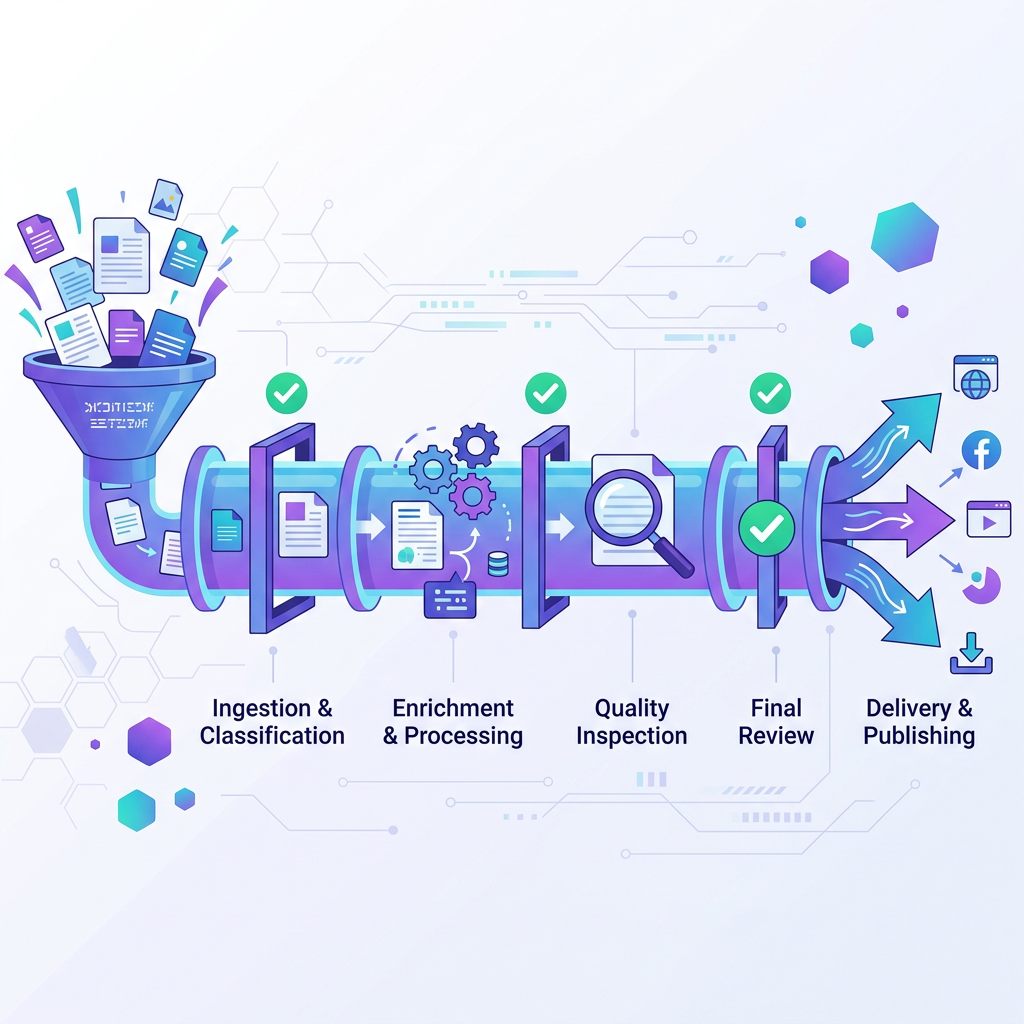
Build an End-to-End AI Localization Workflow: Ingest to QA
A hands-on blueprint for the connective tissue of enterprise localization: ingestion triggers, routing logic, quality gates, and delivery handoffs that turn a good translation engine into a reliable end-to-end pipeline from ingest to QA.

Most enterprise localization programs don't fail because the translation engine is bad. They fail because nobody designed the connective tissue, the ingestion triggers, the routing logic, the quality gates, the delivery handoffs. Teams bolt AI translation onto legacy processes and wonder why turnaround times barely improve while error rates climb. This article provides a complete blueprint for an enterprise-ready AI localization workflow, from the moment source content enters the pipeline to the moment localized assets land in their target systems. You'll learn how to structure ingestion, configure processing layers, calibrate human-in-the-loop checkpoints by content risk, define measurable quality gates, and build the governance scaffolding that keeps everything accountable at scale.
Why Enterprises Need a Structured AI Localization Pipeline
Scaling localization beyond a handful of languages or content types without a structured pipeline creates compounding chaos. Marketing teams submit requests via email, engineering pushes strings through a different channel, legal sends contracts as PDFs with no metadata, and each stream gets handled ad hoc.
The consequences are predictable: duplicated translation effort, inconsistent terminology, missed deadlines, and quality that varies wildly between content types. According to CSA Research, enterprises managing more than 20 target languages often see localization costs grow faster than content volume when workflows remain manual and fragmented.
A structured AI localization pipeline solves this by creating a single, observable system of record. Content enters through defined ingestion points, gets classified and routed automatically, passes through the right combination of machine and human processing, and exits through validated delivery channels. Every step is logged, every decision is traceable, and every quality threshold is enforced programmatically rather than by hope.
From Manual Handoffs to Orchestrated Automation
The shift from manual handoffs to orchestrated automation isn't about removing people. It's about removing ambiguity. In a manual workflow, a project manager decides which translator gets a file, which reviewer checks it, and when it's "good enough" to ship. Those decisions live in someone's head or in a spreadsheet.
In an orchestrated pipeline, routing rules are codified. A marketing blog post in French gets machine-translated with glossary enforcement and routed to a single post-editor. A pharmaceutical label in Japanese gets machine-translated, back-translated, reviewed by a domain specialist, and held for regulatory sign-off. The content's risk tier determines the workflow path automatically, and the project manager's role shifts from traffic cop to exception handler.
This orchestration also unlocks parallelism. Audio transcription, translation, and subtitle formatting can happen concurrently across languages rather than sequentially. When you multiply that efficiency gain across dozens of languages and thousands of assets per month, the impact on turnaround time and cost is substantial.
Where Ollang Fits as the AI Execution Layer
Ollang is the AI execution layer that sits between your content systems and your delivery targets. Rather than replacing your CMS, DAM, or TMS, Ollang connects to them, ingesting content through APIs and connectors, orchestrating the AI and human steps in the middle, and pushing localized output back to the systems that need it.
This means Ollang handles the hard orchestration problems: routing by content type and risk tier, enforcing glossary and style constraints during translation, managing ASR and diarization for audio and video content, gating quality through automated and human checkpoints, and maintaining full audit trails. Whether you're localizing software strings, legal contracts, marketing videos, or live speech, the execution layer adapts the workflow to the content rather than forcing content into a one-size-fits-all process. It provides enterprise-grade connectors, governance, and observability to run localization at scale.
If you're evaluating how this fits your stack, you can request a walkthrough of your specific content types and integration points by using this form: book a demo with Ollang.
Content Ingestion: Connecting Source Systems
Ingestion is the first place most localization workflows break. If content can't enter the pipeline cleanly, with the right metadata, in the right format, at the right time, everything downstream suffers. A well-designed ingestion layer handles three problems simultaneously: it connects to the systems where content lives, it normalizes what it receives, and it captures the metadata needed for intelligent routing.
CMS, Git, DAM, and Cloud Storage Connectors
Enterprise content doesn't live in one place. Marketing copy sits in a CMS like WordPress, Contentful, or Adobe Experience Manager. Software strings live in Git repositories as JSON, XLIFF, or ARB files. Brand assets and media files reside in digital asset management platforms like Bynder or Brandfolder. Large file batches may land in Amazon S3 buckets or Azure Blob Storage.
A production-grade ingestion layer needs connectors for each of these systems, and those connectors need to do more than pull files. They need to:
- Detect changes incrementally, only pulling new or modified content rather than re-ingesting entire repositories
- Preserve structure, maintaining the relationship between a CMS page and its embedded components, or between a Git commit and the specific string keys that changed
- Carry metadata forward, content type, source language, target languages, priority, and any custom fields your workflow needs for routing
Webhook-driven ingestion (triggered when content changes in the source system) is preferable to scheduled polling for most use cases because it reduces latency and avoids unnecessary processing.
Supported File Types: Strings, Documents, Audio, and Video
The ingestion layer must handle a wide range of file types, each with its own parsing requirements:
| Content Category | Common Formats | Key Parsing Considerations |
|---|---|---|
| Software strings | JSON, XLIFF, PO, ARB, YAML, RESX | Preserve placeholders, variables, ICU MessageFormat tokens (e.g., {count, plural, ...}), and key-value structure |
| Documents | DOCX, PDF, HTML, Markdown, IDML | Maintain formatting, styles, tables, and embedded images |
| Subtitles/captions | SRT, VTT, TTML, SSA | Respect timing codes and character-per-line limits |
| Audio | WAV, MP3, FLAC, AAC | Requires ASR before translation; speaker metadata matters |
| Video | MP4, MOV, MKV | May need audio extraction, OCR for on-screen text, and subtitle generation |
| Legal/regulatory | PDF (often scanned), DOCX | Frequently requires OCR; high accuracy thresholds |
A robust ingestion system identifies the file type automatically, selects the appropriate parser, and flags files that can't be parsed cleanly for manual review rather than silently dropping content.
Pre-Processing: Segmentation, OCR, and PII Redaction
Before content reaches the translation engine, it needs pre-processing, and this step is where data quality and compliance are established.
- Segmentation breaks continuous text into translatable units (typically sentences). Good segmentation respects abbreviations, decimal numbers, and language-specific punctuation rules. Poor segmentation, splitting a sentence at "Dr." or "e.g.", creates fragments that machine translation handles badly.
- OCR (optical character recognition) is necessary for scanned PDFs and image-based documents, which are common in legal and regulatory localization. Modern OCR engines achieve high accuracy on clean documents, but handwritten annotations, low-resolution scans, and complex layouts still require human verification. The pipeline should flag OCR confidence scores below a defined threshold.
- PII redaction is a compliance requirement for any content that may contain personal data, names, addresses, account numbers, health information. Redaction should happen before content reaches the translation engine, especially when using cloud-based MT services. The pipeline replaces PII with tokens, translates the tokenized content, and reinserts the original values (or their localized equivalents) after translation. This approach helps satisfy GDPR and HIPAA requirements while preserving translation quality.
Core Processing: Translation, Transcription, and Context
The processing layer is where raw source content becomes localized output. This layer must handle multiple modalities, text, audio, and video, and apply the right combination of machine intelligence and linguistic constraints to each.
ASR and Speaker Diarization for Media Content
Audio and video localization starts with accurate transcription. Automatic speech recognition (ASR) converts spoken audio into text, and speaker diarization identifies who is speaking when. Both are essential for producing accurate subtitles, dubbed scripts, or translated voiceovers.
Modern ASR systems perform well on clear studio audio in major languages, but accuracy drops with background noise, overlapping speakers, heavy accents, and domain-specific terminology. The pipeline should include a confidence scoring step: segments with low ASR confidence get flagged for human transcription review before translation begins. Translating a flawed transcript wastes every downstream step.
Diarization matters because speaker attribution affects translation. In gendered languages, knowing whether Speaker A is male or female changes verb conjugations and adjective agreement. In formal/informal language pairs, knowing the speaker's role (e.g., doctor vs. patient) determines register. The ASR output should tag each segment with a speaker ID and, where possible, speaker metadata.
Machine Translation and LLM-Based Translation with Glossary and TM Leverage
The translation step itself has evolved significantly. Traditional neural machine translation (NMT) engines like Google Translate or DeepL remain strong for high-volume, general-purpose content. Large language models (LLMs) offer advantages for content that requires nuanced tone, creative adaptation, or complex contextual reasoning.
In practice, the best results come from combining both approaches with two critical constraints:
- Glossary enforcement ensures that branded terms, product names, and domain-specific vocabulary are translated consistently. "Cloud storage" should always be "almacenamiento en la nube" in your Spanish output, not a creative alternative. Glossaries are injected into the translation prompt or applied as post-processing rules.
- Translation memory (TM) leverage reuses previously approved translations for identical or similar segments. High-fuzzy matches (segments that are nearly identical to previously translated content) can be pre-filled and routed for lighter review, reducing both cost and turnaround time.
An execution layer like Ollang orchestrates engine selection, enforces glossaries, and applies TM leverage consistently across engines. The pipeline should apply TM matches first, then route remaining segments to MT or LLM translation with glossary constraints applied. This layered approach maximizes consistency and minimizes redundant work.
Context Injection and Tone/Style Control
Translation without context produces technically correct but functionally wrong output. A button label that says "Cancel" could mean "Cancelar" (abort an action) or "Anular" (void a transaction) in Spanish, depending on where it appears in the UI.
Context injection solves this by providing the translation engine with surrounding information: the full paragraph (not just the isolated segment), UI screenshots, content type metadata, and usage notes. LLM-based translation is particularly responsive to contextual prompts, you can specify that a segment is a mobile app button label with a 20-character limit, and the model will adapt accordingly.
Tone and style control extends this further. A brand style guide might specify that marketing content should be warm and conversational in English but formal and authoritative in German. These style parameters can be encoded as system prompts for LLM translation or as post-editing instructions for human reviewers. The key is making style expectations explicit and machine-readable rather than relying on individual translator judgment.
Routing by Content Risk Tier
Not all content deserves the same workflow. A knowledge base article and a pharmaceutical insert have radically different error tolerances, and treating them identically either over-spends on low-risk content or under-protects high-risk content.
Risk-tier routing assigns each piece of content to a workflow path based on its potential impact:
| Risk Tier | Content Examples | Typical Workflow |
|---|---|---|
| Tier 1, Critical | Legal contracts, regulatory filings, medical labels, financial disclosures | MT + human translation + back-translation + specialist review + sign-off |
| Tier 2, High | Marketing campaigns, product UI, customer-facing support docs | MT/LLM translation + post-editing + LQA sampling |
| Tier 3, Standard | Internal comms, knowledge base articles, training materials | MT/LLM translation + automated QE gating + spot-check review |
| Tier 4, Low | Internal chat, developer comments, ephemeral notifications | MT only, no human review |
Risk classification can be automated based on content type, source system, and metadata tags. The routing engine then selects the appropriate processing and review steps for each tier, ensuring that human effort is concentrated where it matters most.
Ready to see Ollang in action?
Talk to our team about your localization goals and see how the Ollang platform fits your workflow.
Human-in-the-Loop and Quality Assurance
AI handles volume. Humans handle judgment. The quality assurance layer defines where and how human expertise enters the pipeline, and what automated systems can gate independently.
MQM-Based Linguistic Quality Assurance
The Multidimensional Quality Metrics (MQM) framework provides a standardized taxonomy for categorizing and scoring translation errors. Rather than a subjective "this sounds off," MQM classifies errors by type (accuracy, fluency, terminology, style, locale convention) and severity (critical, major, minor). See the public documentation at mqm.readthedocs.io.
MQM-based LQA works by having trained reviewers evaluate a statistically significant sample of translated segments against the error taxonomy. Each error is categorized and weighted, producing a composite quality score. This score can be tracked over time, compared across languages and vendors, and used to trigger corrective actions.
For enterprise localization, MQM scoring should feed back into the pipeline: recurring terminology errors trigger glossary updates, systematic fluency issues in a specific language pair trigger MT engine retraining or prompt adjustment, and individual reviewer performance becomes measurable.
Automated Quality Estimation Gating
Not every segment needs human review. Automated quality estimation (QE) models predict translation quality without reference translations, assigning confidence scores to each segment based on features like source complexity, translation fluency, and alignment patterns.
In a well-calibrated pipeline, QE gating works as a filter:
- Segments scoring above a high-confidence threshold pass through without human review
- Segments in a middle band get flagged for lightweight post-editing
- Segments below a low-confidence threshold get routed to full human translation
This approach dramatically reduces the volume of content that requires human attention while maintaining quality thresholds. The key is calibrating the thresholds against your MQM scores, the QE model's confidence predictions should correlate with actual quality outcomes, and those thresholds should be tuned per language pair and content type.
Back-Translation for High-Risk Content
For Tier 1 content, legal, medical, regulatory, back-translation provides an additional safety net. The process translates the target-language output back into the source language using an independent engine, then compares the back-translation against the original source. Significant semantic divergence flags potential errors that forward-only review might miss.
Back-translation is particularly valuable when reviewers are not fluent in the source language (common in regulatory contexts where the domain expert reads only the target language) or when the content contains precise legal or scientific language where even small meaning shifts create liability. It adds cost and time, which is why it's reserved for high-risk tiers, but for regulated content it's often a compliance requirement rather than an optional step.
Defining Review Checkpoints by Content Type
The number and type of review checkpoints should vary by content risk tier and modality:
- Software strings: Automated QE gating + in-context review (seeing the translation rendered in the actual UI) + functional testing for string length and placeholder integrity
- Marketing content: Post-editing for fluency and brand voice + creative review by in-market stakeholders
- Audio/video: Transcript review before translation + subtitle timing and readability review + lip-sync or voiceover quality check for dubbed content
- Legal documents: Full human translation review + back-translation comparison + domain specialist sign-off
Each checkpoint should have a defined owner, a clear pass/fail criterion, and a maximum turnaround time. Checkpoints without owners become bottlenecks; checkpoints without criteria become opinion debates.
Governance, SLAs, and Observability
A localization workflow without governance is a localization experiment. Governance turns a workflow into a system, one that's predictable, measurable, and accountable.
TAT and SLA Modeling
Turnaround time (TAT) commitments should be modeled per risk tier and content type, not as a single blanket SLA. A realistic model accounts for:
- Ingestion and pre-processing time (typically minutes for text, longer for media requiring ASR)
- Translation engine processing time (near-instant for MT, variable for LLM-based translation depending on volume and concurrency)
- Human review queue time (the biggest variable, depends on reviewer availability and content complexity)
- Delivery and integration time
For Tier 3 and Tier 4 content, end-to-end TAT can often be measured in minutes. For Tier 1 content with back-translation and specialist review, TAT may be measured in business days. Setting expectations accurately prevents the chronic over-promising and under-delivering that plagues localization programs.
SLAs should also define escalation paths: what happens when a reviewer misses their window, when QE scores drop below threshold for an entire batch, or when a source system delivers malformed content.
RACI Across Teams
A RACI matrix clarifies who is Responsible, Accountable, Consulted, and Informed for each workflow step. In enterprise localization, the key roles typically span:
| Workflow Step | Responsible | Accountable | Consulted | Informed |
|---|---|---|---|---|
| Content ingestion | Localization engineering | Localization manager | Content owners | , |
| Pre-processing config | Localization engineering | Localization manager | Security/compliance | , |
| Translation/MT | Ollang (AI execution layer) | Localization manager | Linguistic leads | Content owners |
| Post-editing/review | Linguists/reviewers | Linguistic lead | Subject matter experts | Localization manager |
| Quality gating | QA automation + linguistic lead | Localization manager | Product/legal stakeholders | Content owners |
| Delivery to target systems | Localization engineering | Localization manager | Platform/IT teams | Content owners |
The most common governance failure is having no one accountable for quality gating decisions. When automated QE says a batch passes but a stakeholder disagrees, someone needs the authority to make the call, and that authority should be defined before the disagreement happens.
Dashboards, Audit Trails, and Compliance
Observability means being able to answer three questions at any time: Where is my content? What's the quality? Are we on track?
- Dashboards should surface real-time metrics: content volume by language and status, average TAT by tier, QE score distributions, MQM scores over time, and reviewer throughput. These aren't vanity metrics, they're the early warning system that catches problems before they become crises.
- Audit trails record every action taken on every piece of content: who submitted it, when it was ingested, which engine translated it, what glossary version was applied, who reviewed it, what errors were found, and when it was delivered. For regulated industries, audit trails aren't optional, they're the documentation that proves your localization process is controlled and repeatable.
- Compliance controls include PII handling logs, data residency tracking (ensuring content processed in the EU stays in EU-based infrastructure when required), and access controls that limit who can view, edit, or approve content at each stage.
Secure Delivery to Target Systems
The last mile of localization, getting content from the pipeline into the systems where end users consume it, is where many workflows introduce manual steps that negate the automation gains upstream.
Secure delivery means pushing localized content directly back to the source systems through the same connectors used for ingestion: updating CMS pages with translated content, committing localized strings back to Git repositories via pull requests, uploading dubbed audio to the DAM, or syncing subtitle files to the video platform.
Key requirements for the delivery layer:
- Format fidelity: Localized content must match the exact format and structure of the source. A translated XLIFF file with broken XML tags is worse than no translation at all.
- Atomic delivery: All languages for a given content update should be delivered together (or delivery should be gated until all target languages pass QA) to avoid partial updates in production.
- Rollback capability: If a delivery introduces errors, the system should support reverting to the previous version without manual intervention.
- Encryption in transit and at rest: Localized content, especially for legal and financial documents, must be encrypted throughout the delivery process.
Blueprinting Your Workflow: A Step-by-Step Summary
To bring this together, here's the sequence for building your own end-to-end AI localization workflow:
- Map your content sources, identify every system that produces content requiring localization and build or configure connectors for each.
- Define your risk tiers, classify content types by error impact and assign each tier a workflow template with appropriate processing and review steps.
- Configure pre-processing, set up segmentation rules, OCR for scanned documents, and PII redaction policies.
- Set up your translation layer, integrate MT engines and/or LLMs, load glossaries and translation memories, and define style/tone parameters per content type and locale.
- Calibrate quality gates, deploy automated QE with thresholds tuned to your MQM benchmarks, and define human review checkpoints by tier.
- Assign RACI, document ownership for every step, especially quality gating and escalation decisions.
- Model SLAs, set realistic TAT targets per tier, build in buffer for human steps, and define escalation paths.
- Build observability, deploy dashboards, configure audit logging, and establish compliance controls.
- Automate delivery, connect the pipeline's output to your target systems with format validation and rollback capability.
- Iterate, use MQM data, QE calibration metrics, and TAT performance to continuously tune thresholds, glossaries, and routing rules.
Frequently Asked Questions
How do I decide which content needs human review versus full automation?
Start with your risk tiers. Content where errors create legal liability, safety risks, or significant brand damage (Tier 1 and Tier 2) should always include human review checkpoints. Content with low error impact, internal communications, developer-facing documentation, ephemeral notifications, can often pass through automated QE gating alone. Calibrate your QE thresholds against actual MQM scores over time, and adjust the boundary between automated and human-reviewed content as confidence in your models grows.
What KPIs should I track for an AI localization workflow?
Focus on four categories: speed (average TAT by tier and language), quality (MQM scores, QE-to-MQM correlation, error rates by type), cost (cost per word by tier, human review ratio), and throughput (volume processed per period, percentage of content meeting SLA). Track these per language pair and content type, aggregate numbers hide problems. A sudden drop in QE-MQM correlation for a specific language, for example, signals that your automated gating needs recalibration.
How does back-translation work in practice, and when is it worth the cost?
Back-translation takes your localized output and translates it back into the source language using a separate, independent translation engine. A reviewer then compares the back-translation to the original source, looking for semantic divergence that indicates meaning was lost or changed during forward translation. It's most valuable for legal, medical, and regulatory content where precision is non-negotiable. For standard marketing or UI content, the cost and time overhead typically aren't justified, post-editing and MQM-based sampling provide sufficient quality assurance.
Can a single platform handle text, audio, video, and document localization?
Yes, but the platform must support modality-specific processing steps, ASR and diarization for audio/video, OCR for scanned documents, subtitle timing for captions, in addition to the translation layer. The advantage of a unified platform is consistent quality gating, a single audit trail, and the ability to route all content types through the same risk-tier logic. Ollang is built specifically to handle this breadth, covering text, video, audio, software, website, and legal document localization within a single orchestration layer. To explore how that maps to your stack, you can book a demo with Ollang.
Ready to see Ollang in action?
Talk to our team about your localization goals and see how the Ollang platform fits your workflow.
Start Building Your Localization Pipeline
Designing an end-to-end AI localization workflow is a systems problem, not a translation problem. The translation engine is one component; the ingestion connectors, risk-tier routing, quality gates, governance framework, and delivery automation are what make it production-grade.
If you're ready to move from ad hoc localization to a structured, scalable pipeline, book a demo with Ollang to see how the AI execution layer connects to your content systems and orchestrates the full workflow, from ingest to QA to secure delivery.
Published on July 28, 2026