
Building Text Localization Pipelines with Translation APIs and CMS
An engineering guide to building text localization pipelines with translation APIs and CMS integrations: content connectors, automation triggers, translation memory reuse, and the pipeline design that keeps content flowing without manual handoffs.

Most localization teams hit the same wall: content lives in a CMS, code strings sit in Git repos, design copy hides in Figma files, and translations trickle through spreadsheets or disconnected tools. The result is missed strings, stale translations, broken placeholders, and launches that slip because someone forgot to re-export a JSON file. A well-designed localization pipeline eliminates that friction by automating the flow from content creation through translation and back into the systems where that content is consumed.
This article provides a reference architecture for building a resilient, secure, and observable text localization pipeline. It covers the full path, extraction, routing through translation APIs, linguistic quality assurance, and re-ingestion, along with the API contracts, error handling patterns, and monitoring practices that keep the system reliable at scale.
Reference Architecture for Automated Text Localization
A production localization pipeline is not a single integration; it is a chain of discrete stages, each with its own inputs, outputs, and failure modes. Understanding the full flow before writing any code prevents the kind of brittle, one-off scripts that become maintenance nightmares.
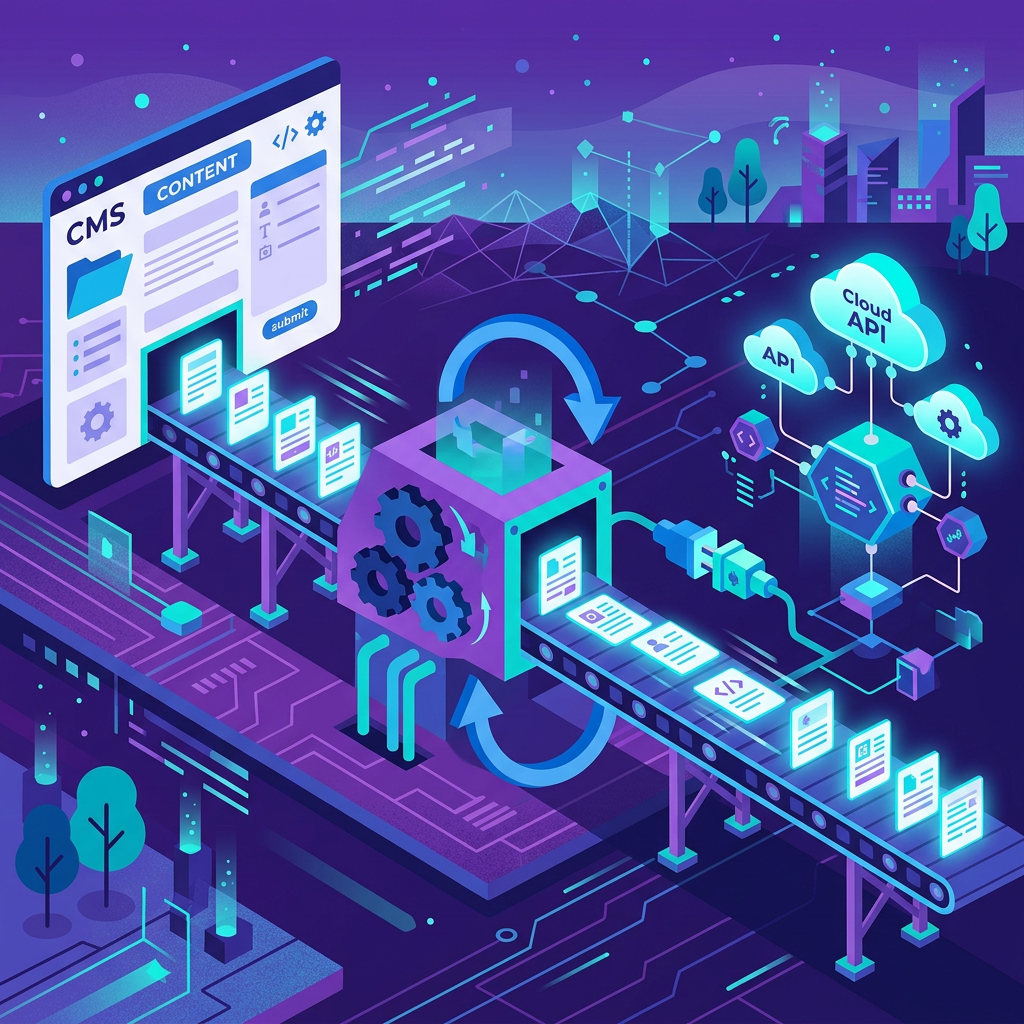
End-to-End Flow: Content Creation β Extraction β TMS β API Routing β LQA β Re-Ingestion
The pipeline begins when a content author publishes a page in a CMS or a developer merges a pull request containing new UI strings. An extraction layer detects the change, parses the content into translatable segments, and pushes those segments to a Translation Management System (TMS) or directly to a translation API.
At the routing stage, the pipeline decides how each segment gets translated. Some strings may hit a machine translation API for speed; others route to professional human translators for brand-sensitive copy. After translation, a linguistic quality assurance (LQA) step validates output, checking placeholder integrity, terminology adherence, and length constraints. Finally, the translated content is re-ingested into the originating system: back into the CMS as a localized variant, committed to a locale file in Git, or pushed into a design tool layer.
The critical principle is that every stage is decoupled. Extraction does not assume anything about how translation happens. Translation does not assume anything about where the output goes. This separation lets you swap providers, add languages, or change CMS platforms without rewriting the entire pipeline.
API Contracts, Webhooks, and Event Payloads
Clean API contracts are the connective tissue of the pipeline. Each handoff between stages should follow a well-defined schema. A typical event payload for a translation request includes:
| Field | Purpose | Example |
|---|---|---|
| string_id | Unique, stable identifier for the source segment | homepage.hero.headline |
| source_text | The translatable content | Start your free trial today |
| source_locale | BCP 47 language tag | en-US |
| target_locales | Array of target language tags | ["de-DE", "ja-JP", "pt-BR"] |
| context | Screenshot URL, page location, or usage note | Hero banner, max 45 chars |
| placeholders | Named variables that must not be translated | {user_name}, {count} |
| callback_url | Webhook endpoint for delivery notification | https://api.example.com/hooks/l10n |
| idempotency_key | Prevents duplicate processing on retry | uuid-v4 |
Webhooks drive the asynchronous parts of the pipeline. When a translation is complete, the translation API or TMS fires a webhook to your callback URL with the translated payload. Your receiving service should validate the webhook signature, acknowledge with a 200 response immediately, and process the payload asynchronously. This prevents timeouts and avoids lost events when downstream processing is slow.
Using a unified platform like Ollang standardizes these schemas across multiple providers, reducing adapter code and mismatch risk while keeping your internal contracts consistent.
Idempotent Sync and Deterministic State Management
Localization pipelines are inherently distributed, and distributed systems experience retries. A webhook can fire multiple times. An extraction job may run on the same content before the first batch returns. Without idempotency, you end up with duplicate translation requests (and duplicate costs) or race conditions that overwrite newer translations with older ones.
Every write operation in the pipeline should be idempotent. Use the string_id plus target_locale plus a content hash as a composite key. If a translation delivery arrives for a segment that already has an identical or newer translation, discard it. Store a version timestamp or monotonically increasing revision number alongside each translated segment, and enforce a "latest wins" policy. This deterministic approach means you can safely re-run any stage of the pipeline, extraction, translation, or re-ingestion, without corrupting state.
Extraction and Content Parsing Strategies
The quality of your pipeline depends entirely on how cleanly you extract translatable content from its source systems. Poor extraction leads to broken context, fragmented sentences, and translators working blind.
Connectors for Headless CMS, Git Repos, and Design Tools
Each content source requires a purpose-built connector:
- Headless CMS (Contentful, Strapi, Sanity, etc.): Use the CMS's content delivery or management API to listen for publish events. Extract rich text fields, resolving references and inline components so translators see complete sentences rather than isolated fragments. Map each field to a stable string_id derived from the content model's entry ID and field path.
- Git repositories: Parse resource files (.json, .xml, .strings, .properties, .po) from the source locale directory. A Git-based connector typically watches for merges to a main branch, diffs the locale files against the previous commit, and extracts only changed or new keys. This delta detection avoids re-translating unchanged content.
- Design tools (Figma, Sketch): Use the Figma REST API or plugin SDK to extract text layers. Attach frame names and component paths as context so translators understand where the string appears visually.
- Issue trackers and documentation platforms: For teams that localize support articles or release notes, connectors to Confluence, Notion, or Zendesk pull content via their respective APIs, preserving formatting markup.
Each connector should normalize its output into the shared event payload schema described above. This normalization is what makes the rest of the pipeline source-agnostic.
Batching, Delta Detection, and Placeholder Handling
Sending one API call per string is wasteful and slow. Batch translation requests into groups, typically by target locale and content source, to reduce HTTP overhead and stay within rate limits. Most translation APIs accept batch payloads of hundreds or thousands of segments per request.
Delta detection is equally important. Before submitting any batch, compare each segment's content hash against the last submitted hash stored in your pipeline's state database. Only segments with changed source text enter the translation queue. This practice alone can reduce translation volume (and cost) dramatically, especially for content-heavy sites where only a small percentage of strings change per release cycle.
Placeholder handling requires explicit rules. Before sending content to translation, validate that all placeholders conform to a known pattern (e.g., {variable_name} or %s). After translation returns, run a post-processing check confirming that every placeholder present in the source also appears in the target. If a placeholder is missing or malformed, flag the segment for review rather than publishing it, a missing {price} variable in a checkout string is a production incident, not a minor quality issue.
Branching, Versioning, and Locale Fallback Logic
Content changes constantly, and localization pipelines must handle the reality that source content and translations are rarely in perfect sync.
Managing Translation Branches Alongside Code and Content Versions
When your development team works in feature branches, your localization pipeline should mirror that branching model. Strings introduced in a feature branch should be translated in a parallel translation branch, not merged into the main translation memory until the feature itself ships. This prevents half-translated experimental strings from leaking into production locales.
In practice, this means tagging each translation request with a branch or version identifier. Your TMS or translation state store should maintain separate namespaces per branch. When the feature branch merges to main, the corresponding translations merge as well. If the feature is abandoned, its translations are discarded cleanly.
For CMS-driven content, versioning is simpler but still important. Each published revision of a CMS entry should generate a new translation request only if the translatable fields actually changed. Tie translations to the specific content revision ID so you can roll back a localized page to match a previous source revision if needed.
Locale Fallback Chains and Graceful Degradation
Not every locale will have complete translations at every moment. A robust pipeline defines fallback chains so that the application never shows a blank string or a broken key.
A typical fallback chain might look like: es-MX β es-ES β en-US. If a Mexican Spanish translation is unavailable, the system falls back to European Spanish, then to the English source. Define these chains in a central configuration file, not scattered across application code.
Fallback logic should be evaluated at render time, not at pipeline time. The pipeline's job is to deliver whatever translations are available; the consuming application's job is to resolve fallbacks. This separation keeps the pipeline stateless with respect to display logic and avoids the need to generate "fake" translations for missing locales.
Ready to see Ollang in action?
Talk to our team about your localization goals and see how the Ollang platform fits your workflow.
Error Handling, Retries, and Rate Limit Management
Translation APIs are external dependencies. They go down, they throttle, they return unexpected errors. Your pipeline must handle all of this gracefully.
Retry Policies with Exponential Backoff
Implement retries with exponential backoff and jitter for all outbound API calls. A sensible default is three retry attempts with delays of 1 second, 4 seconds, and 16 seconds, plus random jitter of up to 25% to avoid thundering herd problems when a provider recovers from an outage.
Distinguish between retryable and non-retryable errors. A 429 Too Many Requests or 503 Service Unavailable is retryable. A 400 Bad Request due to malformed input is not, retrying it will never succeed and wastes quota. Log non-retryable errors immediately and route them to a dead-letter queue for human review.
Rate Limit Awareness and Provider Failover
Most translation APIs enforce rate limits, often expressed as requests per second or characters per minute. Your pipeline should track rate limit headers (X-RateLimit-Remaining, Retry-After) returned by each provider and throttle outbound requests accordingly.
For organizations using multiple translation providers, one for machine translation, another for human professional translation, perhaps a third for specific language pairs, implement a routing layer that can fail over between providers. If Provider A returns errors or exceeds its SLA, the router redirects traffic to Provider B. This multi-provider strategy also enables cost optimization: route high-volume, low-sensitivity content to a cost-effective MT engine, and reserve premium human translation for marketing and legal copy.
Platforms such as Ollang that provide translation API integration can simplify this routing by abstracting multiple providers behind a unified API surface, handling failover and quality routing without custom orchestration code. If you want to see how that abstraction works in practice, request an overview at https://ollang.com/book-a-demo.
Security: Secrets Management and PII Controls
Localization pipelines handle content that may include personally identifiable information, proprietary product details, or legally sensitive text. Security is not optional.
Secrets Management for API Keys and Tokens
Store all API keys, webhook signing secrets, and OAuth tokens in a dedicated secrets manager, AWS Secrets Manager, HashiCorp Vault, GCP Secret Manager, or your platform's equivalent. Never embed credentials in source code, environment files committed to Git, or CI/CD pipeline definitions.
Rotate API keys on a regular schedule and after any suspected compromise. Use scoped credentials wherever possible: a key used by the extraction service should not have permission to delete translations, and a key used by the re-ingestion service should not have permission to submit new translation requests.
PII Detection and Redaction in Translation Payloads
Before any content leaves your infrastructure for an external translation API, scan it for PII. Names, email addresses, phone numbers, and account identifiers should be replaced with tokenized placeholders (e.g., [PII_EMAIL_1]) before submission and restored after translation returns.
This is especially critical for regulated industries. If you localize customer communications, support articles with user-generated content, or legal documents, PII leakage to a third-party translation provider can create compliance violations under GDPR, HIPAA, or CCPA. Automate PII detection using pattern matching and named entity recognition, and log every redaction event for audit purposes.
Translation Memory and Terminology Synchronization
Translation memory (TM) and terminology databases are the institutional knowledge of your localization program. Keeping them synchronized across your pipeline is essential for consistency and cost control.
Keeping TM and Glossaries in Sync Across the Pipeline
Every confirmed translation should be written back to your TM. When a translator improves a machine-translated segment during LQA review, that improved version should update the TM entry, not just the target locale file. This creates a feedback loop where translation quality improves over time and repeated segments leverage existing approved translations instead of being re-translated from scratch.
Terminology glossaries, lists of approved translations for brand names, product terms, and domain-specific vocabulary, should be distributed to every translation provider and engine in the pipeline. If your MT engine translates "workspace" as "espacio de trabajo" but your glossary mandates "Γ‘rea de trabajo," the LQA step should catch the discrepancy. Better yet, inject glossary terms into the MT request as constraints so the engine respects them from the start.
Synchronize TM and glossary updates bidirectionally. When a human translator proposes a new term, it should flow back into the central glossary for review. When the glossary is updated centrally, all downstream consumers, MT engines, TMS platforms, LQA validators, should receive the update before the next batch runs. A platform that centralizes routing and TM updates, such as Ollang, can reduce integration points by pushing TM and glossary changes through a single API endpoint.
Monitoring, KPIs, and SLA Compliance
You cannot improve what you do not measure. A production localization pipeline needs observability just like any other critical system.
Key Metrics: Throughput, Latency, Error Rate, and Translation Coverage
Track these metrics continuously:
| Metric | What It Measures | Target Example |
|---|---|---|
| Throughput | Segments translated per hour/day | Varies by volume; trend upward over time |
| End-to-end latency | Time from content change detection to re-ingested translation | Under 4 hours for MT; under 48 hours for human |
| Error rate | Percentage of segments that fail extraction, translation, or re-ingestion | Below 1% |
| Translation coverage | Percentage of source segments with approved translations per locale | Above 98% for production locales |
| Placeholder integrity | Percentage of translated segments with all placeholders intact | 100% (non-negotiable) |
| TM leverage | Percentage of segments matched from translation memory | Higher is better; reduces cost |
Set up dashboards that surface these metrics in real time. Alert on anomalies: a sudden spike in error rate may indicate a provider outage; a drop in throughput may signal a stuck queue; declining TM leverage may mean content is diverging from established patterns.
SLA Compliance and Reporting
Define SLAs with your translation providers and hold them accountable with data. If a provider commits to returning human translations within 24 hours, your monitoring system should track actual delivery times and flag breaches automatically.
Internally, define SLAs between your localization pipeline and the product teams it serves. A common internal SLA is: "All new strings merged to main will have machine translations available in all tier-1 locales within 2 hours and human-reviewed translations within 2 business days." Publish compliance reports weekly to maintain accountability and justify investment in pipeline improvements.
Frequently Asked Questions
How do I handle translation of content with complex inline markup like HTML or Markdown?
Strip non-translatable markup into placeholder tokens before sending content to translation. For example, convert <a href="/pricing">our pricing page</a> into {link_start}our pricing page{link_end}. The translator works with clean text, and your re-ingestion layer reconstructs the markup. Most TMS platforms and translation APIs support segmentation rules that handle common markup formats, but always validate reconstructed markup before publishing.
What is the best way to avoid re-translating unchanged content?
Implement delta detection using content hashes. Before submitting a batch, compute a hash (SHA-256 is sufficient) of each source segment and compare it against the hash stored from the last successful submission. Only segments with changed hashes enter the translation queue. Combine this with translation memory lookups, even if a segment's hash has changed, the new text may partially or fully match an existing TM entry, reducing cost and turnaround time.
How do I manage localization across multiple translation providers without vendor lock-in?
Design your pipeline around a provider-agnostic abstraction layer. Define a standard internal API for submitting translation requests and receiving results. Each provider gets an adapter that maps your internal schema to the provider's specific API. This pattern lets you switch providers, split traffic for A/B quality testing, or fail over during outages without touching your core pipeline logic. Services such as Ollang provide this abstraction natively, which can accelerate implementation.
Should I use synchronous or asynchronous translation API calls?
Use asynchronous calls for nearly all production workflows. Machine translation APIs may respond in milliseconds, but human translation takes hours or days, and even MT calls at high volume benefit from async batching. Submit requests, receive a job ID or acknowledgment, and process results when a webhook fires or a polling check succeeds. Reserve synchronous calls only for real-time, user-facing scenarios like live chat translation where latency is the primary constraint.
Ready to see Ollang in action?
Talk to our team about your localization goals and see how the Ollang platform fits your workflow.
Start Building Your Localization Pipeline
A well-architected text localization pipeline transforms localization from a bottleneck into a continuous, automated process. The patterns described here, decoupled stages, idempotent sync, delta detection, robust error handling, and real-time monitoring, are not theoretical ideals; they are the baseline for any team shipping software or content in multiple languages at scale.
If you are ready to move from manual handoffs to an automated, observable pipeline, book a demo with Ollang to see how an AI-powered execution layer can handle translation API routing, quality assurance, and multi-format localization across your entire content ecosystem: https://ollang.com/book-a-demo.
Published on July 28, 2026