
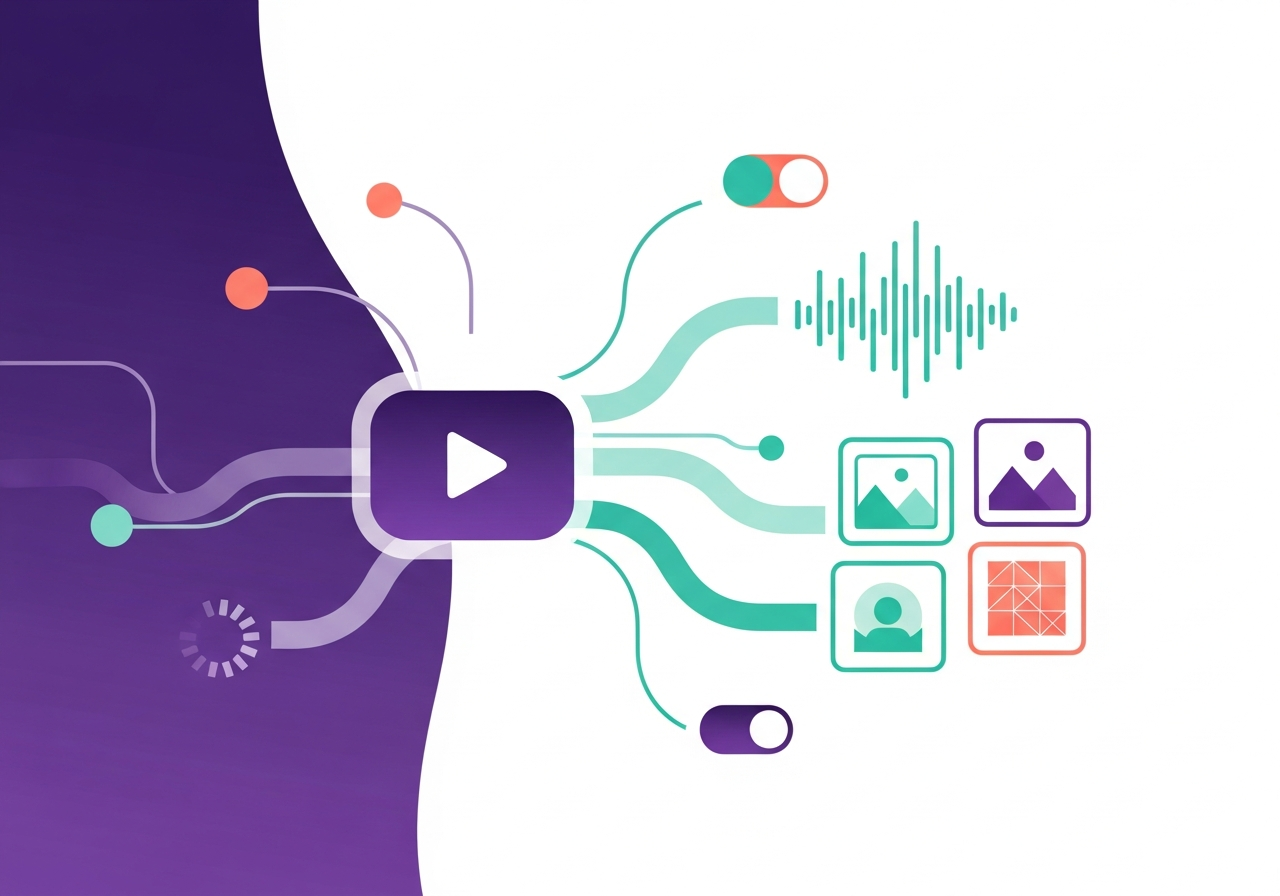
Enterprise Multimodal Localization: One Workflow for Text, Audio, Video, Images, and Dubbing
Global brands no longer communicate through text alone. Product launches span video ads, podcast-style explainers, in-app copy, localized imagery, and dubbed training content, often shipping simultaneously into dozens of markets. Yet most localization programs are still built around documents, software strings, and...

Global brands no longer communicate through text alone. Product launches span video ads, podcast-style explainers, in-app copy, localized imagery, and dubbed training content, often shipping simultaneously into dozens of markets. Yet most localization programs are still built around documents, software strings, and websites, leaving multimedia assets fragmented across separate agencies, freelancers, and point tools. The result is inconsistent terminology, blown timelines, and ballooning costs. Enterprise multimodal localization solves this by unifying every content type, text, audio, video, images, and dubbing, into a single governed workflow. Ollang provides the AI execution layer for this approach, giving enterprises a single platform to localize across every modality at scale while maintaining brand consistency and human-level quality across video, audio, documents, and web.
Why Traditional Localization Stacks Break Down at Multimedia Scale
Most enterprise localization stacks evolved to handle what was historically the highest-volume content type: written text. Translation management systems (TMS) were designed around string-based workflows, importing files, leveraging translation memories, and exporting localized versions. That architecture works well for product UIs, help centers, and marketing web pages.
But when a brand needs to localize a product demo video into 15 languages, complete with dubbed voiceover, translated on-screen text overlays, and synchronized subtitles, the TMS becomes just one piece of a much larger puzzle. The video editing happens in one tool, the voiceover recording in another, subtitle timing in a third, and the translated script in the TMS. Each handoff introduces delay, version drift, and quality risk.
The Hidden Cost of Fragmented Vendor Ecosystems
Splitting localization across multiple vendors and tools creates costs that rarely appear on a single invoice but compound quickly:
- Terminology drift. When a dubbing studio translates independently from the team handling UI strings, product names and feature descriptions diverge across touchpoints.
- Duplicated project management. Each vendor requires its own briefing, file preparation, review cycle, and invoicing workflow. For a 20-language launch spanning four content types, that can mean 80+ parallel workstreams.
- Synchronization failures. A localized video goes live before the matching landing page is translated, or subtitles reference a product name that the marketing team changed two days earlier.
- Quality inconsistency. Without a shared style guide enforcement mechanism, tone and register vary between a brand's dubbed TV spot and its translated email campaign, even within the same target language.
According to CSA Research, organizations that manage localization across three or more disconnected systems report significantly higher rework rates and longer time-to-market compared to those using consolidated platforms. The fragmentation tax is real, and it grows with every new content format a brand adopts.
Mapping the Modalities: What Each Content Type Demands
Effective multimodal localization starts with understanding that each content type has distinct technical requirements, quality criteria, and delivery constraints. A one-size-fits-all approach fails precisely because it ignores these differences.
Text: Documents, Marketing Copy, and Product Content
Text localization remains the backbone of most programs. It includes product descriptions, legal documents, marketing emails, blog posts, knowledge base articles, and packaging copy. The workflow is relatively mature: source content enters a TMS, gets segmented, matched against translation memory and terminology databases, translated (by human, machine, or a combination), reviewed, and delivered.
The key challenges at enterprise scale are volume management, context preservation, and style consistency across thousands of content pieces. Marketing copy demands creative adaptation, transcreation, rather than literal translation, while legal and regulatory documents require precision and certified review.
Audio: Voiceovers, Podcasts, and IVR Systems
Audio localization involves more than translating a script. It requires casting voice talent that matches the brand's sonic identity, recording in acoustically controlled environments, and synchronizing delivery with any accompanying visual or interactive content.
For IVR (interactive voice response) systems, each audio prompt must match exact timing and menu logic. For podcast localization, the challenge is preserving the conversational tone and pacing that made the original content engaging. Script adaptation must account for expansion and contraction rates, a 30-second English segment may require 35 seconds in German or 25 seconds in Japanese.
Video: Subtitles, Captions, and On-Screen Text
Video localization is where complexity multiplies. A single video asset may require:
- Translated and timed subtitles (SRT, VTT, or burned-in)
- Closed captions for accessibility compliance
- Replacement of on-screen text in motion graphics, lower thirds, and title cards
- Adaptation of culturally specific visuals or gestures
Each of these tasks has its own technical workflow. Subtitle timing must respect reading speed norms, typically 15 to 20 characters per second for most languages, while on-screen text replacement often requires re-rendering in video editing software with matched fonts and animations.
Dubbing: Lip-Sync, Voice Matching, and Emotional Fidelity
Dubbing sits at the intersection of audio and video and represents the most technically demanding modality. Enterprise dubbing for training videos, product demos, and brand campaigns requires:
| Requirement | Description |
|---|---|
| Script adaptation | Adjusting translated dialogue to match lip movements and scene timing |
| Voice casting | Selecting talent that matches the original speaker's tone, age, and authority |
| Lip-sync alignment | Ensuring dubbed audio aligns with visible mouth movements (critical for on-camera speakers) |
| Emotional fidelity | Preserving emphasis, pacing, and emotional arc across languages |
| Audio mixing | Balancing dubbed voiceover with background music, sound effects, and ambient audio |
AI-powered dubbing has advanced rapidly, but enterprise use cases still demand human review to catch tonal mismatches, mispronunciations of branded terms, and cultural nuances that automated systems miss.
Images and Visual Assets
Localized imagery includes everything from e-commerce product photos with embedded text to infographics, social media creatives, and in-store signage. The workflow involves extracting translatable text layers, translating and adapting them (including text expansion handling and font compatibility), and re-compositing the final asset.
Cultural adaptation often goes beyond text. Color symbolism, model diversity, gesture interpretation, and even the direction of visual flow (left-to-right vs. right-to-left layouts) may require asset redesign rather than simple text replacement.
Ready to see Ollang in action?
Talk to our team about your localization goals and see how the Ollang platform fits your workflow.
Building a Unified Multimodal Workflow
The goal of multimodal localization is not to treat every content type identically, it is to orchestrate their distinct workflows within a single system of record so that terminology, timing, and quality standards remain consistent.
Asset Ingestion and Content Typing
A unified workflow begins at ingestion. When a new localization request enters the system, the platform must automatically identify the content type, video file, audio clip, document, image, or web content, and route it to the appropriate processing pipeline. This eliminates the manual triage that consumes project management hours in fragmented setups.
Ollang handles this by accepting enterprise assets across all modalities through a single intake process. Whether a team uploads an MP4 for dubbing, a PDF for translation, or a batch of product images with embedded text, the platform applies the correct workflow automatically, including language-specific style guides, glossaries, and quality thresholds. It also preserves asset relationships (for example, linking translated scripts to video timelines) so related assets stay synchronized through the pipeline.
Parallel Processing with Synchronized Delivery
One of the biggest advantages of a unified platform is the ability to process multiple modalities in parallel while keeping them synchronized. When a product launch includes a hero video, a landing page, email copy, and social media images, all assets can move through translation, review, and delivery on coordinated timelines.
This matters because localization delays in one modality cascade into others. If the dubbed video ships a week after the translated landing page, the campaign launches with a broken user experience. Synchronized delivery ensures every touchpoint is ready at the same time, in every target language. Ollang runs these pipelines in parallel and tracks dependencies so teams release synchronized assets across languages.
Terminology and Style Consistency Across Modalities
A shared terminology database and style guide engine is the connective tissue of multimodal localization. When a product name, tagline, or technical term is translated for the website, that same approved translation must flow into the dubbing script, the subtitle file, the image overlay, and the email campaign.
Ollang enforces this consistency by maintaining a centralized terminology layer that applies across all content types. When a term is updated, say, a product rebrand changes "SmartFlow" to "FlowPro" in French, the change propagates to every asset in the pipeline, flagging existing translations for review. This eliminates the terminology drift that plagues organizations managing modalities through separate vendors.
Human Quality Review in an AI-Augmented Pipeline
AI has transformed the speed and cost profile of localization across every modality. Machine translation handles high-volume text. AI dubbing generates synthetic voiceovers in minutes. Automated subtitle generators produce timed caption files from audio tracks. But enterprise brands cannot afford the quality risks of fully automated output.
Where Human Review Is Non-Negotiable
Certain quality dimensions remain beyond the reliable reach of current AI systems:
- Brand voice alignment. Does the translated marketing headline carry the same emotional weight and persuasive intent as the original?
- Cultural appropriateness. Will a dubbed phrase, visual metaphor, or color choice land differently in the target culture?
- Technical accuracy. Are regulated claims, dosage instructions, or legal disclaimers translated with the precision required for compliance?
- Lip-sync naturalness. Does the AI-dubbed voiceover look and sound believable when paired with on-camera talent?
Structured Review Workflows
Effective human review in a multimodal pipeline requires structured workflows, not ad hoc email chains. Reviewers need to see the source and target content side by side, in context. For video, that means reviewing dubbed audio synced to the video timeline. For images, it means seeing the translated text rendered in the final layout. For documents, it means evaluating translations within the formatting of the delivered file.
Ollang integrates human review directly into each modality's workflow, providing in-context review interfaces for video, audio, document, and image assets. Reviewers can flag issues at the segment, scene, or asset level, and corrections feed back into the translation memory and terminology database, improving future output across all content types.
How Ollang Unifies Enterprise Multimodal Localization
Ollang was built for the reality that enterprise content is multimodal by default. Rather than bolting video and audio capabilities onto a text-first TMS, Ollang treats every content type as a first-class citizen within a single orchestration layer.
One Platform, Every Modality
The practical impact for enterprise localization teams is significant:
| Capability | What Ollang Delivers |
|---|---|
| Video localization | Subtitling, captioning, on-screen text replacement, and AI-assisted dubbing with human review |
| Audio localization | Voiceover production, podcast adaptation, and IVR prompt localization |
| Document localization | Translation of marketing, legal, technical, and product content with TM leverage |
| Website localization | Continuous localization of web content with CMS integrations |
| Image localization | Text extraction, translation, and re-compositing for visual assets |
| Quality governance | Centralized terminology, style guides, and structured review workflows across all modalities |
Reducing Vendor Sprawl and Operational Complexity
By consolidating multimodal localization into Ollang, enterprises eliminate the coordination overhead of managing separate dubbing studios, subtitle vendors, translation agencies, and image adaptation freelancers. One platform means one set of terminology rules, one quality standard, one reporting dashboard, and one accountable partner.
This consolidation does not mean sacrificing specialization. Ollang combines AI automation for speed and scale with domain-specific human expertise for quality, applying the right balance to each modality based on the content's risk profile and brand sensitivity. Its CMS integrations and centralized reporting reduce manual handoffs between source systems and localization pipelines.
Ready to see Ollang in action?
Talk to our team about your localization goals and see how the Ollang platform fits your workflow.
Conclusion: The Case for Convergence
Enterprise localization has reached a point where treating each content modality as a separate workstream is no longer sustainable. The brands that win in global markets are those that deliver consistent, high-quality experiences across every touchpoint, video, audio, text, images, and beyond, simultaneously and at scale.
Multimodal convergence is not a future aspiration; it is an operational necessity. Ollang provides the AI execution layer that makes this convergence practical, bringing every content type into one governed workflow with centralized terminology, synchronized delivery, and integrated human quality review. Ollang operationalizes convergence across video, audio, document, and website localization at enterprise scale, so teams can launch globally without the fragmentation and rework that slow them down. For enterprise teams tired of managing localization through a patchwork of agencies and tools, the path forward is clear: one workflow, every modality, every market.
Published on August 25, 2026