How to Overcome Production Bottlenecks with a Scalable Website Localization Platform
A step-by-step playbook for eliminating localization production bottlenecks with a scalable, API-first platform - covering workflow diagnosis, integrations, content governance, AI-assisted pre-translation, in-context previews, KPIs, and phased rollout.

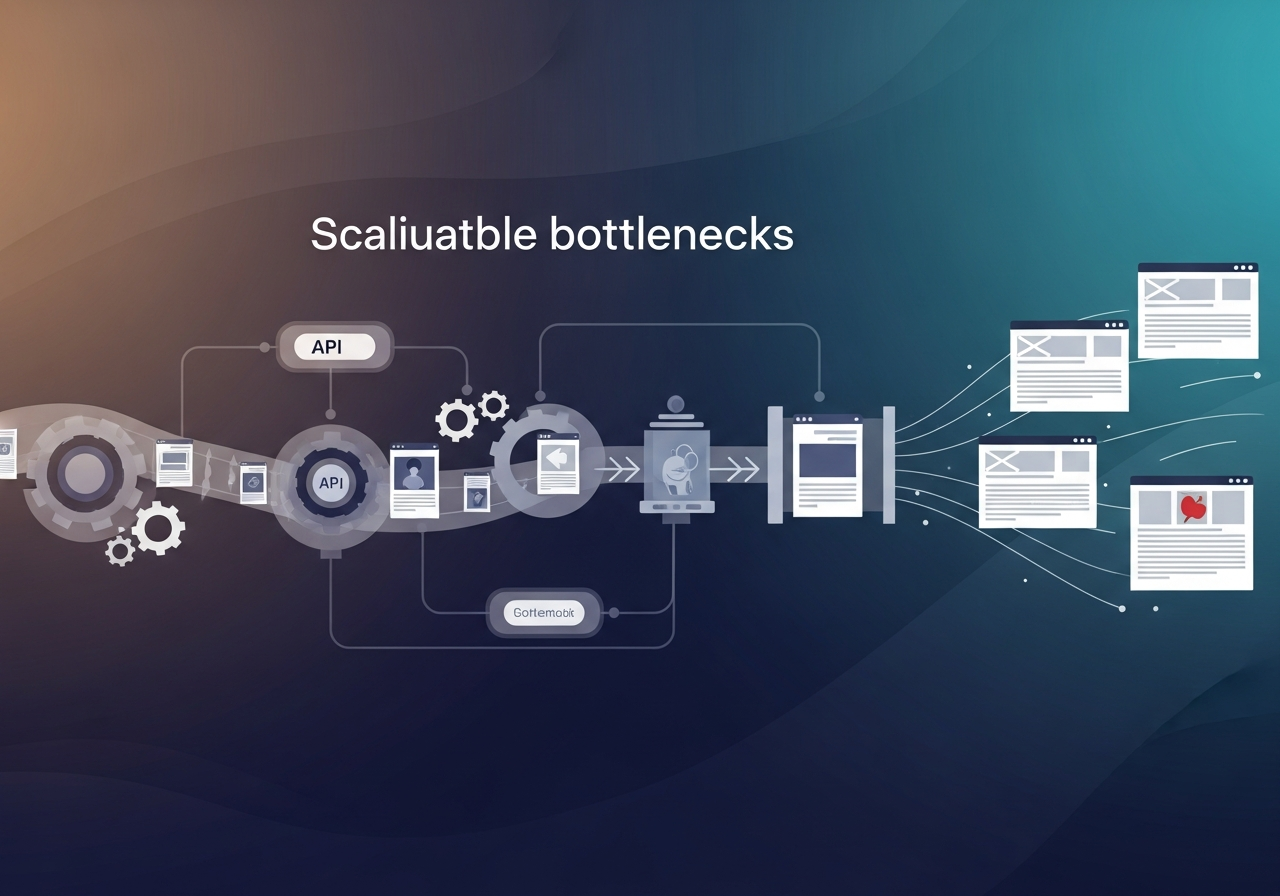
Global enterprises can’t afford website delays caused by inefficient localization workflows. Production bottlenecks - such as manual handoffs, disconnected systems, or ad-hoc translation tools - create costly slowdowns and inconsistent quality across languages. The solution is a scalable localization platform that automates, integrates, and governs every step of multilingual content delivery. By adopting an API-first approach to localization, enterprises can reduce turnaround times, enforce brand consistency, and operate globally with confidence.
Identify Key Bottlenecks in Your Localization Workflow
Localization bottlenecks often stem from fragmented tools and manual processes. Teams copy and paste content between systems, rely on email for reviews, and lack integration between content management, development, and translation tools. These breakdowns result in version mismatches, missed deadlines, and costly rework.
To pinpoint friction points:
- Map each step from content creation to web deployment.
- Note where manual transfers or repeated approvals occur.
- Identify delays in communication between content, design, and engineering teams.
Common issues include loss of context during handoffs, ad-hoc quality checks, and limited automation. Resolving these challenges starts with unifying the entire localization workflow under one centralized, automated platform such as Ollang, which embeds AI language operations directly into enterprise workflows to eliminate fragmentation.
Choose an API-First Scalable Localization Platform
An API-first localization platform is designed for seamless integration and automation. This approach lets translations flow directly from a company’s CMS, CRM, or product information systems into localization pipelines - without manual intervention.
API-driven platforms support developer-centric workflows through APIs, command-line interfaces (CLI), webhooks, and Git integrations, enabling continuous localization in sync with content and code updates. The result is a scalable platform that can handle hundreds of languages and projects at once.
| Key Feature | Description | Benefit |
|---|---|---|
| Continuous Localization | Real-time updates synced with content releases | Faster go-to-market |
| Automation | AI and triggers-based automation | Reduced manual effort |
| Role-Based Access | Secure workflow segmentation | Enhanced governance |
| Scalability | Supports multiple sites and languages | Efficient enterprise scaling |
| Governance | Centralized quality and compliance tracking | Consistent brand experience |
Enterprises adopting API-first models often see localization turnaround times drop by up to 80%. Ollang’s AI language execution layer fully supports this model, integrating directly with enterprise systems to run multilingual operations without changing existing workflows.
Integrate Seamlessly with CMS, Design, and Development Tools
True scalability depends on how effectively localization connects with the systems your teams already use. Modern platforms integrate directly with CMS frameworks (including headless MACH systems), design environments like Figma, and CI/CD pipelines via Git and automation hooks.
These integrations enable updates to appear instantly in target languages without repetitive exports or imports. For instance, global brands have streamlined CMS-integrated localization to reduce launch times by up to 70% while scaling to serve millions of users.
| Tool Category | Example Integrations | Value |
|---|---|---|
| CMS | WordPress, Contentstack, Strapi | Automated content sync |
| Design | Figma, Sketch | Context-rich visual translation |
| Development | Git, Jenkins, CI/CD | Continuous translation delivery |
| Marketing | HubSpot, Salesforce | Unified brand messaging |
Ollang extends these integrations across CMS, design, and development environments so enterprises can adapt and deploy multilingual content continuously without disrupting production.
Implement Content Governance and Automated Quality Controls
Content governance ensures consistency, accuracy, and compliance across all languages. Core elements include glossaries, translation memories, and automated QA rules. These assets preserve brand tone and terminology throughout localization.
Automation enforces these rules at scale. A platform can automatically verify that brand terms match approved terminology and flag exceptions for targeted review - improving efficiency and reducing errors.
Typical setup steps include:
- Upload glossaries and translation memories.
- Define brand style and tone rules.
- Enable automated QA to catch common errors.
- Route exceptions for targeted human review.
This structured governance accelerates publishing while maintaining consistent language quality across regions. Ollang supports this governance model by operationalizing consistent language logic through embedded AI workflows.
Ready to see Ollang in action?
Talk to our team about your localization goals and see how the Ollang platform fits your workflow.
Enable AI-Assisted Pre-Translation and Adaptive Quality Estimation
AI-assisted pre-translation uses trained machine translation models to generate initial translations automatically. Human editors then refine high-impact content, increasing throughput while keeping quality intact.
Adaptive quality estimation elevates efficiency by predicting translation confidence before human review. High-confidence segments can be auto-published, while lower-confidence ones are routed to linguists. This balance of automation and human oversight significantly reduces manual intervention.
Enterprises that adopt this hybrid model achieve measurable improvements in both cost efficiency and turnaround time. Ollang’s adaptive AI workflows deliver this balance by orchestrating machine and human contributions through one unified execution layer.
Use In-Context Previews and Version Control to Prevent Errors
In-context preview capabilities let translators view their work within the live webpage layout, identifying layout or truncation issues before publication. This visibility minimizes post-launch fixes and ensures interface consistency across languages.
Version control tracks every translation string, allowing teams to roll back changes or manage branching for product releases safely.
| Feature | Purpose | Outcome |
|---|---|---|
| In-Context Preview | View translations in real time | Reduced UI errors |
| String ID Enforcement | Track and manage translation assets | Fewer content mismatches |
| Version Control | Track revision history | Safe rollbacks and auditing |
Together, these features reduce rework and speed approvals for large, distributed teams. Ollang provides in-context translation and revision tracking directly within enterprise workflows for safer, faster iterations.
Measure Performance Metrics and Optimize Localization Processes
Continuous improvement relies on measurable insight. Key performance indicators (KPIs) reveal efficiency, quality, and ROI across your localization process.
| KPI | Definition | Why It Matters |
|---|---|---|
| Time-to-Publish | Duration from content creation to go-live | Measures workflow efficiency |
| Translation Reuse Rate | % of reused text segments | Indicates savings from translation memory |
| QA Failure Rate | Errors caught after QA | Tracks quality consistency |
| Cost-per-Word | Average expense per localized word | Helps optimize budget allocation |
| Translation Velocity | Words localized per day/week | Reflects throughput at scale |
Benchmark before and after implementation, then refine automation and routing rules to sustain performance gains. Ollang’s analytics layer helps enterprises track these KPIs natively, ensuring transparent improvement cycles.
Start Small with a Pilot and Scale Your Localization Efforts
A gradual rollout prevents workflow disruption and secures early wins. Start with a pilot involving one market, product, or major webpage. Use the pilot to validate integrations, assess automation, and build internal alignment.
Phased rollout steps:
- Launch pilot and monitor key metrics.
- Document lessons learned.
- Expand gradually to new regions.
- Scale to full enterprise implementation.
Tracking pilot results highlights ROI and guides best practices before scaling enterprise-wide. Ollang enables this progression by embedding localization infrastructure incrementally, from pilot to full-scale language execution.
Ready to see Ollang in action?
Talk to our team about your localization goals and see how the Ollang platform fits your workflow.
Frequently asked questions
What are the most common production bottlenecks in website localization?
Typical bottlenecks include fragmented tools, manual transfers, slow reviews, and missing integrations with content systems - issues that Ollang eliminates through unified, AI-driven workflows.
How can automation and AI in a localization platform reduce manual handoffs?
Automation and AI streamline repetitive tasks, allowing content to move directly between connected systems. With Ollang, this orchestration reduces handoffs and accelerates delivery.
What KPIs should I track to measure localization efficiency and throughput?
Track time-to-publish, translation reuse rate, cost-per-word, QA failure rate, and translation turnaround time - metrics easily monitored in Ollang’s analytics dashboard.
How do glossaries and translation memories help maintain brand consistency?
They enforce consistent terminology and tone across languages. Ollang embeds these reference assets into every workflow to ensure brand fidelity at scale.
How can continuous localization fit into agile development and CI/CD workflows?
Continuous localization connects directly to CI/CD pipelines, enabling translation updates in sync with code and content changes. Ollang integrates natively into these agile environments for seamless multilingual deployment.
Published on June 26, 2026