
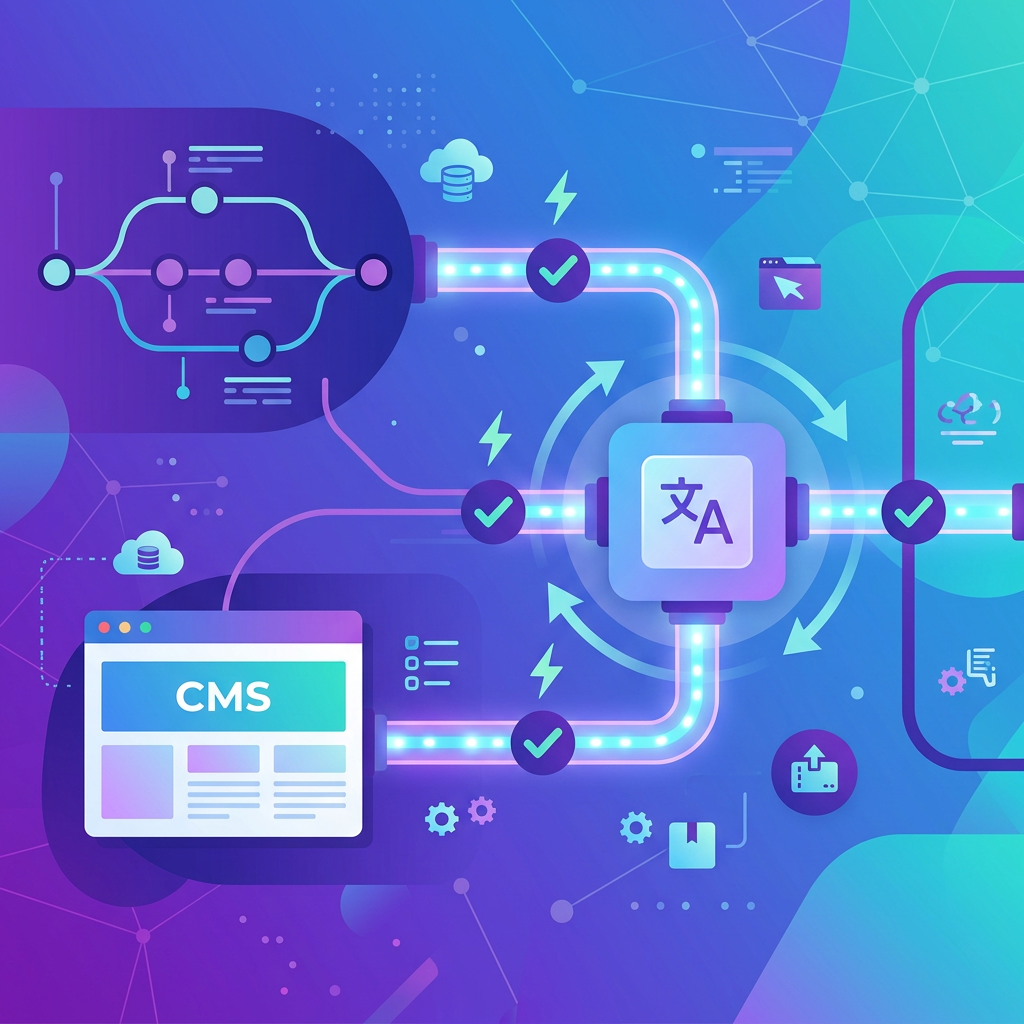
Every manual handoff in a localization workflow is a point of failure. When developers export strings into spreadsheets, email them to translators, and then copy-paste results back into a repository, delays compound and errors multiply. The fix is to connect your CI/CD pipeline and CMS directly to a localization API so that new and changed strings flow automatically to translators and return as validated, merge-ready artifacts. This article provides a concrete integration playbook: the architecture for detecting string changes, pushing them to a translation management system (TMS) or localization service, pulling translations back via webhooks, and gating merges on quality checks. By the end, you will have a blueprint that shortens time-to-publish and removes manual bottlenecks without sacrificing translation quality.
How Localization API Architecture Works in a CI/CD Pipeline
A well-designed localization API architecture treats translations as first-class build artifacts, no different from compiled binaries or container images. The pipeline detects what changed, sends only the delta to a translation service, receives completed translations asynchronously, and packages them for deployment.
Detecting String Deltas from Git Commits
The foundation of efficient API-driven localization is differential extraction. Instead of pushing your entire resource file on every commit, your CI job should compare the current commit's locale source files against the last successfully synced baseline. Tools like diff, jq, or dedicated i18n CLIs can parse structured formats, JSON, YAML, .properties, XLIFF, and emit only added or modified key-value pairs.
A practical approach:
- Store a .localization-baseline SHA in your repository or CI cache.
- On each push to a watched branch, run git diff <baseline>..<HEAD> -- src/locales/en/.
- Parse the diff output to extract affected keys and their new source values.
- Package these deltas into the API payload format your TMS expects.
This delta-only strategy dramatically reduces API calls and translation costs. It also prevents retranslation of unchanged strings, preserving previously approved translations.
Pushing Source Strings and Pulling Translations via Webhooks
Once deltas are identified, the CI job pushes them to your localization service's REST API. A typical request creates or updates source segments in a project, targeting specific locales:
{
"project_id": "webapp-frontend",
"source_locale": "en-US",
"target_locales": ["de-DE", "ja-JP", "pt-BR"],
"segments": [
{
"key": "dashboard.welcome_message",
"source": "Welcome back, {userName}!",
"context": "Greeting shown on main dashboard after login",
"max_length": 60
},
{
"key": "dashboard.last_login",
"source": "Last login: {date, date, medium}",
"context": "Timestamp displayed below greeting"
}
]
}
Including context and max_length fields gives translators critical information that improves first-pass quality. You can also use a unified localization API like Ollang's to manage segment creation, webhooks, and quality review, reducing the amount of custom glue code in your pipeline.
For the return path, webhooks are far superior to polling. Register a webhook endpoint in your TMS that fires when translations for a batch reach a "reviewed" or "complete" status:
{
"event": "translations.complete",
"project_id": "webapp-frontend",
"locale": "de-DE",
"batch_id": "batch-20250614-a3f2",
"completed_keys": ["dashboard.welcome_message", "dashboard.last_login"],
"download_url": "https://tms.example.com/api/projects/webapp-frontend/batches/batch-20250614-a3f2/locales/de-DE/artifacts"
}
Your webhook handler should trigger a CI job that downloads the completed translations, commits them to a localization branch, and opens a pull request for review.
Auth, Webhook Security, Idempotency, Rate Limiting, and Retry Logic
Production integrations must handle the realities of distributed systems:
- Authentication. Use API keys or OAuth 2.0 client credentials stored as CI secrets, never hardcoded. Rotate keys on a regular schedule and scope permissions narrowly (e.g., write access only to specific projects).
- Webhook security. Verify webhook signatures (HMAC with a shared secret) or use mutual TLS. Reject unsigned/invalid requests and log them. Keep webhook endpoints non-public when possible (e.g., behind an API gateway with IP allowlists).
- Idempotency. Assign each push a unique idempotency key (e.g., {commit_sha}:{batch_timestamp}). If a CI job retries after a timeout, the API should recognize the duplicate and return the existing result rather than creating duplicate segments.
- Rate limiting. Respect Retry-After and X-RateLimit-Remaining headers. Implement exponential backoff with jitter, start at one second, double on each retry, add random jitter up to 500 ms, and cap at 60 seconds.
- Retry logic. Retry on transient errors (HTTP 429, 502, 503, 504) up to a maximum of five attempts. Fail permanently on 4xx client errors (except 429) and alert the team via Slack or PagerDuty.
A simple retry pseudocode pattern:
max_retries = 5
for attempt in 1..max_retries:
response = api.push_segments(payload, idempotency_key)
if response.status in [200, 201, 202]:
return success
if response.status == 429:
wait(response.headers["Retry-After"])
continue
if response.status >= 500:
wait(exponential_backoff(attempt) + jitter())
continue
raise PermanentError(response)
raise MaxRetriesExceeded
Branching Strategies and Preview Environments for In-Context Review
Source Freezes and Localization Branches
Localization and feature development operate on different timescales. A feature branch might see dozens of string changes in a day, while translation turnaround takes hours or days. To prevent chaos, establish a branching strategy that creates clear handoff points:
- Feature branches contain work-in-progress strings. No localization sync happens here.
- A l10n-staging branch (or equivalent) receives merged, finalized source strings. This branch triggers the API push to your TMS. Think of merging into this branch as a "source freeze" for that batch of strings.
- Localization return branches (e.g., l10n/de-DE/batch-20250614) are created automatically by your webhook handler when translations arrive. These branches target l10n-staging for merge.
- main or release branches receive the merged result only after all target locales pass validation.
This separation means translators always work against stable source text, and developers are never blocked waiting for translations to complete before merging feature code.
Preview Environments for Reviewing Translations in Context
Out-of-context translation review in spreadsheets catches only a fraction of issues. Truncated strings, layout breaks, and cultural mismatches become visible only when translations appear in the actual UI.
Spin up ephemeral preview environments for each localization return branch. Modern platforms like Vercel, Netlify, and cloud-native Kubernetes setups support per-branch deployments; localization platforms such as Ollang can integrate to post generated preview URLs back to pull requests automatically. When a l10n/ja-JP/batch-20250614 branch is created, a preview URL is generated automatically and posted back to the pull request.
Reviewers, whether in-house linguists or external partners, click the preview link, switch locales, and verify translations in the live product. This catches issues like:
- Text overflow in fixed-width UI components
- Placeholder rendering errors (e.g., {userName} not interpolated)
- Incorrect pluralization in context
- Right-to-left layout breaks for Arabic or Hebrew
Combining preview environments with screenshot diffing tools further accelerates review cycles.
CI Validation Jobs That Block Merges on Localization Errors
Automated validation is the quality gate that replaces manual spot-checking. Every pull request containing locale files should trigger a validation job before merge is permitted.
Validating ICU MessageFormat, XLIFF Structure, and Placeholders
Different resource formats require different validators, but three checks are nearly universal:
| Validation | What It Catches | Tools |
|---|---|---|
| ICU MessageFormat syntax | Malformed plural rules, missing other clause, unmatched braces | messageformat-parser, @formatjs/cli |
| XLIFF schema compliance | Invalid XML structure, missing <target> elements, wrong version attributes | xmllint with XLIFF XSD, xliff-validator |
| Placeholder consistency | Source has {userName} but translation has {username} or omits it entirely | Custom scripts comparing placeholder tokens between source and target |
Additional checks worth implementing:
- Character length limits. Flag translations exceeding the max_length specified in the source segment metadata.
- Forbidden patterns. Detect untranslated source strings copied verbatim into target files (a common translator oversight).
- Encoding validation. Ensure all files are valid UTF-8 without BOM, preventing rendering issues downstream.
- Key completeness. Confirm every key present in the source locale exists in each target locale file, or that an explicit fallback is defined.
Configuring CI to Block or Warn on Critical Errors
Not all validation failures are equal. Structure your CI job to distinguish between blocking errors and non-blocking warnings:
# .github/workflows/l10n-validate.yml
name: Localization Validation
on:
pull_request:
paths:
- 'src/locales/**'
jobs:
validate:
runs-on: ubuntu-latest
steps:
- uses: actions/checkout@v4
- name: Validate ICU syntax
run: npx @formatjs/cli compile --ast 'src/locales/**/*.json'
- name: Check placeholder consistency
run: ./scripts/check-placeholders.sh --source en-US --fail-on-error
- name: Check key completeness
run: ./scripts/check-completeness.sh --warn-only
- name: Bundle locale artifacts
if: success()
run: ./scripts/bundle-locales.sh --output dist/locales/
Placeholder mismatches and ICU syntax errors should block the merge, these cause runtime crashes. Missing keys for a newly added locale might warrant a warning if your application supports graceful fallback.
The final step, bundling locale artifacts, packages validated translations into the format your application consumes at runtime (e.g., compiled ICU message bundles, hashed JSON files for CDN deployment, or binary .mo files for gettext-based systems).