
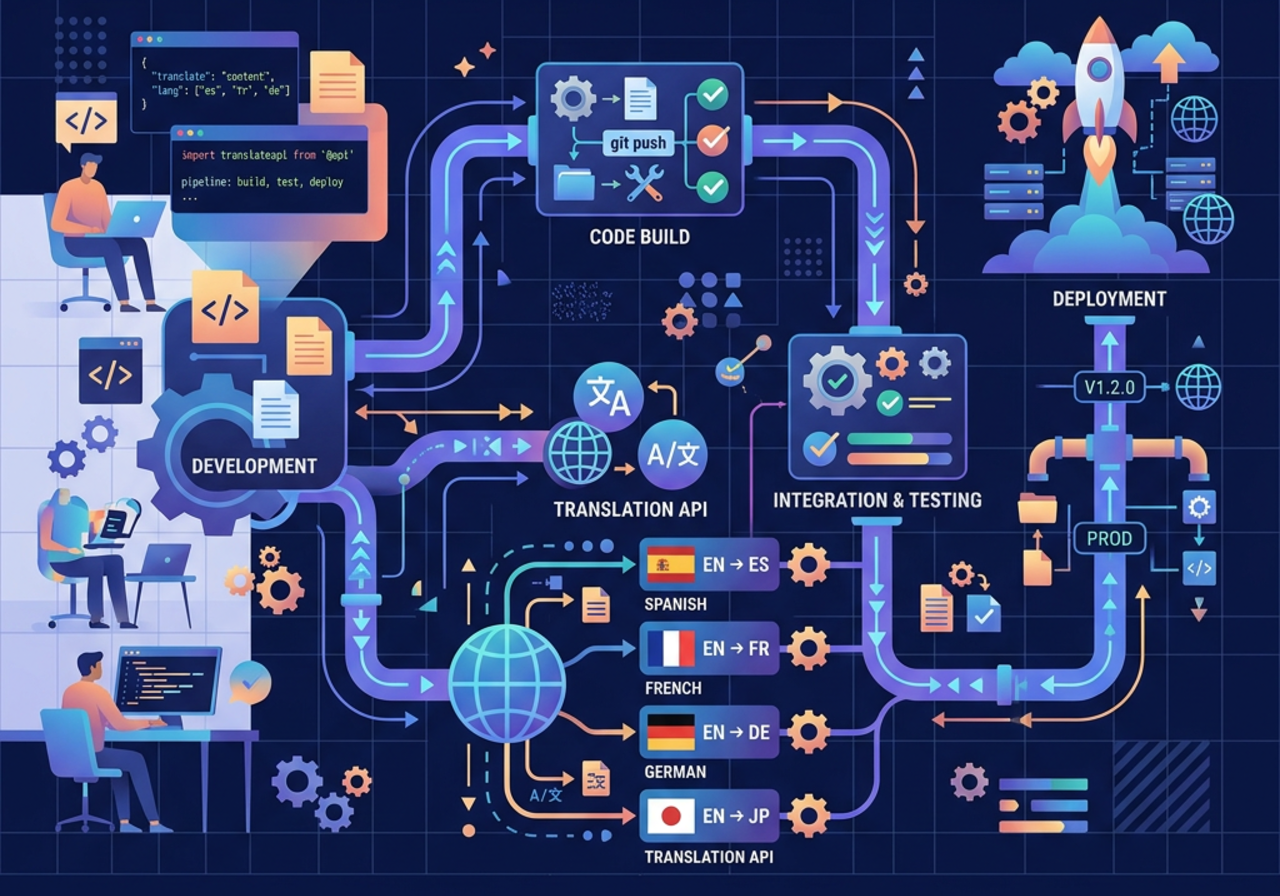
Integrating Translation APIs into CI/CD and Web Stacks
A developer playbook for wiring translation APIs directly into CI/CD pipelines and web stacks: string extraction and resource formats, webhook-driven automation, caching with translation memory, CMS integration, and hreflang management.

Most engineering teams treat localization as an afterthought, a manual handoff that happens days after code freeze, gated by spreadsheets and email threads. The result is predictable: delayed releases, broken strings, missing translations for new locales, and frustrated users. A translation API wired directly into your CI/CD pipeline and web stack eliminates that bottleneck. Instead of batching translation work into large, error-prone handoffs, you ship localized content continuously, alongside every feature branch. This playbook covers the full integration surface, from string extraction and resource formats to webhook-driven automation, caching with translation memory, CMS integration, and hreflang management. Whether you're localizing a SaaS product, a marketing site, or both, these patterns will help you ship faster without sacrificing translation quality.
String Extraction and Resource Formats
Before any translation API call can happen, your source strings need to be extracted from code and stored in a portable, machine-readable format. The format you choose has downstream consequences for context preservation, tooling compatibility, and how gracefully your pipeline handles pluralization and interpolation.
JSON, XLIFF, and PO: Choosing the Right Format
Three formats dominate modern localization workflows:
| Format | Best For | Key Strengths | Limitations |
|---|---|---|---|
| JSON | Web/mobile apps, JavaScript ecosystems | Human-readable, natively parsed in JS, easy to diff in PRs | No built-in metadata for translator notes or state tracking |
| XLIFF (1.2 / 2.0) | Enterprise workflows, CAT tool interop | Rich metadata (notes, state, max-length), industry standard per OASIS XLIFF TC | Verbose XML; harder to hand-edit |
| PO/POT | GNU gettext ecosystems, Python, PHP | Mature tooling, built-in plural forms, widely supported by translators | Less common in modern JS stacks |
For most web applications, flat or nested JSON (using libraries like i18next or react-intl) offers the lowest friction. If your translation vendor or API requires richer metadata, translator notes, character limits, or segment-level state, XLIFF 2.0 is the better choice. PO files remain excellent for backend services built on Python (with gettext) or PHP.
Whichever format you pick, enforce it with a linter in your CI pipeline. A malformed resource file should fail the build before it ever reaches a translation API.
Context Screenshots, Placeholders, and Pluralization
Raw strings without context produce poor translations. A button label like Submit could mean "submit a form," "submit to authority," or "submit a manuscript", and translators need to know which. Context screenshots solve this problem by attaching a visual reference to each string or string group. Tools like Chromatic or Percy can capture UI snapshots during CI runs; you can then attach these as metadata in XLIFF <note> elements or as links stored in a sidecar metadata file or a reserved metadata key alongside your JSON resources.
Placeholders require explicit handling. A string like Welcome, {userName}! You have {count} new messages. must communicate to the translation API (and to human translators) that {userName} and {count} are variables, not translatable text. Most APIs accept placeholder syntax natively, ICU MessageFormat is the most portable standard. Define your placeholder pattern once and validate it with a pre-send check:
// Validate that all source placeholders survive in the translated string function validatePlaceholders(source, translated) { const pattern = /\{(\w+)\}/g; const srcTokens = [...source.matchAll(pattern)].map(m => m[1]); const tgtTokens = [...translated.matchAll(pattern)].map(m => m[1]); return srcTokens.every(t => tgtTokens.includes(t)); }
Pluralization is where many integrations break. English has two plural forms (singular and plural), but Arabic has six, and Polish has four. The Unicode CLDR plural rules define the canonical categories: zero, one, two, few, many, other. Your resource format must support all categories for each locale. ICU MessageFormat handles this elegantly:
{count, plural, =0 {No messages} one {# message} other {# messages} }
Ensure your translation API receives the full plural structure, not just the one and other forms. Missing plural categories cause runtime crashes or grammatically broken output in production.
CI/CD Integration Patterns
The goal is to make localization an invisible, automatic step in your delivery pipeline, not a manual gate. Three patterns make this possible: branch-based localization, webhook-driven syncs, and pull requests for localized resources.
Branch-Based Localization and Webhook Triggers
In a branch-based localization model, every feature branch that modifies source strings triggers a translation cycle. Here's the typical flow:
- A developer adds or modifies strings in the source locale file (e.g., en.json).
- A CI job detects changed strings by diffing the resource file against the base branch.
- The CI job extracts only the new or modified segments and sends them to the translation API.
- The translation API processes the request and fires a webhook when translations are ready.
- A webhook listener (a lightweight service or serverless function) receives the payload and commits the translated resource files back to the branch.
This approach keeps translations scoped to the feature being developed, avoids merge conflicts on large monolithic resource files, and gives developers visibility into translation status before merging.
Webhook payloads should include the locale, the batch identifier, and the completion status. A minimal webhook handler looks like this:
@app.route("/webhook/translations", methods=["POST"]) def handle_translation_webhook(): payload = request.json locale = payload["target_locale"] batch_id = payload["batch_id"] segments = payload["segments"] file_path = f"locales/{locale}.json" existing = load_json(file_path) existing.update({s["key"]: s["translated_text"] for s in segments}) save_json(file_path, existing) create_commit(file_path, f"chore(i18n): update {locale} translations [{batch_id}]") return jsonify({"status": "ok"}), 200
Automated PRs for Localized Resources
Rather than committing translations directly to the feature branch, a cleaner pattern is to open a pull request with the translated resources. This gives reviewers a chance to inspect diffs, run integration tests against the new strings, and catch issues like truncated labels or broken placeholders before merge.
The PR-based workflow:
- The webhook listener creates a new branch (e.g., i18n/feature-xyz-fr) from the feature branch.
- It commits the translated files and opens a PR targeting the feature branch.
- CI runs the full test suite, including pseudo-localization checks and screenshot comparisons, against the PR.
- Once tests pass, the PR is auto-merged or approved by a designated reviewer.
This model integrates cleanly with GitHub Actions, GitLab CI, and Bitbucket Pipelines. It also creates an auditable trail of every translation change, which matters for regulated industries.
API Resilience: Retries, Rate Limits, and Security
Translation APIs are external dependencies. Treating them with the same rigor you'd apply to any third-party service, retry logic, rate limit handling, idempotency, and secure credential management, is essential for production reliability.
Retry Logic and Idempotency
Translation API calls can fail for transient reasons: network timeouts, server errors, or temporary rate limiting. Implement exponential backoff with jitter for retries:
async function callWithRetry(fn, maxRetries = 3) { for (let attempt = 0; attempt <= maxRetries; attempt++) { try { return await fn(); } catch (err) { if (attempt === maxRetries || err.status === 400) throw err; const delay = Math.min(1000 * 2 ** attempt, 10000) + Math.random() * 500; await new Promise(r => setTimeout(r, delay)); } } }
Idempotency is equally important. If a retry sends the same batch twice, you don't want duplicate charges or conflicting translations. Use a client-generated idempotency key (a UUID or a hash of the batch content) and pass it as a header or parameter. Well-designed translation APIs will deduplicate requests based on this key.
Rate Limits, Auth, and Secrets Management
Most translation APIs enforce rate limits, typically expressed as requests per second or characters per minute. Respect these limits proactively:
- Parse Retry-After or X-RateLimit-Reset headers from API responses.
- Implement a client-side token bucket or leaky bucket rate limiter.
- For large batches, chunk requests and process them sequentially or with controlled concurrency.
For authentication, use API keys or OAuth tokens stored in your CI/CD platform's secrets manager, never hardcoded in source. In GitHub Actions, use encrypted secrets; in GitLab, use CI/CD variables marked as protected and masked. Rotate keys on a regular cadence and scope them to the narrowest permissions required (e.g., translate-only, no delete).
A reference .env pattern for local development:
TRANSLATION_API_KEY=your-key-here TRANSLATION_API_URL=https://api.example.com/v2/translate TRANSLATION_API_TIMEOUT_MS=5000
In production CI, these values come from the secrets store, never from the repository.
Ready to see Ollang in action?
Talk to our team about your localization goals and see how the Ollang platform fits your workflow.
Caching, Translation Memory, and Fallbacks
Calling a translation API for every string on every build is wasteful and slow. Intelligent caching and fallback strategies reduce cost, improve speed, and keep your pipeline resilient.
Leveraging Translation Memory and Model Fallbacks
Translation memory (TM) stores previously translated segments and their approved translations. When a new string matches, or fuzzy-matches, an existing TM entry, the API can return the cached translation instantly, often at zero or reduced cost. Enterprise translation platforms such as Ollang expose TM natively and let you manage TM databases per project or domain.
To maximize TM hit rates:
- Keep source strings stable. Avoid unnecessary rewording of existing copy.
- Use consistent terminology. A glossary or termbase enforced at the API level ensures "dashboard" is always translated the same way.
- Segment strings at the sentence level rather than the paragraph level. Shorter segments match more frequently.
Model fallbacks add another layer of resilience. If your primary translation engine is unavailable or returns low-confidence results, fall back to a secondary engine, for example, from a fine-tuned neural model to a general-purpose one. The fallback logic should be transparent to the caller:
def translate(text, source_lang, target_lang): try: result = primary_engine.translate(text, source_lang, target_lang) if result.confidence >= CONFIDENCE_THRESHOLD: return result except ServiceUnavailableError: pass return fallback_engine.translate(text, source_lang, target_lang)
Pseudo-Localization for Early Testing
Pseudo-localization replaces source strings with accented or expanded versions (e.g., Submit becomes [ล รผฦษฑรฎลฃ !!!]) to simulate the visual and functional impact of translation without waiting for real translations. It catches three categories of bugs early:
- Hardcoded strings that weren't externalized into resource files.
- Layout breakage from longer translated text (many locales produce noticeably longer strings than English).
- Broken placeholders or concatenation where translated segments are assembled incorrectly.
Run pseudo-localization as a CI step on every PR. Generate pseudo-localized resource files, boot the application, and run visual regression tests. Any string that appears un-pseudo-localized in the UI is a hardcoded string that needs extraction.
CMS and Website Localization
Marketing sites and content-heavy platforms have different localization needs than application UIs. Content lives in a CMS, pages are generated dynamically or statically, and SEO constraints add another layer of complexity.
CMS Integration and Sitemap-Driven Batching
For headless CMS platforms (Contentful, Sanity, Strapi, WordPress REST API), the integration pattern is event-driven:
- A content author publishes or updates a page in the source locale.
- A CMS webhook fires, sending the content payload to your translation orchestration layer.
- The orchestration layer extracts translatable fields (title, body, meta description, alt text), preserving rich-text structure and inline formatting.
- Segments are sent to the translation API, keyed by content ID and field name.
- Translated content is written back to the CMS via its API, creating or updating locale-specific entries.
For large-scale initial localization, migrating an existing site with hundreds or thousands of pages, sitemap-driven batching is more efficient than event-driven processing. Parse the sitemap XML, extract all URLs, fetch content for each, and queue translation requests in controlled batches. This approach lets you prioritize high-traffic pages, throttle API usage, and track progress across the entire site.
SEO-Safe hreflang and Localized Sitemaps
Search engines rely on hreflang annotations to serve the correct language version of a page to users. Getting hreflang wrong causes duplicate content penalties, ranking dilution, and users landing on pages in the wrong language.
Every localized page must include hreflang tags for all its language variants, including a self-referencing tag. The tags belong in the <head> of each page or in the sitemap:
<link rel="alternate" hreflang="en" href="https://example.com/pricing" /> <link rel="alternate" hreflang="fr" href="https://example.com/fr/pricing" /> <link rel="alternate" hreflang="de" href="https://example.com/de/pricing" /> <link rel="alternate" hreflang="x-default" href="https://example.com/pricing" />
Automate hreflang generation as part of your build or SSR pipeline. When a new locale is added, the build system should automatically add hreflang entries to all existing pages and generate a locale-specific sitemap. Submit localized sitemaps to Google Search Console promptly.
Key rules for SEO-safe localized sites:
- Use consistent URL structures: subdirectories (/fr/) or subdomains (fr.example.com), not query parameters.
- Translate page slugs where appropriate (e.g., /fr/tarifs instead of /fr/pricing), but ensure redirects are in place if slugs change.
- Localize metadata, title tags, meta descriptions, and Open Graph tags, not just body content.
- Validate hreflang with an SEO site-audit tool to catch missing or mismatched annotations.
Reference Architecture
A production-grade translation pipeline ties together all the patterns above. Here's a reference architecture for a typical SaaS product with both an application UI and a marketing site:
โโโโโโโโโโโโโโโโโโโ โโโโโโโโโโโโโโโโโโโโ โโโโโโโโโโโโโโโโโโโโโโโ โ Source Code โโโโโโถโ CI/CD Pipeline โโโโโโถโ Translation API โ โ (app strings) โ โ (GitHub Actions) โ โ (with TM + glossary)โ โโโโโโโโโโโโโโโโโโโ โโโโโโโโโโโโโโโโโโโโ โโโโโโโโโโโโโโโโโโโโโโโ โ โฒ โ โ โ webhook โ โผ โ โผ โโโโโโโโโโโโโโโโโโโโ โโโโโโโโโโโโโโโโโโโโโโโ โ PR with localizedโ โ Quality Review โ โ resource files โ โ (LQA scoring) โ โโโโโโโโโโโโโโโโโโโโ โโโโโโโโโโโโโโโโโโโโโโโ โโโโโโโโโโโโโโโโโโโ โโโโโโโโโโโโโโโโโโโโ โโโโโโโโโโโโโโโโโโโโโโโ โ Headless CMS โโโโโโถโ Translation โโโโโโถโ Translation API โ โ (marketing site)โ โ Orchestrator โ โ (same TM + glossary)โ โโโโโโโโโโโโโโโโโโโ โโโโโโโโโโโโโโโโโโโโ โโโโโโโโโโโโโโโโโโโโโโโ โ โ โผ โผ โโโโโโโโโโโโโโโโโโโโ โโโโโโโโโโโโโโโโโโโโโโโ โ CMS locale โ โ hreflang + sitemap โ โ entries updated โ โ generation โ โโโโโโโโโโโโโโโโโโโโ โโโโโโโโโโโโโโโโโโโโโโโ
Both paths, application and CMS, share the same translation memory and glossary, ensuring terminological consistency across product and marketing. The translation orchestrator handles batching, retries, rate limiting, and fallback logic. For teams evaluating a managed solution that covers this full surface, text, software, website, and document localization with API integration and quality review, consider requesting a tailored Ollang demo to see how the platform fits into your existing stack. Ollang consolidates translation memory, glossary management, API orchestration, and quality review so you can manage the full pipeline from a single platform.
Testing, Rollback, and Release Strategy
Localization bugs are production bugs. Treat them with the same testing and rollback discipline you apply to code changes.
Test plan for localized releases:
- Unit tests: Validate that all resource files parse correctly and contain no duplicate keys.
- Placeholder integrity tests: Assert that every translated string preserves source placeholders.
- Pseudo-localization visual tests: Run on every PR to catch hardcoded strings and layout overflow.
- Integration tests: Boot the app with each target locale and run smoke tests for critical user flows.
- hreflang validation: Automated checks that every localized page has correct, reciprocal hreflang tags.
Rollback strategy:
Because translated resource files are committed via PRs, rollback is a standard git revert. If a bad translation ships, revert the translation PR, which restores the previous version of the resource files. For CMS content, maintain version history on locale entries so you can restore the prior published version without affecting the source locale.
Release cadence tips:
- Decouple translation completion from release gating. Ship with available translations and backfill missing locales asynchronously.
- Use feature flags to hide untranslated UI behind a locale-aware gate.
- Set SLAs for translation turnaround (e.g., 24 hours for UI strings, 48 hours for long-form content) and alert when SLAs are at risk.
FAQ
What resource format should I use for a React or Next.js application?
JSON is the most natural fit for JavaScript-based stacks. Libraries like react-intl and next-intl consume JSON natively, and JSON diffs are easy to review in pull requests. If you need to pass translator notes or enforce character limits, consider wrapping your JSON workflow with XLIFF export/import for the translation step, then converting back to JSON for the application. If you need an integrated export/import flow, platforms like Ollang can automate XLIFF roundtrips and manage the workflow.
How do I handle translation for feature branches that haven't merged yet?
Use the branch-based localization pattern: extract changed strings on each feature branch, send them for translation scoped to that branch, and merge translated resources via a PR targeting the feature branch. This keeps translation work isolated and avoids conflicts on shared resource files. If two branches modify the same string, the merge to main will surface the conflict through standard Git resolution.
What happens if the translation API is down during a CI build?
Your pipeline should not fail the build due to a translation API outage. Implement a graceful degradation path: if the API is unreachable after retries, log a warning, skip the translation step, and proceed with the existing resource files. Open a tracking issue or send an alert so the translation batch is retried on the next pipeline run or via a scheduled job.
How do I ensure translated content doesn't break my site's SEO?
Automate hreflang tag generation as part of your build process so every localized page includes correct, reciprocal annotations. Generate locale-specific sitemaps and submit them to search engines. Translate metadata (titles, descriptions, Open Graph tags) alongside body content. Run automated audits with SEO site-audit tools to catch orphaned hreflang references or missing locale pages before they impact rankings.
Ready to see Ollang in action?
Talk to our team about your localization goals and see how the Ollang platform fits your workflow.
Next Steps: See a Tailored Integration
If you'd like to evaluate a managed platform that integrates with CI/CD, CMSs, and your translation workflow, schedule a tailored Ollang demo. Youโll see how TM, glossary enforcement, webhook automation, and quality review come together in one place to accelerate localized releases without sacrificing quality.
Published on July 28, 2026