
Multilingual Style Guides: Tone, Formality, and Inclusive Language
How to write multilingual style guides that travel well: tone and formality decisions per locale, inclusive language standards, and the reference structures that keep translated copy on-brand across markets.

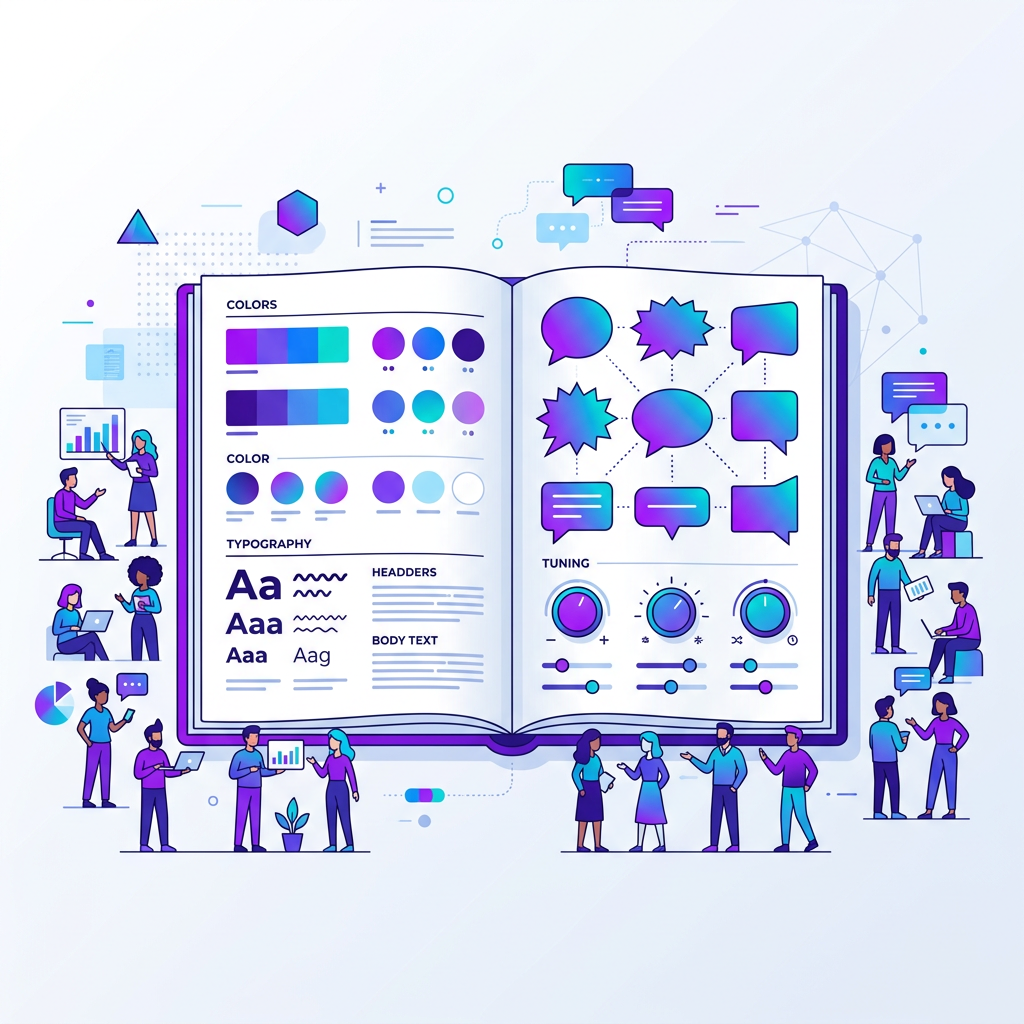
Most localization quality problems are not translation errors, they are style inconsistencies. A product string rendered in overly formal German, a support article in Latin American Spanish that reads like it was written for Madrid, or a CTA that sounds aggressive in Japanese: these issues erode user trust and inflate review cycles. A well-constructed multilingual style guide eliminates ambiguity before translators ever open a file. It codifies tone, formality registers, inclusive language expectations, and microcopy patterns so that every linguist, reviewer, and MT engine works from the same playbook. This article walks through the practical architecture of scalable multilingual style guides, from audience personas and T-V pronoun decisions to controlled language rules that improve machine translation output and governance workflows that keep guides current.
Why Multilingual Style Guides Matter
A monolingual style guide protects brand voice in one language. A multilingual style guide does something harder: it ensures that voice survives adaptation into languages with fundamentally different grammatical structures, politeness systems, and cultural registers.
Without one, localization teams default to translator preference. That means one linguist might use the informal "tĂș" in Spanish while another uses "usted", within the same product. According to CSA Research, inconsistent terminology and style are among the top reasons enterprises escalate localization costs through rework. The guide is the cheapest quality intervention available because it prevents errors at the source.
Style guides also reduce onboarding time for new vendors or linguists. Instead of absorbing tribal knowledge over weeks, a translator can consult a concrete reference document and start producing on-brand content immediately.
Aligning Brand Voice Across Locales and Content Types
Brand voice is not a single setting, it is a spectrum that flexes across content types and markets. A fintech company might be conversational in its marketing emails but precise and neutral in its regulatory disclosures. Both registers still need to feel like the same brand.
A multilingual style guide achieves this by defining:
- Voice constants, attributes that never change regardless of locale (e.g., "We are always clear, never condescending").
- Locale-specific registers, how those constants manifest in each language (e.g., clarity in German may require shorter compound nouns; clarity in Japanese may require explicit subject markers).
- Content-type modifiers, adjustments for help center articles versus in-app strings versus legal notices.
This layered approach prevents the common mistake of treating style as a flat, one-size-fits-all document.
The Cost of Inconsistency: Rework, Brand Erosion, and User Confusion
Inconsistent translations create compounding problems. Users lose confidence when the same product addresses them formally in one screen and informally in the next. Support teams waste hours answering tickets that stem from confusing microcopy. And review cycles balloon when editors must correct stylistic drift that a guide would have prevented.
The downstream cost is measurable: organizations that lack style governance typically see higher per-word review costs and longer time-to-publish for localized content. Beyond cost, there is a brand perception risk. Research from Common Sense Advisory (now CSA Research) has consistently shown that consumers are significantly more likely to purchase from sites that address them in their own language, and in a tone that feels native, not translated.
Building Audience Personas per Locale
Defining Demographics, Preferences, and Cultural Context
A style guide without audience personas is a style guide built on assumptions. Before making any tone or formality decision, teams need to define who they are writing for in each market.
Effective locale-specific personas go beyond demographics. They capture:
- Digital literacy and product familiarity, A B2B SaaS user in Stockholm has different expectations than a first-time mobile banking user in Lagos.
- Cultural communication norms, Direct communication styles common in the Netherlands differ sharply from the high-context, indirect norms prevalent in Japan or South Korea.
- Content consumption habits, Does the audience prefer long-form documentation or scannable bullet points? Do they expect formal salutations in emails?
These personas should be co-created with in-market teams or native-speaking linguists, not extrapolated from the source-language persona.
Mapping Personas to Tone Decisions
Once personas exist, they become the decision engine for every stylistic choice. A persona for a young, tech-savvy Brazilian audience might justify the use of "vocĂȘ" and casual sentence fragments in UI strings. A persona for a German enterprise buyer might demand "Sie," complete sentences, and restrained punctuation.
Document these mappings explicitly in the style guide as a reference table:
| Locale | Primary Persona | Formality | Tone Keywords | Pronoun |
|---|---|---|---|---|
| pt-BR | Millennial mobile user | Informal | Friendly, direct, encouraging | VocĂȘ |
| de-DE | Enterprise IT buyer | Formal | Precise, respectful, neutral | Sie |
| ja-JP | General consumer | Polite-formal | Helpful, humble, clear | ă§ă/ăŸă form |
| es-MX | Young professional | Semi-formal | Warm, approachable, clear | TĂș |
This table is a quick-reference anchor for translators and reviewers alike.
Tone and Formality: Getting T-V Choices Right
Understanding T-V Distinction Across Languages
The T-V distinction, named after the Latin "tu" (informal) and "vos" (formal), is one of the most consequential style decisions in multilingual content. Languages like French, German, Spanish, Portuguese, Korean, and Japanese encode social distance directly into grammar. Choosing the wrong register is not a minor style preference; it can make a brand sound either presumptuous or cold.
In French, the choice between "tu" and "vous" carries significant weight. Most consumer-facing tech brands have shifted toward "tu" in recent years, but B2B and financial services companies often retain "vous." In Korean, honorific levels are even more granular, with multiple speech levels that affect verb endings, vocabulary, and even sentence structure.
The style guide must make these choices explicit and non-negotiable. Leaving them to individual translator judgment guarantees inconsistency.
Documenting Formality Registers for Each Target Language
For each target language, the guide should include:
- The chosen pronoun or address form, with justification tied to the audience persona.
- Verb conjugation implications (e.g., imperative mood in informal Spanish differs from formal).
- Exceptions by content type, for instance, legal disclaimers may require formal address even if the product UI uses informal.
- Examples of correct and incorrect usage in context.
A simple do/don't format works well here:
German (de-DE), Formal register chosen:
- â Geben Sie Ihre E-Mail-Adresse ein. (Enter your email address, formal)
- â Gib deine E-Mail-Adresse ein. (Enter your email address, informal)
Brazilian Portuguese (pt-BR), Informal register chosen:
- â Insira seu e-mail. (Enter your email, informal)
- â Insira o seu endereço de correio eletrĂŽnico. (Overly formal and verbose)
Reading Level Targets and Sentence Structure
Setting Readability Benchmarks by Language
Reading level targets ensure content remains accessible. In English, many organizations target a Flesch-Kincaid grade level between 6 and 8 for consumer-facing content. But readability formulas are language-specific, and not every language has a widely adopted equivalent.
For languages without established readability indices, the style guide can set proxy rules:
- Maximum sentence length (e.g., 20 words for UI strings, 25 for help articles).
- Preference for active voice.
- Avoidance of double negatives.
- Limits on subordinate clause nesting, particularly important in German and Dutch, where nested clauses can extend sentences dramatically.
These rules serve a dual purpose: they improve human comprehension and they produce cleaner input for machine translation engines.
Sentence Length, Active Voice, and Clarity Rules
Concrete sentence-level rules are more actionable than abstract guidance like "write clearly." Effective style guides specify:
- Sentence length caps per content type (shorter for UI, slightly longer for documentation).
- Active voice preference with named exceptions (e.g., passive may be appropriate in Japanese to soften directives).
- One idea per sentence, this is especially critical for content that will be machine-translated, as MT engines handle simple structures more reliably.
- Avoidance of idiomatic expressions in source content, since idioms rarely survive translation intact.
Punctuation, Quotation Marks, and Typographic Norms
Punctuation is deceptively complex across languages. French requires a non-breaking space before colons, semicolons, question marks, and exclamation marks. German uses âlow-highâ quotation marks. Japanese uses ăcorner bracketsă instead of quotation marks. Spanish opens questions and exclamations with inverted marks (Âż and ÂĄ).
A style guide should include a punctuation reference table for each target language covering:
| Element | en-US | fr-FR | de-DE | ja-JP | es-MX |
|---|---|---|---|---|---|
| Quotation marks | "âŠ" | « ⊠» | ââŠâ | ăâŠă | «âŠÂ» or "âŠ" |
| Decimal separator | . (period) | , (comma) | , (comma) | . (period) | . (period) |
| Thousands separator | , (comma) | (space) | . (period) | , (comma) | , (comma) |
| List separator | , (comma) | ; (semicolon) | ; (semicolon) | ă | , (comma) |
These details are minor until a misplaced decimal separator turns a price of 1.500 into 1,500, or vice versa.
Number, Date, and Unit Formatting Standards
Locale-Aware Formatting for Dates, Currencies, and Measurements
Date formats alone can cause confusion. "01/02/2025" means January 2 in the US and February 1 in most of Europe. The style guide must specify the expected format per locale and, ideally, align with CLDR (Unicode Common Locale Data Repository) standards to ensure consistency with platform-level formatting.
Key formatting decisions to document:
- Date format: MM/DD/YYYY (en-US), DD/MM/YYYY (en-GB, fr-FR), YYYYćčŽMMæDDæ„ (ja-JP).
- Time format: 12-hour with AM/PM (en-US) versus 24-hour (de-DE, fr-FR).
- Currency placement: $100 (en-US), 100 ⏠(fr-FR), 100,00 ⏠(de-DE).
- Measurement system: Imperial for en-US, metric for nearly all other locales.
Handling Ambiguity in Numeric and Temporal Data
When source content contains ambiguous numeric references, the guide should instruct translators on how to resolve them. For example, Q1 may need to be rendered as 1er trimestre in French or left as Q1 if the audience uses English business terminology. Similarly, fiscal year boundaries differ by country, so FY2025 may need clarification.
The rule of thumb: if a number or date could be misread, the guide should mandate explicit formatting or a translator query.
Ready to see Ollang in action?
Talk to our team about your localization goals and see how the Ollang platform fits your workflow.
Inclusive and Accessible Language
Gender-Neutral Strategies Across Gendered Languages
Inclusive language is a moving target, and gendered languages present particular challenges. In English, shifting to "they/them" as a singular pronoun is now widely accepted. In Spanish, French, German, and other grammatically gendered languages, the solutions are more complex and sometimes contested.
Practical approaches by language:
- Spanish: Some brands use usuario/a or the more neutral persona usuaria. The use of x or e endings (e.g., usuarix or usuarie) remains controversial and is not universally understood.
- French: Inclusive writing techniques like midpoints (e.g., utilisateur·rice) are used by some organizations but rejected by the Académie française. The style guide should take a clear position.
- German: The gender star (e.g., Benutzer*innen) or the colon (e.g., Benutzer:innen) are increasingly common in progressive and public-sector communications.
- Portuguese: Similar to Spanish, with o/a constructions or rephrasing to avoid gendered terms entirely.
The style guide must make a definitive choice for each locale rather than leaving it to translator discretion. That choice should be informed by the brand's values, the target audience's expectations, and local regulatory or institutional norms.
Disability, Age, and Cultural Sensitivity Guidelines
Beyond gender, inclusive language encompasses disability-first versus person-first language, age-neutral phrasing, and cultural sensitivity. The guide should specify:
- Use person-first language ("users with visual impairments") or identity-first language ("blind users") based on the preference dominant in each locale's disability community.
- Avoid age-based assumptions ("even your grandmother can use it").
- Flag culturally loaded metaphors, colors, or symbols that carry different connotations across markets (e.g., white symbolizes mourning in some East Asian cultures).
- Ensure that examples, names, and imagery in localized content reflect the diversity of the target audience.
Microcopy Patterns: Errors, Empty States, and CTAs
Crafting Consistent UI Strings Across Languages
Microcopy, the small strings that guide users through a product, is where style inconsistency is most visible and most damaging. Error messages, empty states, tooltips, and CTAs are high-frequency touchpoints that shape the user's emotional experience.
The style guide should define patterns for each microcopy category:
- Error messages: Lead with what happened, then what the user can do. Avoid blame language. Example pattern: [What went wrong]. [What to do next].
- Empty states: Use encouraging, forward-looking language. Avoid Nothing here in favor of Get started by [action].
- CTAs: Specify verb form (imperative vs. infinitive), maximum character count, and capitalization rules per locale.
- Confirmation messages: Define whether to use Done, Success, Got it, or locale-appropriate equivalents.
Do/Don't Examples for Translators
Concrete examples are the most effective section of any style guide. For each microcopy pattern, provide parallel do/don't strings in the source language and at least one target language:
Error message (en-US â fr-FR):
- â EN: We couldn't save your changes. Please try again.
- â FR: Vos modifications n'ont pas pu ĂȘtre enregistrĂ©es. Veuillez rĂ©essayer.
- â FR: Erreur ! Impossible de sauvegarder. (Too abrupt, missing guidance)
CTA (en-US â de-DE):
- â EN: Start free trial
- â DE: Kostenlos testen (Infinitive form, concise)
- â DE: Starten Sie jetzt Ihre kostenlose Testversion (Too long for a button)
These examples train translators faster than abstract rules ever could.
Controlled Language Rules to Improve MT Output
Machine translation engines perform best on predictable input. Controlled language rules constrain the source content to structures that MT handles reliably, reducing post-editing effort and improving consistency.
Effective controlled language rules include:
- One term, one meaning: Do not use set to mean both configure and collection in the same content set.
- No phrasal verbs when a single verb exists: Use configure instead of set up, remove instead of take out.
- No elliptical constructions: Write Click the button that says "Save" instead of Click Save.
- Avoid humor, wordplay, and cultural references in source strings destined for MT.
- Standardize terminology using a term base that the MT engine can reference.
These rules benefit human translators too, but their impact on MT quality is particularly significant. Organizations that adopt controlled authoring practices consistently report reduced post-editing time and fewer critical errors in MT output.
If your team is exploring how to integrate controlled language with MT workflows at scale, book a demo with Ollang to see how the platform enforces terminology, integrates with MT/TM, and automates quality-review workflows across languages: https://ollang.com/book-a-demo
Governance: Keeping Style Guides Current
Ownership, Review Cadence, and Change Management
A style guide that is never updated becomes a historical artifact. Governance ensures the guide evolves with the brand, the product, and the languages it covers.
Assign clear ownership:
- Global owner: Typically a localization program manager or content strategist who maintains the master guide and approves changes.
- Locale owners: In-market linguists or localization leads who propose updates based on evolving language norms, user feedback, or regulatory changes.
- Review cadence: Quarterly reviews are a practical minimum. Major product launches or brand refreshes should trigger ad hoc reviews.
Change management should follow a lightweight but documented process: proposed change â review by locale owner â approval by global owner â version update â notification to all stakeholders.
Version Control and Stakeholder Notifications
Style guides should be versioned with clear changelogs. When a guide is updated, all active translators, reviewers, and vendor project managers must be notified, ideally through a localization platform such as Ollang or the TMS they already use, not through an email that gets buried.
Maintain a changelog that specifies:
- What changed and why.
- Which locales are affected.
- The effective date.
- Whether existing translations need retroactive updates.
Distribution and Onboarding for Vendors and Reviewers
Making the Guide Accessible and Actionable
A style guide locked in a PDF on someone's desktop is useless. Distribution strategy matters as much as content quality.
Best practices for distribution:
- Host the guide in a centralized, always-current location, a localization platform such as Ollang, a TMS, a wiki, or a shared workspace.
- Provide locale-specific views so that a French translator sees only the French guide, not a 90-page omnibus document.
- Include a quick-reference card (one page) with the five most critical rules for each locale, suitable for printing or pinning.
- Make the guide searchable. Translators working on a tight deadline will not read 40 pages; they will search for "date format" or "gender-neutral."
Onboarding New Linguists with Style Guide Training
New translators should complete a brief onboarding exercise before starting production work:
- Read the locale-specific guide (not the full global document).
- Complete a short style test, five to ten strings that test key decisions (formality, microcopy patterns, formatting).
- Receive feedback from a reviewer before entering the production workflow.
This process takes a few hours and prevents weeks of corrective feedback. It also gives localization managers a signal about linguist fit before committing to a full project.
Metrics to Track Style Guide Adherence
Measuring Consistency and Quality Over Time
What gets measured gets maintained. Style guide adherence should be tracked through a combination of automated and human evaluation:
- LQA (Linguistic Quality Assurance) scores: Track style-related error categories (tone, formality, terminology) separately from accuracy errors. A declining style score signals guide drift or onboarding gaps.
- Terminology consistency rate: Measure how often approved terms are used versus unapproved variants. TMS-integrated term bases can automate this.
- Review rejection rate by error type: If a high percentage of rejections are style-related, the guide may need clarification or the translator may need retraining.
- Time-to-publish: A well-adopted style guide should reduce review cycles over time. If it does not, the guide may be too complex or poorly distributed.
Using Feedback Loops to Refine the Guide
Metrics are only useful if they feed back into guide improvements. Establish a quarterly feedback loop:
- Collect LQA data and reviewer comments.
- Identify recurring style issues by locale.
- Determine whether the issue stems from a gap in the guide, a training gap, or a legitimate language evolution.
- Update the guide, notify stakeholders, and monitor whether the issue resolves in the next cycle.
This continuous improvement loop is what separates a living style guide from a static document.
Frequently Asked Questions
How long should a multilingual style guide be?
There is no ideal page count, but the most effective guides are modular. A global section covering universal brand voice principles might be five to ten pages. Each locale-specific appendix should be ten to fifteen pages, covering formality, punctuation, formatting, inclusive language, and microcopy patterns. If the guide exceeds thirty pages for a single locale, it is likely too detailed to be practical, consider splitting it into a quick-reference card and a full reference document.
Should we create one style guide or separate guides per language?
A hybrid approach works best. Maintain a single global style guide that defines brand voice constants, content-type modifiers, and universal rules (like controlled language for MT). Then create locale-specific supplements that address formality registers, punctuation norms, inclusive language choices, and formatting standards. This structure avoids redundancy while ensuring each translator has clear, locale-relevant guidance.
How do we handle style guide disagreements between linguists?
Disagreements are healthy, they often surface genuine ambiguities in the guide. Route disputes to the designated locale owner for resolution. If the disagreement reflects a broader shift in language norms (e.g., evolving gender-neutral conventions in French), escalate it to the global owner for a policy decision. Document the resolution and update the guide so the same question does not arise again.
Can a style guide improve machine translation quality?
Yes. Controlled language rules, such as avoiding phrasal verbs, limiting sentence length, and enforcing one-term-one-meaning policies, produce source content that MT engines translate more predictably. When combined with an enforced term base and consistent style patterns, organizations typically see meaningful reductions in post-editing effort. The style guide effectively trains both humans and machines to produce consistent output.
Ready to see Ollang in action?
Talk to our team about your localization goals and see how the Ollang platform fits your workflow.
Start Building Your Multilingual Style Guide Today
A multilingual style guide is not a nice-to-have, it is the foundation of scalable, consistent localization. Without one, every translation is a coin flip between on-brand and off-brand. With one, teams can onboard new linguists faster, reduce review cycles, improve MT output, and deliver a product experience that feels native in every market.
The principles in this article give you a framework to start. If you are ready to operationalize style governance across languages, content types, and workflows, book a demo with Ollang to see how enterprise localization teams manage tone, terminology, and quality at scale: https://ollang.com/book-a-demo
Published on July 28, 2026