
Back to Partners
Guide

Multimodal Localization: Localizing Images, Audio & Video at Scale

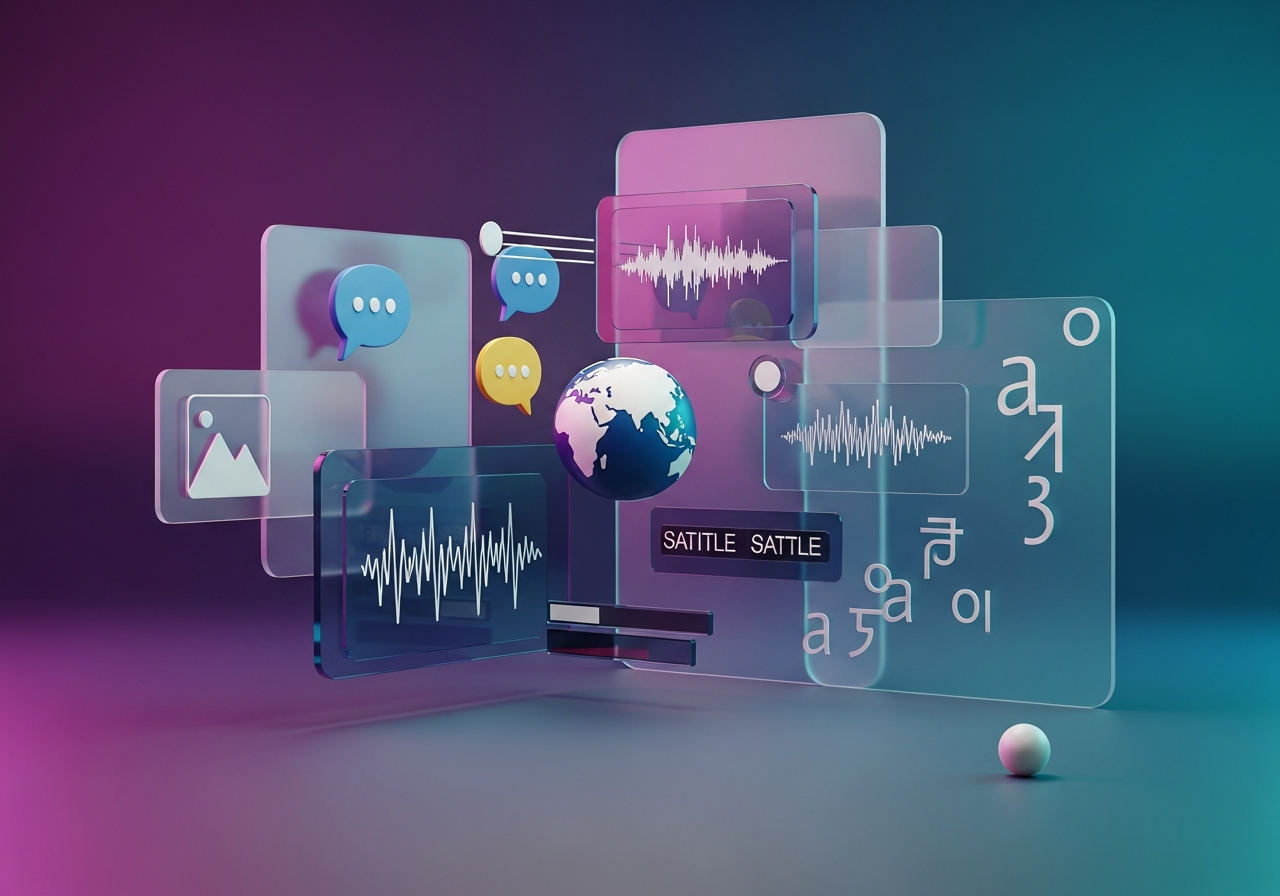
Multimodal localization adapts not just text but images, audio, video, and interactive UI elements for different languages, cultures, and markets. As global products grow more visually and experientially rich, translating strings alone no longer works.

Multimodal Localization: Localizing Images, Audio & Video at Scale

Multimodal localization adapts not just text but images, audio, video, and interactive UI elements for different languages, cultures, and markets. As global products grow more visually and experientially rich, translating strings alone no longer works. Users expect culturally relevant visuals, natural-sounding voiceovers, properly formatted subtitles, and interfaces that feel native regardless of locale. This discipline sits at the intersection of traditional localization, computer vision, speech technology, and cultural adaptation. For teams building products at scale, coordinating these diverse asset types efficiently is the difference between a truly global experience and one that feels like an afterthought. Here is what it takes to localize multimodal content well.

What is multimodal localization?

Multimodal localization extends translation and localization to every content type a user encounters: images with embedded text or culturally specific imagery, audio narration and voiceovers, video with subtitles or dubbed dialogue, and interactive UI components like buttons, tooltips, and onboarding flows. Rather than treating each modality as a separate workflow, modern multimodal localization treats them as interconnected assets that must be adapted together to deliver a coherent user experience.

The term "multimodal" comes from AI research, where it describes systems that process and reason across multiple input types simultaneously. The parallel is apt: a single product screen might contain a hero image with text overlay, an explainer video, and a set of interactive controls — all of which need to be localized in concert to avoid jarring inconsistencies.

Why text-only localization falls short

Text-only workflows miss most of what users actually see and hear. A perfectly translated UI string loses its impact next to a stock photo that's culturally irrelevant, or when the accompanying tutorial video is only available in English. Full, native-feeling experiences drive higher engagement and conversion. Text-only localization also creates accessibility gaps: users who rely on audio descriptions, video captions, or visual cues are underserved when those assets are not adapted.

Modalities covered: images, audio, video, and interactive UI

Each modality carries its own localization challenges.

Images: Embedded text, culturally specific symbols, color associations, reading direction (LTR vs. RTL), and representation in photography all require attention.

Audio: Voiceover recording, text-to-speech generation, tone and pacing adjustments, and music licensing across regions.

Video: Subtitle timing and formatting, dubbing, on-screen text replacement, and visual content adaptation.

Interactive UI: Layouts that accommodate text expansion or contraction, locale-aware date/time/currency formatting, and interaction patterns that vary by market.

A mature multimodal localization strategy addresses all of these in a unified pipeline, not as add-ons.

Why multimodal localization matters for global products

User experience and engagement

Users form impressions in milliseconds. If a product's visuals, audio, and interactions feel foreign, trust erodes before the user reads a word. Fully localized multimodal experiences reduce cognitive friction, increase time on task, and improve satisfaction. For content-heavy products — e-learning platforms, streaming services, and e-commerce — the effect is especially pronounced because rich media is the primary vehicle for engagement.

Revenue and market expansion

Localized multimedia content directly affects conversion. App store listings with localized screenshots and preview videos outperform text-only translations. Marketing campaigns with region-specific video and imagery generate higher click-through rates and lower cost-per-acquisition. The cost of not localizing rich media is measured in missed market share.

Regulatory and accessibility drivers

Many markets now require localized content for specific industries. The EU’s accessibility directives require captioned and audio-described video. Healthcare and financial sectors face strict requirements for localized visual disclosures. Accessibility standards like WCAG 2.1 extend to multimedia, making localized captions, transcripts, and alt text compliance requirements.

AI-driven workflows for multimodal content

Image localization with vision models

Modern vision models can detect, extract, and replace text embedded in images — a task that used to require manual graphic design for every locale. AI-powered OCR identifies text regions, machine translation handles the linguistic conversion, and inpainting models reconstruct backgrounds so new text blends naturally. Beyond text, image classifiers can flag culturally sensitive content (gestures, symbols, attire) for human review. The result: a pipeline that handles mechanical work at scale while routing cultural decisions to experts.

Audio and voice adaptation

Text-to-speech systems have reached near-human quality in dozens of languages, making it feasible to generate localized voiceovers without booking studio time for every locale. Neural TTS engines can clone a brand voice across languages, preserving tone and personality. For higher-stakes content — advertising or e-learning narration — AI-generated drafts speed production and provide a solid base for voice talent to refine. Speech-to-text models also accelerate transcription of source audio, feeding downstream subtitle and dubbing workflows.

Video subtitle and dubbing pipelines

Video localization pipelines chain automatic speech recognition (ASR), machine translation, subtitle timing engines, and lip-sync dubbing models. ASR generates source-language transcripts, MT produces target-language text, timing algorithms adjust subtitle segmentation to match cadence, and lip-sync tools adjust mouth movements for dubbed tracks. Each step can introduce errors, so human review remains essential, but automation shortens timelines from weeks to days.

Retrieval-based geolocation and visual context

An emerging capability is using AI to infer where an image was taken, enabling smarter localization decisions based on geographic and cultural context. Systems like TransGeoCLIP demonstrate how vision-language models can geolocate images by learning locational distances between visually similar photos and dynamically reordering retrieval databases to resolve ambiguity. On standard benchmarks, TransGeoCLIP improved 1 km street-level localization accuracy on YFCC26k by 9.75% (arxiv.org), improved 1 km localization on IM2GPS by 1.5% and on YFCC4k by 7.18%, and outperformed prior baselines on IM2GPS3k by margins of 1.41% to 2.67% across distance thresholds. Teams can apply models like TransGeoCLIP to inform which cultural adaptations an image asset requires, addressing a common failure mode where visually similar images from different regions are misclassified.

Tooling and platform choices

What to look for in a multimodal localization platform

Key capabilities to evaluate.

Asset-type support: Can the platform ingest and process images, audio, video, and UI strings in a single project?

AI integration: Does it offer built-in or pluggable MT, TTS, ASR, and vision models?

Context preview: Can reviewers see translations in visual context, like screenshots or video frames?

Workflow orchestration: Does it support parallel workflows across modalities with dependency management?

API and CI/CD integration: Can it plug into your build pipeline for continuous localization?

Role-based review: Does it support distinct reviewer roles for linguistic, cultural, and technical QA?

Ready to see Ollang in action?

Talk to our team about your localization goals and see how the Ollang platform fits your workflow.

Book a Demo

How Ollang orchestrates multimodal assets

Ollang’s platform handles multimodal localization without fragmenting work across disconnected tools. It ingests diverse asset types into a unified project workspace, applies AI-driven pre-processing (OCR, ASR, MT) to generate draft localizations, and routes each asset to the appropriate review stage based on content type and risk level. The platform maintains asset relationships — linking a video's subtitle file to its source transcript or an image's localized overlay to its design template — so changes propagate cleanly. This orchestration layer turns a collection of point solutions into a coherent, scalable workflow, reducing the operational overhead of coordinating specialists and allowing teams to focus on cultural decisions.

Quality assurance across modalities

Linguistic and cultural review

Linguistic QA for multimodal content goes beyond grammar and terminology. Reviewers evaluate whether translated text fits spatially within an image, whether a voiceover's tone matches the brand, and whether video subtitles are readable at playback speed. Cultural review adds another layer: are the visuals appropriate for the target market, does the color palette carry unintended connotations, does humor in a dubbed script land as intended? These reviews require reviewers with both linguistic expertise and cultural fluency.

Automated QA checks

Automation handles mechanical QA tasks that are tedious but critical.

Character limits: Flag translations that overflow image text boxes or subtitle display areas.

Timing validation: Ensure subtitle segments don’t overlap or flash too quickly.

Audio sync: Check dubbed audio alignment with video timing within acceptable tolerances.

Consistency: Verify terminology across modalities (e.g., the same product name in UI, video, and help docs).

File integrity: Confirm exported assets meet format, resolution, and encoding specs.

These checks run automatically on every asset, catching issues before they reach human reviewers and reducing review cycles.

Measuring success: KPIs and ROI

Key metrics for multimodal localization

Measure both operational efficiency and output quality.

Turnaround time per modality: Time to localize an image batch, a video, or an audio file from source to approved.

First-pass acceptance rate: Percentage of AI-generated drafts that pass human review without revision.

Error density: Issues per 1,000 words or per minute of audio/video found in QA.

Coverage: Percentage of your content catalog localized across all modalities.

User-facing metrics: Engagement, conversion, and support ticket volume by locale.

Calculating ROI

ROI should account for cost savings and revenue impact. Compare per-asset costs of fully manual workflows (designer time, studio recording, manual subtitling) against AI-assisted pipelines. Typical savings range from 40% to 70% on per-asset production costs when AI handles first drafts. On the revenue side, measure incremental lift in conversion, retention, or market penetration attributable to fully localized experiences. The strongest business cases are in markets where competitors haven’t invested in multimodal localization — a better local experience translates into market share.

Common pitfalls and how to avoid them

Context loss across modalities

A frequent failure mode is localizing each modality in isolation. When translators work on UI strings without seeing the accompanying images, or subtitle translators don’t have access to the video’s visual context, inconsistencies creep in. The fix is structural: use a platform that provides visual context for every asset and ensure reviewers can see how modalities come together in the final product.

Over-reliance on automation

AI accelerates multimodal localization but doesn’t replace human judgment. Machine-translated subtitles may be linguistically correct but culturally tone-deaf. AI-generated voiceovers may mispronounce proper nouns. Inpainted images can introduce artifacts. The right approach is human-in-the-loop: let AI do the heavy lifting and build review gates wherever cultural nuance or brand voice matters.

Ignoring locale-specific technical constraints

Different markets have different technical realities. Video encoding standards vary. Audio bitrate expectations differ by bandwidth. Image file sizes matter more where data costs are high. RTL layouts break assumptions baked into LTR design systems. These technical details are easy to overlook but can undermine even the best linguistic work.

Compliance and data privacy considerations

Multimodal content raises data privacy issues that text-only localization rarely triggers. Voice recordings may constitute biometric data under GDPR and state laws like Illinois’s BIPA. Images of people raise consent and likeness-rights issues that vary by jurisdiction. Video content may be subject to broadcast regulations. AI-generated voices and likenesses add legal complexity as synthetic media regulations evolve.

A responsible multimodal localization program includes:

Clear data processing agreements with vendors and platform providers.

Consent workflows for voice talent or individuals depicted in visual content.

Data residency controls to ensure content is processed and stored in compliant jurisdictions.

Audit trails documenting which AI models were used and what human review occurred.

Ready to see Ollang in action?

Talk to our team about your localization goals and see how the Ollang platform fits your workflow.

Book a Demo

Implementation checklist

Use this checklist to plan and execute a multimodal localization pilot:

  1. Audit your content: Catalog all asset types (images, audio, video, UI) and their current localization status.
  2. Prioritize by impact: Start with the modalities and markets that drive the most engagement or revenue.
  3. Select your platform: Choose a tool that supports all your modalities in a unified workflow; fragmented toolchains create fragmented quality. Consider platforms like Ollang that centralize assets and workflows.
  4. Establish style guides per modality: Define tone of voice for audio, visual standards for images, subtitle conventions for video, and UI patterns for interactive elements.
  5. Build AI-assisted draft pipelines: Configure MT, TTS, ASR, and vision models for first-pass generation.
  6. Design review workflows: Assign linguistic, cultural, and technical reviewers with clear responsibilities per modality.
  7. Automate QA checks: Implement validation for character limits, timing, sync, consistency, and file integrity.
  8. Measure and iterate: Track turnaround time, acceptance rates, error density, and user-facing metrics from day one; use the data to refine AI models and review processes.
  9. Address compliance early: Map data privacy and regulatory requirements before processing any voice, image, or video assets.
  10. Scale incrementally: Expand to additional markets and modalities based on pilot learnings, not assumptions.

Multimodal localization is now the baseline expectation. Teams that build scalable, AI-assisted pipelines with strong human oversight will deliver experiences that feel native in every market; teams that rely on text-only workflows will increasingly fall behind.

Published on July 2, 2026