
Back to Partners
Localization Strategy

Operating Model for AI Localization Teams: RACI, KPIs, Risk

An operating model for AI localization programs: team structure and RACI, the KPIs that actually measure quality and throughput, risk management for AI-generated output, and governance that scales from pilot to production.

Operating Model for AI Localization Teams: RACI, KPIs, Risk

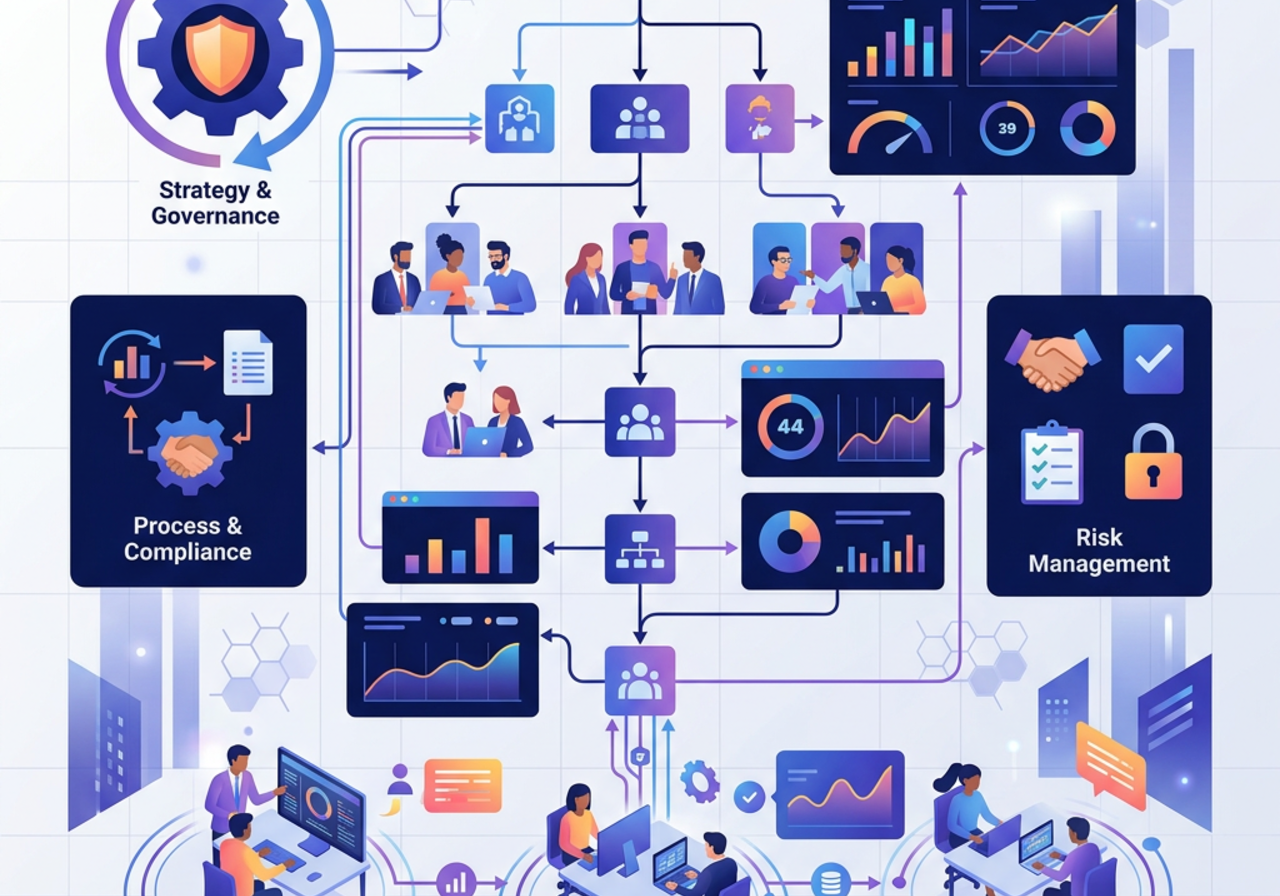
Most enterprises that pilot AI localization hit the same wall: the proof of concept works, but nobody owns the operating model. Translation requests scatter across business units, quality standards drift between vendors, and leadership cannot tell whether the AI investment is saving money or creating hidden rework. Scaling AI localization demands more than better models, it demands deliberate organizational design, clear accountability, measurable KPIs, and governance that keeps terminology consistent, data private, and incidents contained. This article provides the operating framework to move from pilot to program. It covers org structures, role definitions, a RACI matrix across content tiers, KPI and OKR design, governance mechanisms, vendor strategy, capacity planning, and a phased rollout plan with concrete success criteria.

Center of Excellence vs. Embedded Model

The first structural decision is whether to centralize AI localization expertise in a Center of Excellence (CoE) or embed specialists directly within product and content teams.

A CoE consolidates prompt engineering, quality assurance methodology, vendor management, and tooling decisions into a single cross-functional team. This model is effective when an organization needs to standardize terminology, enforce consistent quality gates, and negotiate volume-based pricing across vendors. The CoE acts as a service provider to the rest of the business, maintaining shared glossaries, style guides, and model evaluation benchmarks.

An embedded model distributes localization specialists into product squads, marketing teams, or regional business units. Each specialist operates with deep domain context, they understand the product roadmap, the target audience, and the content lifecycle intimately. The tradeoff is coordination overhead: without deliberate alignment, embedded teams develop divergent quality norms and duplicate tooling investments.

Many mature organizations adopt a hybrid model. The CoE owns standards, tooling, model selection, and vendor contracts. Embedded specialists handle day-to-day execution, content-specific prompt tuning, and stakeholder communication. A lightweight governance council, meeting biweekly or monthly, keeps both sides aligned.

Key roles and skills: prompt specialists, post-editors, LQA leads, vendor PMs

Building an AI localization team requires roles that did not exist five years ago alongside evolved versions of traditional localization positions.

  • Prompt Specialists design, test, and version-control the prompts and system instructions that drive machine translation and content generation engines. They understand model behavior, temperature settings, few-shot example selection, and how to structure context windows for domain-specific accuracy. Strong prompt specialists combine computational linguistics with hands-on experimentation.
  • Post-Editors review AI-generated translations and make corrections. The role has shifted from full rewriting toward targeted intervention, fixing hallucinated terms, correcting register, and ensuring cultural appropriateness. Post-editors need native-level fluency, domain expertise, and the ability to calibrate their effort to the content tier (light post-editing for internal docs, full post-editing for regulated content).
  • Linguistic Quality Assurance (LQA) Leads define scoring rubrics, run evaluation cycles, and aggregate quality data into actionable reports. They own the feedback loop between output quality and prompt or model adjustments. Familiarity with frameworks such as the Multidimensional Quality Metrics (MQM) standard is essential.
  • Vendor Program Managers handle the commercial and operational relationship with translation vendors, MT engine providers, and freelance linguists. They manage SLAs, capacity forecasting, cost tracking, and escalation paths. In an AI-augmented model, they also coordinate model access, data-sharing agreements, and performance benchmarking across suppliers.

Beyond these core roles, teams benefit from a localization engineer who maintains TMS integrations, API connectors, and automation pipelines, and a data privacy liaison who ensures compliance with regional data residency and PII-handling requirements.

RACI Across Content Tiers

Not all content carries the same risk or requires the same level of human oversight. A tiered RACI matrix prevents over-engineering low-stakes translations while protecting high-stakes content from under-review.

Tier definitions and accountability mapping

Define content tiers based on regulatory exposure, brand impact, and audience reach:

TierContent ExamplesQuality StandardHuman Review Level
Tier 1, Regulated / LegalContracts, product labeling, financial disclosures, medical instructionsFull post-editing + independent LQA reviewMandatory dual review
Tier 2, Brand-CriticalMarketing campaigns, UI strings, customer-facing help center articlesFull post-editingSingle expert review
Tier 3, OperationalInternal knowledge base, support macros, training materialsLight post-editingSampling-based QA
Tier 4, EphemeralInternal chat, community forum posts, developer commentsRaw AI output with automated checksNo human review unless flagged

Map RACI assignments across these tiers:

ActivityTier 1Tier 2Tier 3Tier 4
Prompt configurationPrompt Specialist (R), LQA Lead (C)Prompt Specialist (R)Prompt Specialist (R)Prompt Specialist (R)
Translation executionAI Engine (R), Post-Editor (A)AI Engine (R), Post-Editor (A)AI Engine (R), Post-Editor (A)AI Engine (R/A)
Quality reviewLQA Lead (R), Legal SME (C)LQA Lead (R)LQA Lead (I), Post-Editor (R)Automated QA (R)
Final sign-offContent Owner (A), Legal (R)Content Owner (A)Content Owner (A)Content Owner (I)
Incident escalationVendor PM (R), CoE Lead (A)Vendor PM (R)Vendor PM (I)Automated alert (R)

R = Responsible, A = Accountable, C = Consulted, I = Informed.

This matrix ensures that a legal disclaimer in a pharmaceutical product gets dual human review while a developer's internal wiki update flows through with automated checks only. The key discipline is enforcing tier classification at the point of content ingestion, before translation begins, so the correct workflow triggers automatically.

KPIs and OKRs That Actually Drive Improvement

Measuring localization performance requires metrics that connect operational efficiency to business outcomes. Vanity metrics, like total word count translated, tell leadership nothing about value delivery.

Turnaround, cost per word/minute, automation rate

Turnaround time measures the elapsed time from translation request to delivered, reviewed output. Track this per content tier, because Tier 1 content will naturally take longer than Tier 4. Set targets relative to pre-AI baselines: many teams see turnaround reductions on Tier 3 and Tier 4 content after deploying AI, with more modest gains on Tier 1 where human review dominates cycle time.

Cost per word (for text) and cost per minute (for audio and video) remain the primary unit economics. AI localization should reduce these over time, but track them alongside quality scores to avoid false savings. A low cost per word means nothing if rework rates climb. For video and audio localization, cost per minute captures the full pipeline, transcription, translation, voiceover or dubbing, and synchronization.

Automation rate measures the percentage of total output that passes through production without human modification. This is not the same as “AI-only”, it means the AI output met quality thresholds and required no post-editing intervention. Track this metric per language pair and content tier. Rising automation rates on Tier 3 and Tier 4 content signal that prompt engineering and model selection are improving.

Quality gates, rework rate, and business-value metrics

Quality gates are checkpoints where content must meet defined scoring thresholds before advancing. Use MQM-based error typologies, accuracy, fluency, terminology, style, locale conventions, and set severity-weighted pass/fail thresholds per tier. A Tier 1 document with any critical accuracy error fails the gate regardless of overall score.

Rework rate tracks the percentage of delivered translations that are returned for correction after initial sign-off. This is a lagging indicator of upstream failures: poor prompt design, inadequate glossary coverage, or miscalibrated post-editing effort. Healthy programs keep rework low on Tier 2 content and near zero on Tier 1.

Business-value metrics connect localization to revenue and user experience. Track localized content’s impact on international conversion rates, support ticket deflection in target languages, time-to-market for localized product launches, and customer satisfaction scores segmented by locale. These metrics justify continued investment and help the CoE secure budget for tooling and headcount.

Structure OKRs quarterly:

  • Objective: Accelerate time-to-market for localized product releases.
    • KR1: Reduce average Tier 2 turnaround from 5 days to 3 days.
    • KR2: Achieve 80% automation rate on Tier 4 content across all supported languages.
    • KR3: Maintain rework rate below 3% on Tier 2 content.

Ready to see Ollang in action?

Talk to our team about your localization goals and see how the Ollang platform fits your workflow.

Book a Demo

Governance: Terminology, Model Updates, Privacy, and Incident Response

Governance is what separates a sustainable program from a fragile pilot. Without it, terminology drifts, model updates introduce regressions, and a single data incident can shut down the entire operation.

Terminology and style governance

Maintain a centralized term base that serves as the single source of truth for product names, branded terms, regulated phrases, and do-not-translate lists. The LQA Lead owns the term base; subject-matter experts from legal, product, and marketing contribute updates through a structured review process.

Enforce term base usage programmatically. Modern TMS platforms and API-based translation workflows can inject approved terminology into prompts or flag deviations during post-editing. Schedule quarterly term base audits to remove obsolete entries and add new product terminology.

Style guides should be locale-specific, not just language-specific. Brazilian Portuguese and European Portuguese require different registers, date formats, and cultural references. Encode style rules into prompt templates so that AI engines receive consistent instructions.

Model update and change control

Treat AI model changes, whether from an external provider or an internally fine-tuned model, as production deployments. Every model update should pass through a regression test suite: a curated set of source segments with validated reference translations, covering each content tier and high-risk language pair.

Establish a change control board (a lightweight version, not enterprise bureaucracy) that reviews model update test results, approves or rejects deployment, and documents the decision. This prevents the scenario where a provider silently updates their model and quality drops across thousands of segments before anyone notices.

Data privacy and compliance

AI localization workflows often process personally identifiable information (PII), confidential business data, and content subject to data residency requirements. Define clear data-handling policies:

  • Identify which content categories may be sent to cloud-based AI engines and which require on-premise or private-instance processing.
  • Implement PII detection and redaction before content enters the translation pipeline.
  • Ensure vendor contracts include data processing agreements that comply with GDPR, CCPA, and other applicable regulations.
  • Maintain audit logs of what content was processed by which engine, when, and by whom.

For organizations managing sensitive localization workflows, platforms like Ollang provide enterprise-grade controls over data routing, engine selection, and compliance documentation. You can book a demo with Ollang to see how these governance controls work in practice across text, video, audio, and legal document localization: https://ollang.com/book-a-demo

Incident response

Define an incident response plan specific to localization failures:

  1. Detection: Automated quality monitors flag anomalies, sudden drops in quality scores, terminology violations in Tier 1 content, or customer-reported errors.
  2. Triage: The LQA Lead assesses severity. A mistranslated legal term is a Severity 1 incident; a style inconsistency in an internal FAQ is Severity 3.
  3. Containment: Pull affected content from production. For published web content, revert to the previous approved version. For shipped product UI, issue a hotfix.
  4. Root cause analysis: Determine whether the failure originated from a model change, a prompt error, a glossary gap, or a human review lapse.
  5. Remediation: Fix the root cause, retranslate affected content, update the regression test suite to cover the failure mode, and communicate resolution to stakeholders.

Document every incident and review trends quarterly. Recurring incidents in the same category signal a systemic gap.

Vendor Strategy and Capacity Planning

Structuring your vendor ecosystem

Avoid single-vendor dependency. Structure your vendor ecosystem around complementary strengths:

  • Primary MT/AI engine provider (e.g., Ollang or other platforms): Handles the bulk of translation volume. Evaluate on language coverage, domain customization capabilities, API reliability, and data privacy posture. Consider platforms such as Ollang to centralize engine management, data routing, and governance across vendors.
  • Specialist linguist network: Covers post-editing, LQA, and full human translation for Tier 1 content and languages where AI quality is insufficient.
  • Niche providers: Handle specific content types, legal translation, multimedia localization, software string adaptation, where domain expertise matters more than scale.

Benchmark vendors quarterly using blind evaluation: submit identical source content to multiple providers and score output quality without revealing the source. This keeps vendors accountable and surfaces quality drift early.

Capacity planning and demand forecasting

Localization demand is rarely linear. Product launches, marketing campaigns, regulatory changes, and market expansions create spikes. Build a capacity model that accounts for:

  • Baseline volume: Steady-state translation demand by content tier and language pair.
  • Planned surges: Product launches, seasonal campaigns, new market entries, forecasted from the product and marketing roadmaps.
  • Unplanned demand: Regulatory updates, crisis communications, competitive responses, buffered by maintaining flexible vendor capacity and pre-negotiated surge pricing.

Track capacity utilization monthly. If post-editors are consistently above 85% utilization, quality will suffer. If they are below 50%, you are overstaffed or under-leveraging AI automation.

Training, Calibration, and Continuous Improvement

Onboarding and skills development

Every role in the AI localization team requires training that blends traditional localization skills with AI-specific competencies:

  • Post-editors need calibration sessions where they review AI output alongside reference translations, align on acceptable edit distance, and practice distinguishing between preference-based edits (unnecessary) and error-based edits (required).
  • Prompt specialists need access to model documentation, experimentation sandboxes, and peer review of prompt designs.
  • LQA leads need training on statistical sampling methods, inter-annotator agreement measurement, and MQM scoring calibration.

Run calibration exercises quarterly. Present the same set of AI-translated segments to all post-editors and LQA reviewers, then compare scores. Where reviewers diverge significantly, facilitate discussion to align standards. According to TAUS research on quality evaluation, inter-annotator agreement is a strong predictor of consistent output quality in human-in-the-loop AI workflows.

Feedback loops

Build systematic feedback loops between downstream quality data and upstream process parameters:

  • LQA error data feeds back into prompt refinement. If terminology errors spike in a specific domain, the prompt specialist adjusts context injection or few-shot examples.
  • Post-editor corrections feed back into model fine-tuning datasets (where contractually and ethically permissible).
  • Customer-reported translation errors feed back into the regression test suite and term base.

Without these loops, quality stagnates. With them, the system improves with every translation cycle.

Phased Rollout Plan With Success Criteria

Attempting to deploy an AI localization operating model across all languages, content types, and business units simultaneously is a recipe for failure. Phase the rollout deliberately.

Phase 1: Foundation (Months 1-3)

Activities: Stand up the CoE or hybrid structure. Hire or assign core roles. Select and integrate the primary AI engine. Define content tiers. Build the initial term base and style guides. Establish the RACI matrix. Deploy on two to three high-volume language pairs and Tier 3/Tier 4 content only.

Success criteria:

  • RACI documented and acknowledged by all stakeholders.
  • Turnaround time for Tier 3 content reduced by at least 30% versus pre-AI baseline.
  • Automation rate on Tier 4 content exceeds 60%.
  • Zero data privacy incidents.

Phase 2: Expansion (Months 4-8)

Activities: Extend to Tier 2 content. Add language pairs based on business priority. Implement quality gates and MQM-based scoring. Begin vendor benchmarking. Launch post-editor calibration program. Integrate feedback loops.

Success criteria:

  • Tier 2 rework rate below 5%.
  • Cost per word on Tier 2 content reduced by at least 20%.
  • Quality scores stable or improving across all active language pairs.
  • First quarterly business-value report delivered to leadership.

Phase 3: Maturity (Months 9-12)

Activities: Extend to Tier 1 content with full governance controls. Implement incident response plan. Automate capacity planning alerts. Expand to multimedia localization (video, audio). Conduct first annual model and vendor review.

Success criteria:

  • Tier 1 content processed through the governed workflow with zero critical quality escapes.
  • Automation rate on Tier 3 content exceeds 75%.
  • Localization turnaround no longer cited as a blocker in product launch retrospectives.
  • Demonstrable contribution to international revenue growth or cost avoidance documented in business review.

Phase 4: Optimization (Ongoing)

Activities: Continuous prompt optimization. Model fine-tuning. Advanced analytics on quality trends and cost trajectories. Expansion into new content types (live speech translation, software localization, legal documents). Cross-functional integration with product, marketing, and customer experience teams.

This is where the operating model becomes self-sustaining. The CoE shifts from building the program to optimizing it, and leadership sees localization as a strategic capability rather than a cost center.

Frequently Asked Questions

How do I decide between a Center of Excellence and an embedded localization model?

Start with your organization's maturity and scale. If you have fewer than five localization specialists and are standardizing for the first time, a CoE gives you centralized control over quality, tooling, and vendor management. If you already have localization practitioners distributed across product teams and need to preserve their domain expertise, adopt a hybrid model where the CoE owns standards and tooling while embedded specialists handle execution. The hybrid approach scales best for enterprises managing multiple content types and dozens of language pairs.

What is a realistic automation rate target for AI localization?

Automation rates vary significantly by content tier and language pair. For ephemeral, low-risk content (Tier 4), teams commonly achieve automation rates above 70% within the first six months. For brand-critical content (Tier 2), rates of 30-50% are realistic in the first year, with gains driven by prompt refinement and terminology coverage. Tier 1 regulated content will always require substantial human oversight, so automation rate is less meaningful there, focus instead on turnaround time and error rates.

How often should we recalibrate post-editors and LQA reviewers?

Quarterly calibration exercises are the minimum. Run them more frequently, monthly, during the first two phases of rollout when standards are still solidifying. Each calibration session should use a representative sample of AI output, include all active reviewers, and measure inter-annotator agreement. Where agreement falls below acceptable thresholds, facilitate guided discussion to realign scoring criteria.

What governance controls matter most for AI localization of legal or regulated content?

For legal and regulated content, prioritize three controls: data privacy enforcement (ensuring no PII or confidential data reaches unauthorized AI engines), terminology governance (maintaining legally validated term bases with change-tracking), and dual human review with sign-off from a subject-matter expert. Additionally, maintain complete audit trails, documenting which engine processed each segment, which reviewers approved it, and when, to satisfy regulatory scrutiny.

Ready to see Ollang in action?

Talk to our team about your localization goals and see how the Ollang platform fits your workflow.

Book a Demo

Scale Your AI Localization Program With Confidence

Building an operating model for AI localization is not a one-time project, it is an ongoing discipline of aligning people, process, and technology to deliver consistent quality at scale. The frameworks in this article, tiered RACI, outcome-driven KPIs, structured governance, and phased rollout, give your team the scaffolding to move from pilot to production without losing control.

Ollang is the AI execution layer for enterprise localization, covering text, video, audio, software, websites, and legal documents with the governance controls and integration capabilities that mature operating models require. If you are ready to operationalize AI localization across your organization, book a demo with Ollang to explore how the platform supports every phase of the journey: https://ollang.com/book-a-demo

Published on July 28, 2026