
Run Localization Like a Product: Team Model, SLAs and KPIs
Running localization like a product: the team model, service-level agreements, and KPIs that turn translation from a reactive cost center into a measurable growth function.

Most localization programs fail not because of bad translations, but because of bad operations. Requests arrive through Slack DMs, spreadsheets multiply, deadlines slip, and nobody can tell the CFO whether the investment is paying off. The root cause is treating localization as a service desk rather than a product capability, something that runs on defined processes, measurable outcomes, and continuous improvement.
This guide provides the operating model to change that. It covers the team structure, intake and scoping workflows, SLAs by content type, governance frameworks, vendor and AI strategy, tooling, budgeting, KPIs, and career paths you need to run localization like a product. The goal is a durable, scalable capability that delivers predictable results and proves its value to the business.
If your current localization operation relies on heroics instead of systems, explore how Ollang can help you build a scalable foundation.
Defining the Localization Product Model
Why "Service Desk" Fails at Scale
The service-desk model works when you have a handful of languages and a small content footprint. A project manager takes a request, routes it to a vendor, and delivers the output. The problem is that this model doesn't scale. As content volume grows and more teams need localization, the project manager becomes a bottleneck. There's no prioritization framework, no visibility into capacity, and no way to forecast costs.
Worse, the service-desk model positions localization as reactive. It waits for requests instead of shaping how content gets created in the first place. Teams learn to work around localization rather than with it, leading to last-minute requests, untranslatable source content, and duplicated effort. Quality suffers because there's no time for review, and cost balloons because everything is treated as urgent.
Product Thinking Applied to Localization
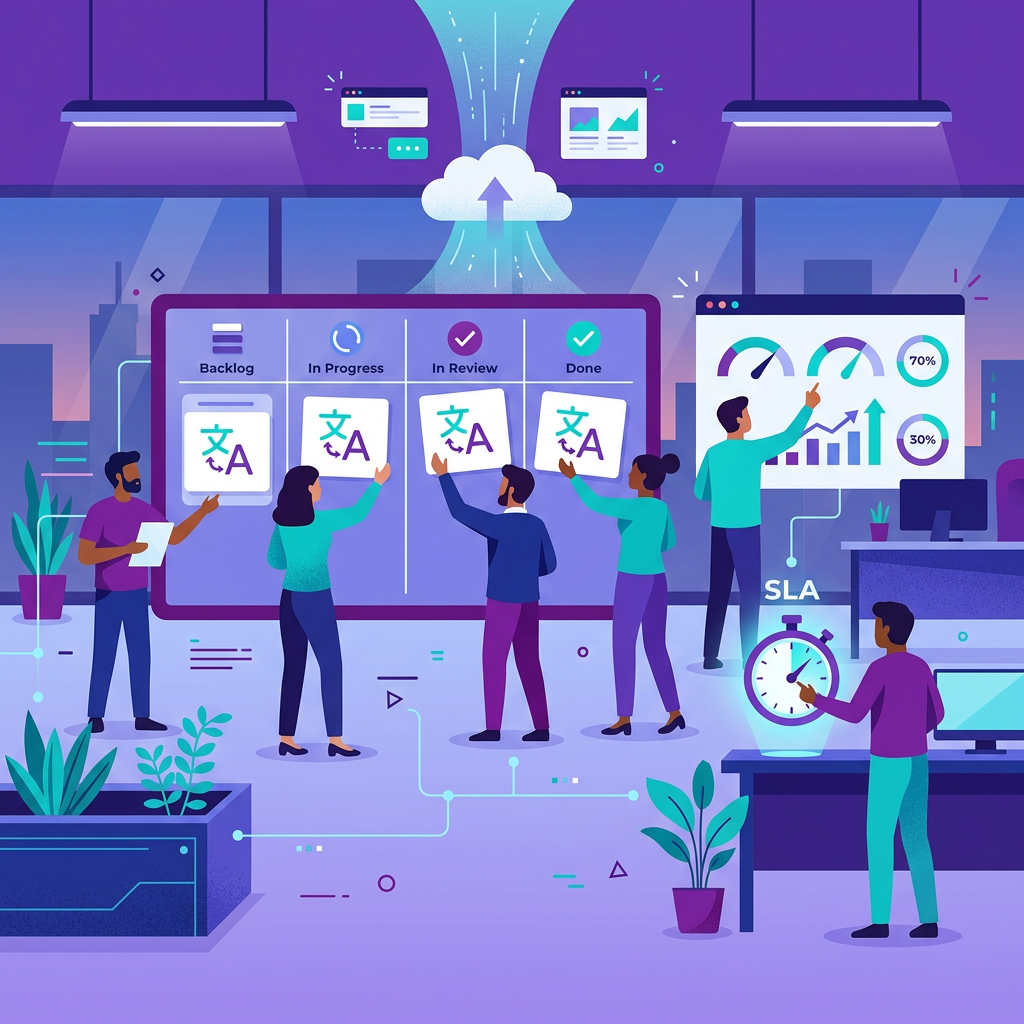
A product model flips this dynamic. Localization has a roadmap, a backlog, defined stakeholders, and success metrics, just like any other product capability. The localization team owns a platform (processes, tools, vendor relationships, AI pipelines) that other teams consume through well-defined interfaces.
Key principles of the product approach:
- Intake is structured. Requests flow through a single channel with required metadata (content type, target locales, deadline, context).
- Prioritization is transparent. A scoring model weighs business impact, locale revenue, and effort.
- Capacity is planned. Quarterly planning aligns localization work with product launches, marketing campaigns, and legal requirements.
- Quality is measured. Defined KPIs replace subjective assessments of "good enough."
- Improvement is continuous. Retrospectives and data reviews drive process changes every sprint or quarter.
This doesn't mean localization needs to adopt every ritual from software product management. It means borrowing the disciplines that make product teams effective: clear ownership, stakeholder alignment, measurable outcomes, and iterative improvement.
Team Model and RACI
Stakeholder Map: Marketing, Web, Product, Legal, Support
Localization touches nearly every function that produces content, which is exactly why ownership gets murky. A clear stakeholder map prevents the "everybody owns it, so nobody owns it" trap.
| Function | Localization Touchpoints | Typical Volume |
|---|---|---|
| Marketing | Campaigns, ads, social media, brand content | High volume, burst patterns |
| Web | Website pages, landing pages, SEO content | Steady, with launch spikes |
| Product | UI strings, in-app help, release notes | Tied to sprint cycles |
| Legal | Contracts, terms of service, compliance docs | Low volume, high stakes |
| Support | Knowledge base, chatbot scripts, macros | Ongoing, incremental |
Each function has different quality expectations, turnaround requirements, and risk tolerances. Marketing may accept creative adaptation; Legal requires terminological precision. A product-model localization team designs different workflows for each, rather than forcing a one-size-fits-all process.
RACI Matrix for Common Workflows
A RACI matrix eliminates ambiguity about who does what. Below is a representative example for a website localization workflow:
| Activity | Localization Lead | Content Owner | Engineering | Locale Reviewer | Vendor/AI |
|---|---|---|---|---|---|
| Source content creation | I | A/R | , | , | , |
| Internationalization readiness | C | I | A/R | , | , |
| Translation request & scoping | A/R | R | I | I | , |
| Translation/adaptation | A | I | , | C | R |
| Linguistic QA | A/R | , | , | R | C |
| Technical QA (build, layout) | A | , | R | , | , |
| Final sign-off | R | A | , | R | , |
| Publication | I | A | R | , | , |
A = Accountable, R = Responsible, C = Consulted, I = Informed.
The critical insight is that the localization lead is accountable for translation quality and process, but the content owner is accountable for final sign-off and publication. This shared accountability prevents the localization team from becoming a scapegoat when source content changes late or requirements are unclear.
Hiring Profiles and Career Ladders
Scaling a localization product team requires more than linguists. The modern localization team includes:
- Localization Program Manager. Owns intake, vendor management, SLAs, and stakeholder communication. Requires project management discipline and enough linguistic awareness to evaluate quality signals.
- Localization Engineer. Builds and maintains integrations between the TMS, CMS, code repositories, and QA tools. Owns automation pipelines and AI prompt engineering.
- Terminologist / Linguistic Lead. Maintains glossaries, style guides, and termbases. Conducts quality audits and trains in-market reviewers.
- Localization Data Analyst. Tracks KPIs, builds dashboards, and runs cost models. Increasingly important as AI-driven workflows generate more data.
Career ladders should mirror those in product and engineering organizations. An individual contributor path might progress from Localization Coordinator β Program Manager β Senior Program Manager β Director of Localization. A technical path might run from Localization Engineer β Senior Engineer β Localization Architect. Both paths should have equivalent compensation bands to retain talent.
Intake, Scoping and Change Management
Structured Intake Process
Every localization request should pass through a single intake channel, whether that's a form in your project management tool, a TMS submission portal, or an API call from your CMS. The intake form captures:
- Content type (UI strings, marketing copy, legal document, video script, etc.)
- Source language and target locales
- Word count or duration estimate
- Desired delivery date
- Business context (launch, regulatory deadline, campaign flight date)
- Reference materials (screenshots, Figma links, glossary pointers)
- Sensitivity level (public, internal, confidential)
Structured intake eliminates the back-and-forth that consumes project management time. It also creates a dataset you can use to forecast demand, identify patterns, and improve scoping accuracy over time.
Scoping and Prioritization
Not every request is equal. A prioritization framework helps the localization team allocate capacity to the highest-impact work. A simple scoring model might weight:
- Revenue impact, Is this locale a top-five market?
- Regulatory requirement, Is there a legal deadline?
- Launch dependency, Does a product launch or campaign depend on this?
- Effort, How many words, how complex, how many locales?
Requests that score above a threshold enter the current sprint or cycle. Others are queued for the next planning window. This transparency prevents the "everything is urgent" problem and gives stakeholders a clear mechanism to escalate when business conditions change.
Change Management for In-Flight Content
Source content changes after translation has started are the single largest driver of cost overruns and missed deadlines. A change-management process defines:
- Freeze dates. Source content locks at a defined point before the delivery deadline. Changes after the freeze trigger a re-scoping conversation.
- Delta handling. The TMS should surface only changed segments for re-translation, not the entire file.
- Cost attribution. Late changes are tracked and attributed to the requesting team, creating accountability and behavioral incentives.
This isn't about being rigid. It's about making the cost of late changes visible so teams can make informed tradeoffs.
SLAs by Content Type and Locale
Defining Tiered SLAs
A single SLA for all localization work is either too aggressive for complex content or too lenient for simple updates. Tiered SLAs set realistic expectations:
| Content Type | Quality Tier | Turnaround SLA (per locale) | Review Requirement |
|---|---|---|---|
| UI strings | Human-level | 2-3 business days | In-context review required |
| Marketing landing pages | Transcreation | 5-7 business days | Brand review + in-market reviewer |
| Knowledge base articles | Good enough + post-edit | 1-2 business days | Spot-check QA |
| Legal documents | Certified quality | 7-10 business days | Legal reviewer sign-off |
| Release notes | MT + light post-edit | Same day, 1 business day | Automated QA only |
| Video subtitles | Broadcast quality | 3-5 business days | Timing + linguistic review |
Locale-Specific Considerations
Not all locales are created equal from an operational standpoint. Tier-one markets (often the top five by revenue) may justify dedicated in-market reviewers, richer glossaries, and tighter SLAs. Long-tail locales may rely more heavily on machine translation with lighter human oversight.
Locale-specific SLA adjustments should account for:
- Reviewer availability. Some languages have smaller pools of qualified reviewers, which affects turnaround.
- Script complexity. Languages with complex scripts (Arabic, Thai, CJK) may require additional layout QA time.
- Regulatory environment. Locales with strict data residency or content regulations may need additional compliance checks.
Document these adjustments explicitly so stakeholders understand why Turkish delivery takes longer than Spanish.
Governance: Glossaries, Style Guides and Termbases
Ownership and Maintenance Cadence
Terminology inconsistency is one of the most common quality complaints in localized content. A glossary that nobody maintains is worse than no glossary at all, because translators follow outdated terms while reviewers flag them as errors.
Effective governance assigns clear ownership:
- The Terminologist or Linguistic Lead owns the master termbase and approves all additions and changes.
- Subject-matter experts from each function (Product, Marketing, Legal) nominate terms and validate translations in their domain.
- The localization team enforces termbase usage through TMS integration and automated QA checks.
Maintenance should happen on a defined cadence, monthly for active termbases, quarterly for style guides. Every product launch or brand refresh should trigger a terminology review before translation begins.
Style Guide Structure
A localization style guide is not just a translation of the English style guide. It should cover:
- Brand voice adaptation for each locale (formal vs. informal register, humor conventions)
- Formatting rules (date, time, number, currency, address formats)
- UI conventions (button labels, error messages, placeholder text patterns)
- Prohibited terms or phrases (culturally sensitive content, competitor references)
- Preferred translation approaches for common patterns (e.g., gerunds in headings, passive voice)
Style guides should be living documents, accessible in the TMS, and versioned so translators always work from the latest edition.
Ready to see Ollang in action?
Talk to our team about your localization goals and see how the Ollang platform fits your workflow.
Vendor and AI Strategy
Designing the Vendor/LLM Mix
The binary choice between human translation and machine translation is obsolete. Modern localization programs use a spectrum of approaches, matched to content type and quality requirements:
- Full human translation for high-stakes content: legal, regulated, brand-defining creative.
- Machine translation with professional post-editing (MTPE) for high-volume, moderate-quality content: knowledge base, support articles, user-generated content.
- LLM-powered translation with human review for content that benefits from contextual fluency: marketing copy, product descriptions, in-app messaging.
- Raw machine translation for internal-only or ephemeral content where speed matters more than polish.
The right mix depends on your content portfolio, quality requirements, and budget. Most enterprise programs end up with a blend, and the ratio shifts over time as AI capabilities improve and trust builds.
Ollang helps map content to the right mix of human, MTPE, and LLM workflows and enforces guardrails across integrations. If you're evaluating how to integrate AI translation into your existing vendor workflows, schedule a conversation with Ollang's localization architects.
AI Guardrails and Security Controls
Using LLMs for translation introduces risks that traditional vendor workflows don't have. A responsible AI strategy addresses:
- Data privacy. Confidential content (contracts, pre-announcement product details, PII-containing support tickets) should not be sent to public LLM APIs without appropriate data processing agreements. Use enterprise-grade endpoints with contractual guarantees, or on-premises models for the most sensitive content.
- Output validation. LLMs can hallucinate, omit content, or inject unrelated text. Automated QA must check for completeness (source vs. target segment count), terminology compliance, and format preservation.
- Prompt versioning. Treat translation prompts like code, version-controlled, tested, and reviewed before deployment. A prompt change can shift output quality across all locales simultaneously.
- Human-in-the-loop. Define which content types require human review of AI output and which can be published after automated QA only. This decision should be documented in the SLA matrix.
- Bias and cultural sensitivity. LLMs can produce culturally inappropriate output. In-market reviewers should flag patterns, and flagged examples should feed back into prompt refinement.
Tooling Stack
TMS, Connectors, QA Automation, and Review UI
The tooling stack is the infrastructure of the localization product. It should be evaluated like any other enterprise platform, on integration capabilities, scalability, and total cost of ownership.
- Translation Management System (TMS). The TMS is the system of record for all translation work. Key requirements include translation memory, termbase integration, workflow automation, role-based access, and robust API support. Leading options include Ollang, Phrase, memoQ, Lokalise, and Crowdin, each with different strengths depending on your content mix. Ollang acts as an execution layer that integrates with TMS platforms, automating AI-driven workflows and quality checks.
- Connectors. The TMS should connect directly to your content sources: CMS (WordPress, Contentful, Adobe Experience Manager), code repositories (GitHub, GitLab), design tools (Figma), marketing platforms (HubSpot, Marketo), and support systems (Zendesk, Intercom). Manual file handoffs are the enemy of speed and accuracy.
- QA Automation. Automated quality checks should run on every translation before human review. At minimum, check for:
- Untranslated segments
- Terminology violations
- Tag and placeholder errors
- Number and date format mismatches
- Length violations (critical for UI strings)
- Consistency with translation memory
- Review UI. In-market reviewers are often not linguists, they're product managers, marketers, or support leads who happen to speak the target language. The review interface should be simple, contextual (showing screenshots or live previews), and integrated with the approval workflow. Friction in the review step is the most common cause of bottlenecks.
Integration Architecture
The tooling stack should support a continuous localization model where content flows automatically from source to TMS to translated output without manual intervention. The ideal architecture looks like:
- Source content is created or updated in the CMS/repository.
- A connector detects the change and pushes new or modified segments to the TMS.
- The TMS applies translation memory, routes to the appropriate workflow (human, MTPE, or AI), and triggers QA.
- Reviewed translations are pushed back to the source system.
- A CI/CD pipeline or publishing workflow deploys the localized content.
Each step should be observable, logged, timestamped, and surfaced in dashboards, so the team can identify bottlenecks and measure cycle time accurately.
Budget Forecasting
Building a Predictable Cost Model
Localization budgets that rely on annual lump-sum estimates inevitably run out in Q3 or balloon with unplanned requests. A product-model approach to budgeting is bottom-up and continuous:
- Cost per word by workflow type. Track the blended cost per word for each workflow (human, MTPE, AI + review) and each content type. This gives you a unit cost you can multiply by projected volume.
- Volume forecasting. Use historical intake data to project monthly word volumes by content type and locale. Overlay known events (product launches, campaign calendars, regulatory deadlines) to anticipate spikes.
- Fixed vs. variable costs. Separate platform costs (TMS licenses, connector fees) from variable translation costs. This distinction matters for financial planning and for evaluating the ROI of automation investments.
- Scenario modeling. Build models for "add a new locale," "double content volume," or "shift 30% of volume to AI." These scenarios help leadership understand the cost implications of business decisions before they commit.
Present the budget as a cost-per-locale or cost-per-content-unit metric that business leaders can relate to their own P&L, rather than as an abstract line item.
Quarterly Planning, Roadmaps and Tiger Teams
Quarterly Planning Cadence
Localization should participate in the same quarterly planning process as Product and Marketing. This means:
- Input gathering. Two to three weeks before the quarter starts, collect planned content from all stakeholder teams: product launches, campaign calendars, website redesigns, legal updates.
- Capacity planning. Map projected volume against available capacity (internal team, vendor bandwidth, AI throughput). Identify gaps early.
- Prioritization. Apply the scoring model to rank work. Share the prioritized backlog with stakeholders for alignment.
- Commitment. Publish the quarterly localization plan with committed deliverables, stretch goals, and explicitly deferred items.
Mid-quarter check-ins (monthly or bi-weekly) track progress against the plan and surface risks before they become crises.
Localization Roadmap
A localization roadmap communicates strategic investments beyond day-to-day translation work. Examples of roadmap items:
- Onboarding three new locales in Q2
- Migrating from manual file handoff to CMS connector integration
- Piloting LLM-powered translation for knowledge base content
- Implementing automated QA scoring to reduce reviewer workload
- Building a self-service translation portal for low-risk content types
The roadmap should be visible to all stakeholders and updated quarterly. It demonstrates that localization is investing in capability, not just processing tickets.
Tiger Teams for Major Launches
Major product launches or market entries require coordination that exceeds normal workflows. A Tiger Team is a temporary, cross-functional group assembled for a specific launch with:
- A dedicated localization lead
- Representatives from Product, Marketing, Engineering, and the target locale
- A shared timeline with milestones and dependencies
- Daily standups during the critical path
- A post-launch retrospective
Tiger Teams disband after the launch. Their purpose is to compress cycle times and resolve blockers in real time, not to become a permanent structure.
KPIs and Dashboards
Core Localization KPIs
You cannot manage what you don't measure, and you cannot prove value to executives with anecdotes. The following KPIs form the foundation of a localization measurement framework:
| KPI | Definition | Target Direction | Why It Matters |
|---|---|---|---|
| Cycle time | Time from request submission to delivery | β Decrease | Measures operational speed |
| Quality score | Aggregated QA score (automated + human review) | β Increase | Measures output quality |
| Cost per word | Blended cost across all workflows | β Decrease (without quality loss) | Measures efficiency |
| On-time delivery | % of deliveries meeting SLA | β Increase | Measures reliability |
| SEO impact | Organic traffic to localized pages vs. baseline | β Increase | Measures market reach |
| Conversion rate | Conversion on localized pages vs. source | β Increase | Measures business impact |
| Reviewer turnaround | Time reviewers take to complete reviews | β Decrease | Identifies bottlenecks |
| Translation memory leverage | % of segments matched from TM | β Increase | Measures reuse efficiency |
Building Dashboards
KPIs are only useful if they're visible and current. Build dashboards at two levels:
- Operational dashboard for the localization team: updated daily, showing queue depth, in-progress work, QA scores, and SLA adherence by project.
- Executive dashboard for leadership: updated monthly or quarterly, showing cost trends, quality trends, cycle time trends, and business impact metrics (SEO, conversion).
Most TMS platforms offer built-in reporting. For cross-system metrics (connecting localization data to web analytics or revenue data), a lightweight BI tool like Looker, Tableau, or even a well-structured spreadsheet can bridge the gap.
Retrospectives
Every quarter, the localization team should run a retrospective that examines:
- Which SLAs were met and which were missed, and why
- Quality trends by locale and content type
- Cost per word trends and the impact of AI adoption
- Stakeholder satisfaction (a short survey works)
- Process changes from the previous retro, did they work?
Retrospectives close the feedback loop. Without them, the product model degrades back into a service desk over time.
Frequently Asked Questions
How do I get executive buy-in for a localization product model?
Frame it in terms executives care about: predictability, cost control, and business impact. Start with a pilot, demonstrate results for a quarter, and tools like Ollang can supply the operational data executives need. When youβre ready to formalize the pilot, bring a quarterly plan and SLA matrix to the table.
What's the right team size to start with?
A minimum viable localization product team is three roles: a Program Manager, a Localization Engineer, and a Linguistic Lead, with vendors and AI handling production. Add analysts, additional program managers, or locale leads as volume and complexity increase. For major launches, spin up a Tiger Team to augment the core.
How should I measure the quality of AI-generated translations?
Use automated QA for mechanical checks and periodic human evaluation sampled against a standard like MQM. Track error rates by locale and content type and feed those patterns back into prompt engineering and workflows. Compare business metrics (bounce, conversion, support deflection) on AI- vs. human-translated content where appropriate.
How do I handle localization for content types with very different workflows, like video and legal documents?
Create separate workflow tracks in your TMS so each content type follows its own SLA and review path: video needs transcription, timing, and rendering; legal needs certified translators and reviewer sign-off. Route intake by content type so the right pipeline is applied automatically.
Ready to see Ollang in action?
Talk to our team about your localization goals and see how the Ollang platform fits your workflow.
Scale Localization with Confidence
Running localization like a product is not a one-time transformation, it's an ongoing discipline. The operating model described here gives you the structure to scale predictably: clear ownership through RACI, tiered SLAs that set realistic expectations, governance that keeps quality consistent, a vendor and AI strategy that balances cost and quality, tooling that eliminates manual handoffs, and KPIs that prove impact to the business.
The teams that succeed are the ones that treat localization as a capability worth investing in, not a cost center to minimize. If you're ready to build or upgrade your localization operating model, Book a Demo.
Published on July 30, 2026