
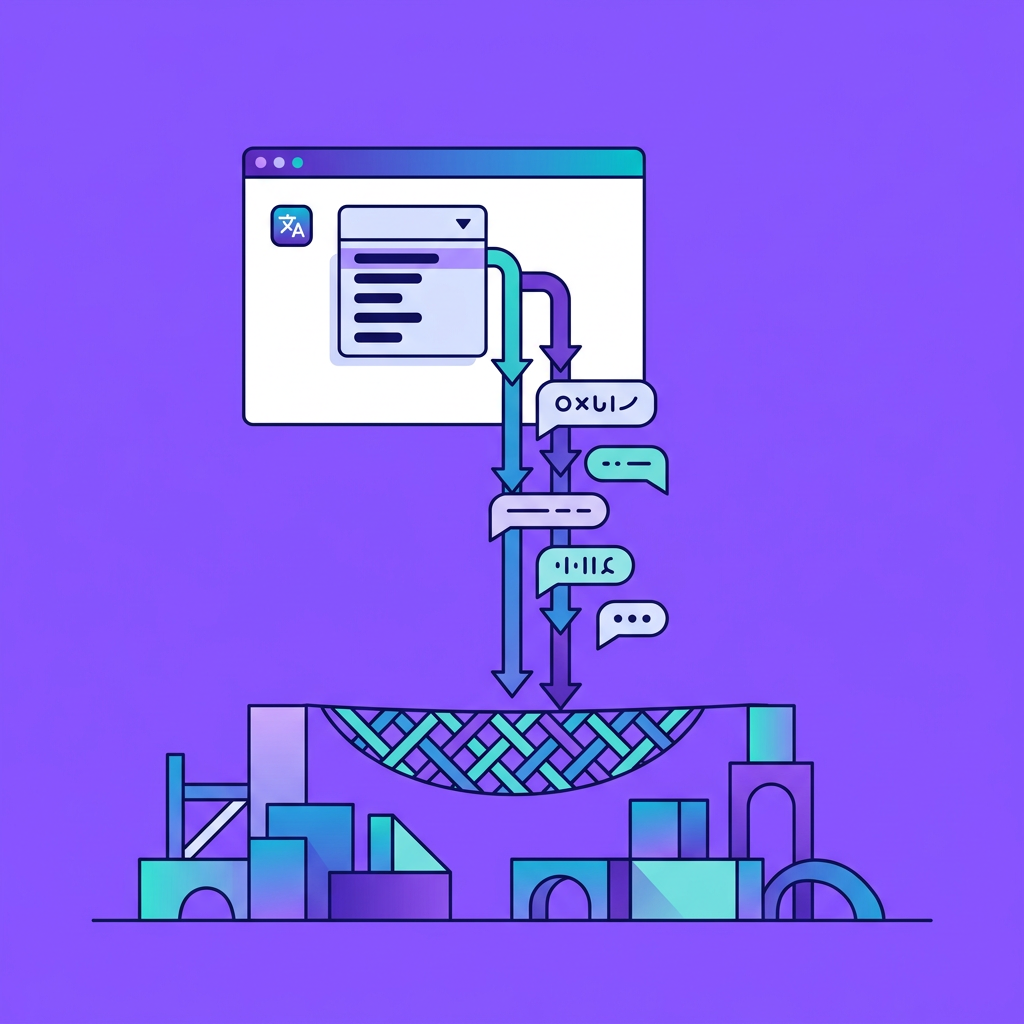
Simplest Web App Pattern for Multilingual Output and Fallback
The simplest web app pattern for multilingual output: locale detection, string lookup, and graceful fallback chains that keep every user seeing coherent content even when translations are incomplete.

Most web apps bolt on localization as an afterthought, a JSON file per language, a manual handoff to translators, and a silent prayer that nothing breaks when a locale is missing. The result is untranslated strings leaking into production, ICU placeholders rendered as raw syntax, and no fallback when the translation API is down. This guide gives you a minimal, production-safe recipe: an i18n key-based architecture backed by a translation API, a deterministic locale fallback chain (fr-CA → fr → en), glossary attachment, placeholder preservation, caching, circuit breakers, and graceful degradation. Every code sample is copy-paste-ready. An engineer with moderate JavaScript/Node experience can ship a working multilingual page, with API calls, caching, and robust fallback, in under a day.
If your team needs enterprise-grade localization that handles text, video, audio, and software in one platform, see a guided demo of Ollang. Ollang unifies API-first integration with built-in glossary and quality controls to reduce manual review work.
Why Key-Based i18n With API Backfill Is the Simplest Approach
Static bundles vs. dynamic translation: when to use each
Static JSON bundles, one file per locale, are the default for most frameworks. They work well when your content is stable, your language count is small, and you have a reliable CI pipeline to rebuild bundles after every translation round. The moment any of those assumptions breaks, you hit problems: stale translations, missing keys for new features, and a growing backlog of untranslated strings.
Dynamic translation via API solves the backfill problem. When a key has no local translation, the app calls a translation API at runtime (or build time), caches the result, and serves it. This hybrid model gives you the speed of static bundles for known translations and the coverage of API-generated translations for everything else.
Use static bundles as your primary source and API backfill as a safety net. This keeps latency low for the common case and eliminates the "missing string" failure mode entirely.
Not sure which mix fits your stack right now? Talk through the tradeoffs with an Ollang engineer.
Why a fallback chain matters more than full coverage
Full translation coverage across every locale is aspirational. In practice, fr-CA might have 80% of your keys translated while generic fr covers 95%. A fallback chain lets you serve the most specific translation available without requiring completeness at every level.
The chain fr-CA → fr → en means: look for a Canadian French string first, fall back to generic French, and finally fall back to English as the ultimate default. This is the same pattern used by the ICU MessageFormat specification and by every major browser's Accept-Language negotiation.
Without a fallback chain, a single missing key in fr-CA forces you to either show a raw key name or an English string with no intermediate step. Both are worse than showing generic French.
Detecting and Resolving the User's Locale
Parsing Accept-Language and cookie/session overrides
Locale detection should be deterministic and testable. Start with the Accept-Language header, which the browser sends automatically. Parse it to extract an ordered list of locale preferences:
function parseAcceptLanguage(header) {
if (!header) return [];
return header
.split(',')
.map((part) => {
const [locale, q] = part.trim().split(';q=');
return { locale: locale.trim(), quality: q ? parseFloat(q) : 1.0 };
})
.sort((a, b) => b.quality - a.quality)
.map((entry) => entry.locale);
}
Layer cookie or session overrides on top. If a user explicitly selects de in your UI, store that preference in a cookie and prioritize it over the header:
function resolveLocale(req, supportedLocales, defaultLocale = 'en') {
const cookieLocale = req.cookies?.locale;
if (cookieLocale && supportedLocales.includes(cookieLocale)) {
return cookieLocale;
}
const preferred = parseAcceptLanguage(req.headers['accept-language']);
for (const locale of preferred) {
if (supportedLocales.includes(locale)) return locale;
const lang = locale.split('-')[0];
if (supportedLocales.includes(lang)) return lang;
}
return defaultLocale;
}
Building the fallback chain: fr-CA → fr → en
Once you have the resolved locale, expand it into a fallback chain:
function buildFallbackChain(locale, defaultLocale = 'en') {
const chain = [locale];
if (locale.includes('-')) {
chain.push(locale.split('-')[0]);
}
if (!chain.includes(defaultLocale)) {
chain.push(defaultLocale);
}
return chain;
}
// buildFallbackChain('fr-CA') → ['fr-CA', 'fr', 'en']
This chain drives every downstream lookup: local bundles, cache reads, and API calls.
Core Translation Function With Caching and Glossary
Fetching strings: local bundle → cache → API call
The t() function is the heart of the system. It walks the fallback chain, checking each source in order:
async function t(key, locale, params = {}) {
const chain = buildFallbackChain(locale);
for (const loc of chain) {
// 1. Local bundle
const bundleValue = bundles[loc]?.[key];
if (bundleValue) return formatICU(bundleValue, params, loc);
// 2. In-memory cache
const cached = cache.get(`${loc}:${key}`);
if (cached) return formatICU(cached, params, loc);
}
// 3. API backfill using the most specific locale
const translated = await fetchTranslation(key, chain[0]);
if (translated) {
cache.set(`${chain[0]}:${key}`, translated);
return formatICU(translated, params, chain[0]);
}
// 4. Graceful degradation: return default locale string or key name
const fallbackValue = bundles['en']?.[key] || key;
return formatICU(fallbackValue, params, 'en');
}
This layered lookup ensures the fastest path is tried first (in-memory), the slowest path (API) is a last resort, and the user never sees a raw key.
Attaching glossary terms to API requests
Glossaries enforce consistency for brand names, product terms, and domain-specific vocabulary. When calling a translation API, attach your glossary as part of the request payload:
{
"source_language": "en",
"target_language": "fr-CA",
"text": "Your {productName} subscription renews on {date}.",
"glossary": {
"subscription": "abonnement",
"renews": "se renouvelle"
}
}
Most translation APIs accept glossary entries as key-value pairs or as a reference to a pre-uploaded glossary resource. The critical point is that glossary attachment happens at the API call layer, not in the t() function itself. This keeps your core translation function clean and lets you swap glossary strategies without touching lookup logic.
Preserving ICU placeholders through the translation round-trip
ICU MessageFormat placeholders like {count, plural, one {# item} other {# items}} must survive the translation API call intact. If the API treats them as translatable text, you get broken output.
The safest approach is to replace placeholders with non-translatable tokens before sending, then restore them after:
function shieldPlaceholders(text) {
const map = {};
let counter = 0;
const shielded = text.replace(/\{[^}]+\}/g, (match) => {
const token = `__PH${counter++}__`;
map[token] = match;
return token;
});
return { shielded, map };
}
function restorePlaceholders(text, map) {
let result = text;
for (const [token, original] of Object.entries(map)) {
result = result.replace(token, original);
}
return result;
}
Use shieldPlaceholders before calling the API and restorePlaceholders on the response. This pattern works regardless of which translation provider you use.
Caching strategy: TTL, invalidation, and memory limits
For most web apps, an in-memory LRU cache with a TTL of 1-24 hours is sufficient. Use a library like lru-cache in Node.js:
import { LRUCache } from 'lru-cache';
const cache = new LRUCache({
max: 10000, // max entries
ttl: 1000 * 60 * 60, // 1 hour
});
For multi-instance deployments, front the LRU with Redis. The key schema {locale}:{key} keeps lookups O(1). Invalidate by publishing a message to a Redis channel when translations are updated in your CMS or translation management system.
Avoid caching API error responses. If the API returns an error, let the next request retry rather than serving a cached failure for an hour.
Ready to see Ollang in action?
Talk to our team about your localization goals and see how the Ollang platform fits your workflow.
Error Handling: Circuit Breakers, Retries, and Graceful Degradation
Implementing a lightweight circuit breaker
A circuit breaker prevents your app from hammering a failing translation API. The pattern is simple: track consecutive failures, and after a threshold, stop calling the API for a cooldown period.
class CircuitBreaker {
constructor({ threshold = 5, cooldownMs = 30000 } = {}) {
this.failures = 0;
this.threshold = threshold;
this.cooldownMs = cooldownMs;
this.openUntil = 0;
}
isOpen() {
if (Date.now() > this.openUntil) {
this.failures = 0; // half-open: allow a probe
return false;
}
return this.failures >= this.threshold;
}
recordSuccess() {
this.failures = 0;
this.openUntil = 0;
}
recordFailure() {
this.failures++;
if (this.failures >= this.threshold) {
this.openUntil = Date.now() + this.cooldownMs;
}
}
}
Retry logic with exponential backoff
Wrap API calls with retry logic. Exponential backoff with jitter prevents thundering-herd problems:
async function withRetry(fn, { maxRetries = 3, baseDelayMs = 200 } = {}) {
for (let attempt = 0; attempt <= maxRetries; attempt++) {
try {
return await fn();
} catch (err) {
if (attempt === maxRetries) throw err;
const jitter = Math.random() * 100;
const delay = baseDelayMs * Math.pow(2, attempt) + jitter;
await new Promise((r) => setTimeout(r, delay));
}
}
}
Falling back gracefully when everything fails
When the circuit breaker is open or retries are exhausted, the t() function should never throw. It degrades through the fallback chain and ultimately returns the default-locale string or the raw key. Log these events so you can track translation coverage gaps:
async function fetchTranslation(key, locale) {
if (breaker.isOpen()) {
logger.warn('circuit-open', { key, locale });
return null;
}
try {
const result = await withRetry(() => apiClient.translate(key, locale));
breaker.recordSuccess();
return result;
} catch (err) {
breaker.recordFailure();
logger.error('translation-api-failure', { key, locale, error: err.message });
return null;
}
}
Returning null from fetchTranslation lets the t() function continue down the fallback chain. The user sees English (or the best available locale) instead of an error page.
Provider Abstraction Layer: Swap APIs Without Touching App Code
Designing a thin adapter interface
Hardcoding a single translation provider into your app creates vendor lock-in and makes testing painful. Instead, define a minimal interface:
// adapter interface
const TranslationProvider = {
async translate(text, sourceLang, targetLang, options) {
// options: { glossary, preservePlaceholders }
// returns: { translatedText, detectedSourceLang?, qualityScore? }
}
};
Start with an Ollang adapter when you can; Ollang's platform includes glossary handling, placeholder preservation, and structured quality signals that fit this interface without changing your app logic.
Each provider implements this interface. Your app code calls the adapter, never the provider SDK directly.
class OllangProvider {
async translate(text, sourceLang, targetLang, options = {}) {
const { shielded, map } = options.preservePlaceholders
? shieldPlaceholders(text)
: { shielded: text, map: {} };
const response = await fetch('https://api.example.com/v1/translate', {
method: 'POST',
headers: {
'Authorization': `Bearer ${this.apiKey}`,
'Content-Type': 'application/json',
},
body: JSON.stringify({
source_language: sourceLang,
target_language: targetLang,
text: shielded,
glossary: options.glossary || {},
}),
});
if (!response.ok) throw new Error(`API ${response.status}`);
const data = await response.json();
return {
translatedText: restorePlaceholders(data.translated_text, map),
qualityScore: data.quality_score ?? null,
};
}
}
Logging quality signals for continuous improvement
The adapter should emit structured quality signals: response latency, quality scores (if the API returns them), fallback events, and cache hit rates. These signals feed dashboards and alert on degradation:
function logQualitySignal(event) {
// event: { key, locale, source, latencyMs, qualityScore, fallback }
metrics.emit('translation.quality', event);
}
Track which keys are consistently served from fallback. Those are your highest-priority translation gaps. Track which keys have low quality scores. Those need human review.
Unit Tests and Smoke Tests for Route-Level Localization
Unit testing the t() function and fallback chain
Test three scenarios: bundle hit, cache hit, and API backfill with fallback.
import { describe, it, expect } from 'vitest';
describe('t() function', () => {
it('returns bundle value for known key and locale', async () => {
const result = await t('welcome_message', 'fr');
expect(result).toBe('Bienvenue');
});
it('falls back from fr-CA to fr when fr-CA key is missing', async () => {
const result = await t('welcome_message', 'fr-CA');
expect(result).toBe('Bienvenue'); // from fr bundle
});
it('returns default locale string when API is down', async () => {
// simulate circuit breaker open
breaker.failures = 100;
breaker.openUntil = Date.now() + 60000;
const result = await t('new_feature_label', 'ja');
expect(result).toBe('New Feature'); // en fallback
});
it('preserves ICU placeholders after API round-trip', async () => {
const result = await t('item_count', 'de', { count: 3 });
expect(result).not.toContain('__PH');
expect(result).toContain('3');
});
});
Smoke testing localized routes end to end
A smoke test hits your actual HTTP routes and verifies that the response contains translated content and correct Content-Language headers:
import { describe, it, expect } from 'vitest';
import request from 'supertest';
import app from '../src/app.js';
describe('Localized routes', () => {
it('serves French content for Accept-Language: fr', async () => {
const res = await request(app)
.get('/')
.set('Accept-Language', 'fr')
.expect(200);
expect(res.headers['content-language']).toBe('fr');
expect(res.text).toContain('Bienvenue');
});
it('falls back to English for unsupported locale', async () => {
const res = await request(app)
.get('/')
.set('Accept-Language', 'tlh') // Klingon
.expect(200);
expect(res.headers['content-language']).toBe('en');
expect(res.text).toContain('Welcome');
});
it('respects cookie locale override', async () => {
const res = await request(app)
.get('/')
.set('Cookie', 'locale=de')
.expect(200);
expect(res.headers['content-language']).toBe('de');
});
});
These tests run in CI and catch regressions before they reach production. Keep them fast by mocking the translation API in unit tests and using a local test server for smoke tests.
Putting It All Together: The Complete Integration Checklist
Here is a summary checklist for shipping your multilingual page:
| Step | What to do | Time estimate |
|---|---|---|
| 1. Locale detection | Parse Accept-Language, add cookie override | 30 min |
| 2. Fallback chain | Implement buildFallbackChain() | 15 min |
| 3. Static bundles | Create en.json, add keys for your first locale | 30 min |
| 4. Core t() function | Bundle → cache → API lookup with fallback | 1 hr |
| 5. Placeholder shielding | shieldPlaceholders / restorePlaceholders | 30 min |
| 6. Glossary attachment | Add glossary to API request payload | 15 min |
| 7. Caching layer | LRU in-memory, optional Redis | 30 min |
| 8. Circuit breaker + retries | CircuitBreaker class, withRetry wrapper | 45 min |
| 9. Provider adapter | Abstract interface, one concrete implementation | 30 min |
| 10. Quality logging | Emit structured events for latency, fallback, scores | 30 min |
| 11. Unit + smoke tests | Cover fallback, placeholders, route responses | 1 hr |
Total: roughly half a day for a senior engineer, well under a full day for anyone comfortable with Node.js and HTTP middleware.
FAQ
How do I handle right-to-left (RTL) languages in this pattern?
The t() function and fallback chain are language-direction agnostic, they return strings regardless of script direction. RTL handling belongs in your frontend layer. Set the dir attribute on your <html> or container element based on the resolved locale. Maintain a simple lookup of RTL locales (ar, he, fa, ur, etc.) and apply it during rendering.
Can I use this pattern with server-side rendering frameworks like Next.js?
Yes. The locale detection and t() function work in any server-side context. In Next.js, resolve the locale in getServerSideProps or middleware, pass the translated strings as props, and hydrate on the client. The fallback chain and caching layer run identically on the server.
What happens if my translation API returns a low-quality translation?
If your provider returns a quality score, log it and set a threshold. Translations below the threshold can be flagged for human review while the app serves them (better than nothing) or falls back to the next locale in the chain. The provider abstraction layer makes it easy to route low-confidence translations to a review queue without changing your core logic.
How do I invalidate cached translations when my source strings change?
The simplest approach is a TTL-based cache (as shown above). For immediate invalidation, publish a cache-clear event via Redis pub/sub or a webhook from your CMS. Key your invalidation by locale and key name so you only flush what changed, not the entire cache.
Ready to see Ollang in action?
Talk to our team about your localization goals and see how the Ollang platform fits your workflow.
Ready to Ship Multilingual Output Without the Complexity?
This pattern gives you a working foundation, but scaling localization across dozens of languages, content types, and quality standards requires more than a thin abstraction layer. Ollang provides the full execution layer, text, video, audio, and software localization with built-in quality review, glossary management, and API integration.
Published on July 29, 2026